
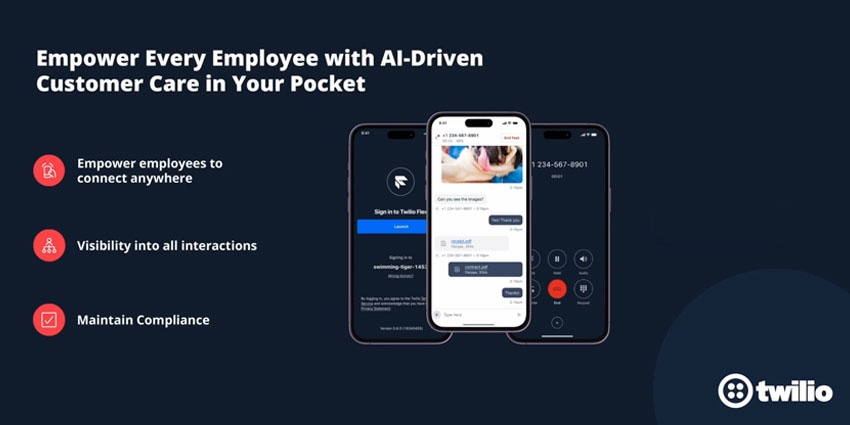
Twilio has announced a mobile app for Flex – its CCaaS platform – as one of several significant announcements within its Q2 2024 release.
The Flex Mobile app is pre-built for iOS and Android, requiring zero developer effort to deploy.
Indeed, users may access all the information and functionality the business has already configured within Twilio Flex.
All they need to do is download Flex Mobile from their app store or Google Play, sign in via the single sign-on, and start engaging in conversations across all digital channels and voice.
Meanwhile, Flex Mobile will work with the same users, phone numbers, routing, queues, and customer data as the desktop version.
Moreover, as Philip Borden, Principal Product Marketing Manager of Twilio Flex, added:
Flex Mobile will also become part of the Flex roadmap. As such, new features available on the Flex product, application, and desktop are now going to be available on tablet and mobile devices.
Now available in a public beta, Flex users can download the app at no additional cost, while additional Flex-only mobile licenses can be purchased at a discounted rate.
That discount underlines Twilio's overarching ambition for Flex Mobile: to leverage the app to extend CCaaS solutions across the enterprise.
Currently, most providers require customers to pay full price for an additional agent seat.
Yet, via the app, Twilio puts more cost-efficient CCaaS in the hands of external subject matter experts (SMEs), from sales and marketing teams to store associates, field services personnel, and beyond.
That not only allows businesses to expand their contact handling strategy beyond the confines of customer service but also empowers other departments with new tech. That could be significant.
Consider an example of a utilities customer who has a plumbing issue. After contacting customer service, they route to an SME in a store 500 miles away.
Using Flex Mobile, that employee could help recommend the best-placed product to fix the installation, complete a purchase, and schedule a pick up at the local store close to the customer’s home address. That’s all through Flex Mobile.
After sharing similar examples in an introductory webinar, Borden stressed:
As a business, you’re able to track every interaction, take every data point from the interactions that are happening, and use this to improve your understanding of the customer over time and how you should interact with them moving forward.
Finally, it's worth noting how the app may empower conventional contact center agents who spend their days tied to their desks.
With the app, they can step away from their desks to grab a cup of coffee or run a quick errand without going offline or putting the customer on hold.
In doing so, the contact center can keep up with modern employee expectations to communicate on any device, wherever they are.
Twilio Launches a Personalized IVR In Private Beta
Alongside Flex Mobile, Twilio released a "Personalized IVR" in a private beta.
The IVR combines static CRM data with real-time behavioral insights to intelligently route contacts and – where possible – deliver individualized self-service interactions.
In delivering self-service, the solution balances both conversational and generative AI "right out-of-the-box" enabling a more dynamic experience.
Sharing more, an enthusiastic Jason Spulak, Senior Product Marketing Manager at Twilio, stated:
Picture being able to deploy a customer-centric, conversational-AI-enabled IVR in hours. That’s the reality the Personalized IVR offers.
Also, when conversations route through to a human agent, the solution provides enterprise connectors to ensure they can access the "latest customer insights." This helps them further personalize and contextualize the experience.
After suggesting that the innovation marks "a significant leap forward to the future of interactions," Spulak summarized: