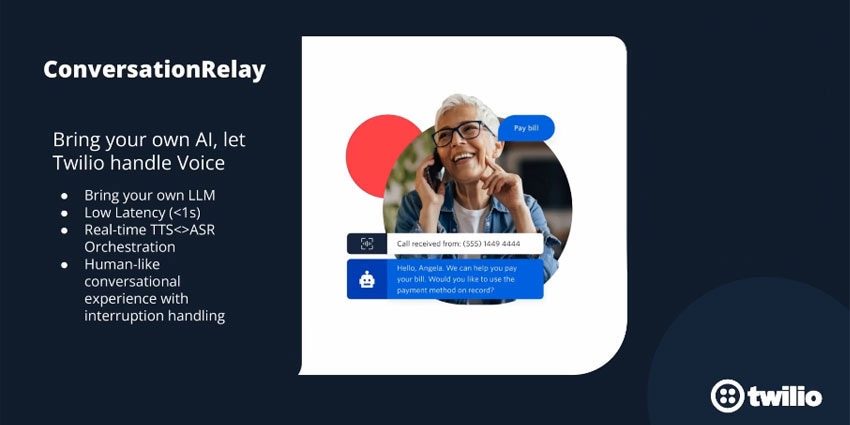
Twilio has unveiled Conversation Relay, a suite that gives developers new tools to create seamless, natural voice interactions.
Sharing the news as part of its Q4 release, Twilio noted how Conversation Relay differentiates with real-time interruption handling. This ensures voice AI interactions stay smooth, frustration-free, and responsive, even when disruptions occur.
Another notable feature is its natural conversational pacing, which ensures voice AI conversations feel human-like, removing awkward pauses and robotic tones.
In a demo led by Jason Spulak, Senior Product Marketing Manager at Twilio, Conversation Relay could also switch language preferences on request.
"Conversation Relay takes the hassle out of building robust voice AI," observed Spulak.
The effortless integration seamlessly connects to your existing AI tech and top-tier speech-to-text and text-to-speech providers like Deepgram, Google, and Amazon.
"We offer flexibility, scalability, reliability, and future-proof voice AI for any use case," he concluded.
One potential use case is for a contact center IVR or intelligent virtual agent.
When enabling these, CX teams may also leverage Twilio Studio. The Studio offers a low-code/no-code app builder with drag-and-drop widgets to build voice, messaging, and comms workflows.
As part of its release, Twilio revamped the offering, so much so that it’s now called "Studio 2.0".
Twilio Studio 2.0: The Next Evolution
Twilio Studio allows businesses to create flows for proactive notifications, IVR trees, customer survey flows, and more.
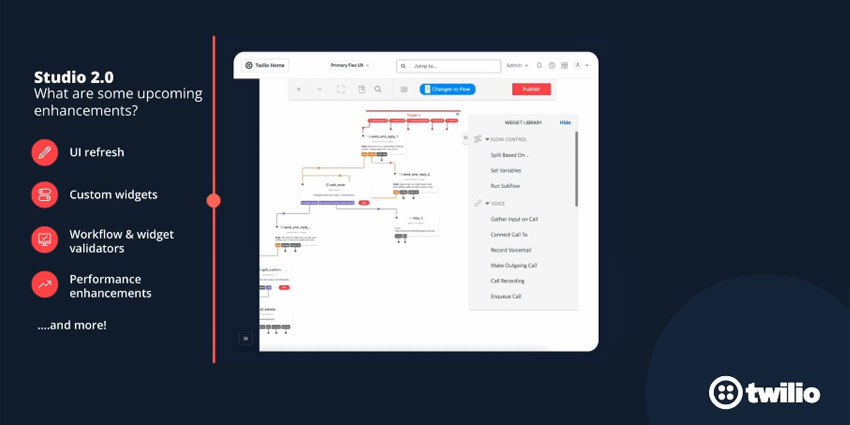
Studio 2.0 introduces a refreshed UI, enabling users to refine their CX workflows with access to custom widgets, Twilio function information, and more.
Yet, most notably, Twilio has enhanced Studio’s orchestration engine so it can build out cradle-to-grave service journeys that incorporate personalization and automation.
As such, Studio 2.0 enables AI-based routing decisions to internal, external, and AI team members. It also accesses CRM data to personalize interactions, automate custom wrap-ups, and more.
However, the use cases for Studio 2.0 go beyond contact center automation. CX teams can leverage it to enable predictive dialing, execute bidirectional marketing campaigns, and create workflows for tasks like digital transfers or post-call AI analysis.
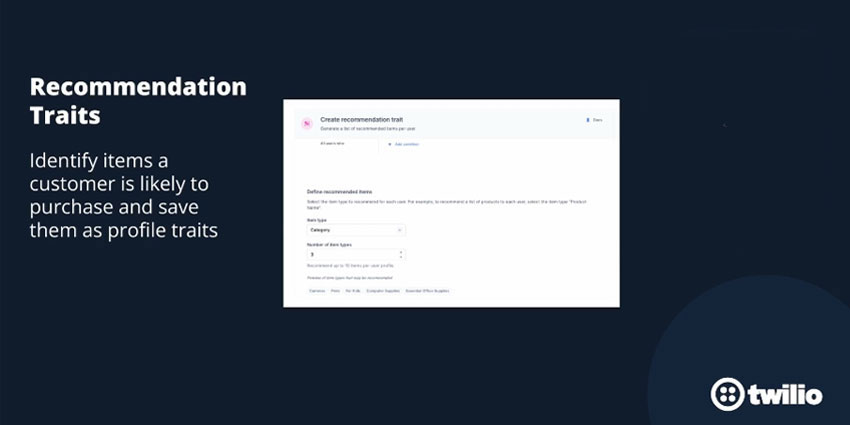
Alongside Studio 2.0 and Conversation Relay, Twilio announced several other feature launches during its Q4 release. These include a Compliance Toolkit, Recommendation Traits tool, and Linked Events for Segment.
Twilio Introduces Compliance Toolkit In a Private Beta
A Compliance Toolkit will soon become available to Twilio Messaging customers. It uses intelligence to manage aspects of local regulatory compliance requirements.
How? By proactively detecting regulatory messaging violations and preventing non-compliant messages from reaching customers. For example:
- It prevents non-essential messages during silent hours (i.e., the middle of the night).
- It ensures messages don’t reach opted-out consumers.
- It confirms that phone numbers are still assigned to the intended recipients.
In doing so, the solution leverages AI to scan opt-out databases, identify local area codes and time zones, and verify phone number ownership through the FCC database.
As such, the Toolkit can help CX teams cope with changing regulations and varying rules for different types of messages. It also helps them interact with customers who move, change phone numbers, or live in different time zones.