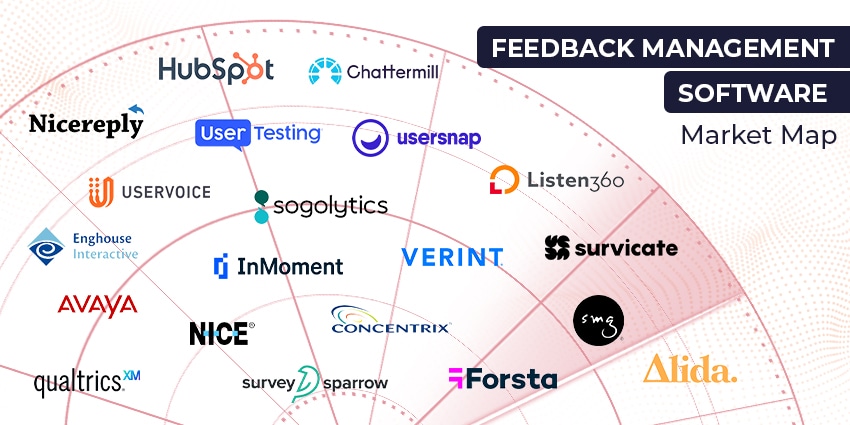
Most companies collect feedback, but few know how to use it effectively. That’s starting to change, with the help of the top feedback management software. More teams are beginning to build feedback into their day-to-day workflows, taking a new approach to decision making.
The right software ensures businesses don’t just collect voice of the customer insights every once in a while, with the occasional survey. These systems pull in signals from different parts of the business, support tickets, call transcripts, reviews, web sessions, and help teams make sense of it all.
As the market for feedback software continues to accelerate, growing at a rate of 11.7% CAGR, it’s time for business leaders to evaluate which vendors can help them better understand their customers. Here are some of the top vendors offering feedback management software in the market today.
The Top Feedback Management Software Vendors
The Top Feedback Management Software Vendors in 2025
There are a lot of platforms in this space. Some are built for enterprise IT teams, others are more hands-on for marketing or CX leads. What they all try to do is solve the same problem: how to take a mess of incoming feedback and turn it into something useful.
The ones listed here stood out for different reasons. Some are stronger on real-time alerts. Some offer deeper integrations. Others are introducing cutting-edge AI. But each one brings something solid to the table, whether the goal is improving retention, closing the loop faster, or just getting clearer visibility into what customers are actually saying.
Medallia
Medallia doesn’t just helps companies build the infrastructure for turning feedback into action, and not just in the call center. Whether it's a shopper tapping “unhappy” on a kiosk, a customer venting on social media, or a hotel guest filling out a mobile survey, Medallia pulls it all together in one place.
The Experience Cloud is at the center of that. It takes structured and unstructured feedback, from web, voice, video, messaging, and more, and gives teams the tools to actually do something with it. Managers get real-time alerts when things go sideways. AI models pick up on emotion, urgency, or recurring issues before they blow up. And case management tools help teams close the loop, quickly.
For big enterprises juggling global teams, Medallia keeps things flexible. It integrates cleanly with CRMs and service platforms, and offers native support for privacy and compliance across markets.
Qualtrics
Qualtrics has become one of the first names that comes up when companies talk about experience data. It’s not just a feedback platform; it’s an entire system for understanding how people feel, why they feel that way, and what to do next.
The platform connects different pieces of data from across the customer journey. It brings together survey responses, support interactions, reviews, even operational data, then layers on natural language processing and predictive analytics to help teams make sense of it.
The full XM solution can introduce insights into employee engagement, customer satisfaction, and brand awareness, combining them into a central view. Qualtrics also puts a lot of focus on making feedback visible to the right people. There are tools to build custom dashboards, set up automated alerts, and even link feedback to frontline KPIs.
InMoment
One of the top feedback management software vendors focusing on the full experience ecosystem, from employee, to customer experience, InMoment offers a powerful platform to business leaders. Named a major player in conversational intelligence and analytics by IDC, InMoment forms part of the Forsta ecosystem.
With the platform, companies can connect feedback from surveys, reviews, digital interactions, and support channels, all in one place. But where InMoment really stands out is in how it handles unstructured data. Its text analytics tools dig into comments, transcripts, and social mentions to pull out the stuff that actually matters, without burying teams in noise.
There’s also a strong focus on actionability. The platform doesn’t just flag issues, it guides users toward what to do about them. That might be a recommendation for a store manager to follow up with a customer, or an alert to the product team about a recurring issue.
Concentrix
Concentrix takes a different angle on feedback. Instead of focusing just on surveys or scores, it’s more interested in how the entire customer journey feels, and where it breaks down. The iX product suite uses artificial intelligence to clarify every element that impacts experience.
Their platform, ConcentrixCX, pulls feedback from all the usual channels, web, email, messaging, in-store. But what stands out is how the data ties into the bigger picture. Companies don’t just see what went wrong. They see when it happened, where in the journey it started, and what team’s responsible for fixing it.
It’s built with operations in mind. There are tools to route issues, track resolutions, and flag repeat complaints early. Teams can zoom in on individual problems or step back and see trends across products, stores, or regions.
NICE
NICE has been around long enough to know where feedback fits in a contact center. It’s not something you look at once a week. It’s something you act on in real time.
Their CXone Feedback platform is built to do exactly that. It pulls in survey responses across channels and connects them to what’s happening inside the operation. That might be call wait times, escalation rates, or agent notes.
Enlighten AI is where it starts to go deeper. It scans responses for urgency, flags issues with high emotional weight, and surfaces patterns before they show up in your metrics. It can even trigger follow-up workflows automatically, so teams aren’t stuck reacting after the fact.
Verint
CX and contact center innovator Verint offers a comprehensive toolkit to businesses in search of feedback management solutions. The platform supports multichannel surveying, to help businesses capture input across a range of platforms. Businesses can develop multi-modal campaigns, and utilize conditional logic to boost the chances of receiving relevant insights.
One feature that stands out is Open Feedback. It gives companies a way to capture unsolicited input, things like chat logs, forum comments, or in-app messages, and blend it with formal surveys. It’s especially useful for teams that want more than NPS trends.
Verint’s tools also align with other components of the Verint toolkit, from the agent copilot system, to the platform for in-depth business analytics, workforce engagement, and knowledge management.
Forsta
Forsta is a software company committed to helping organizations access and leverage the voice of the customer. The digital feedback platform allows brands to use their website and company apps to build real-time views of digital customer journeys.
Forsta’s solutions are now aligned with the tools offered by InMoment, but there are plenty of other features to explore too. Forsta can mix structured and unstructured data into enlightening reports, and visualize patterns across customer journey.
There’s a big emphasis on presentation too. Dashboards, journey maps, and reports can be tailored for different teams, from the C-suite to frontline ops. Forsta also integrates easily with a range of other systems through open APIs and pre-built connectors.
Alida
VOC company Alida specializes in total experience management, giving businesses the tools they need to collect insights from both employees and customers at the same time. The all-in-one toolkit comes with access to survey creation tools, allowing businesses to build branded surveys which focus on collecting data about specific KPIs and CX metrics.
The core of the system is a mix of survey tools, digital intercepts, and always-on feedback channels. But what makes it different is how it connects that feedback to actions. Users can tag ideas, vote on priorities, or track the progress of their suggestions through a branded portal.
Alida offers solid analytics and reporting too. Teams can slice feedback by customer type, location, or product line, and push results into CRM or support tools through native integrations. For product teams, it’s a clean way to spot patterns. For CX leaders, it’s a fast read on what’s improving, and what’s not.
SMG
Experience and feedback management software vendor, SMG gives brands the tools they need to track customer experiences, and map buyer journeys. The platform offers insights into everything from customer sentiment to pain points, ratings, and reviews across a variety of channels.
They system collects data through short, mobile-friendly surveys, usually triggered right after a visit or transaction. The goal is to keep response rates high and get results in quickly. Store managers and frontline teams get daily alerts, so they’re not waiting weeks for head office to flag an issue.
The SMG platform comes with a comprehensive reporting and analytics kit too, marrying CX data with business intelligence, benchmarking, and AI-native text analytics. Companies can utilize role-based reporting tools, sort through data using API-centric open architecture, and even leverage real-time views of metrics with a mobile reporting app.
Avaya
Avaya’s been known for decades as a leading contact center vendor. But in recent years, they’ve put more energy into customer experience, and feedback now plays a bigger part in that.
Their voice-of-the-customer tools are integrated into the broader Avaya ecosystem. That means companies using Avaya for customer service don’t need to bolt on separate survey tools, they can trigger feedback requests automatically based on call outcomes, chatbot conversations, or agent interactions.
The platform supports voice, SMS, and digital surveys, with basic analytics and response tracking. It’s not as advanced as some of the standalone tools, but it’s tightly connected to contact center workflows, and workforce management strategies.
Enghouse Interactive
Enghouse keeps things straightforward. Their survey management tools are designed to plug directly into the contact center, so companies can gather feedback without adding a new system or changing how agents work.
It supports surveys across voice, email, and web, and lets teams build rules around when and how those surveys go out. That might be after a resolved case, a missed SLA, or a completed call. The feedback flows into dashboards where supervisors can review trends and drill into individual interactions. Enghouse plays well with existing systems too.
It integrates with Microsoft Teams and other enterprise tools, making it easier for hybrid and remote teams to stay aligned. Plus, the company also offers a voice of the customer (VoC) tool that aims to take customer listening to the next level.
NiceReply
Leading customer experience and feedback management software vendor NiceReply offers a simple way to collect, manage and understand customer feedback. The company’s platform delivers access to a range of survey templates designed to assist organizations in tracking customer satisfaction scores, NPS, and more.
Business leaders can use NiceReply to send post-resolution, and in-signature email surveys, survey links, and other requests for feedback to clients in various channels.Most teams use it to track things like CSAT or NPS inside their helpdesk. The big draw is how well it fits into tools like Zendesk, Intercom, or Freshdesk.
There are some great reporting tools for teams that want to track trends or filter by agent or team. Leaders can also get alerts when something goes off track, like a drop in satisfaction or a spike in negative comments.
HubSpot
Software as a service company HubSpot produces various flexible solutions for marketing, sales and service teams. As part of the organization’s comprehensive Service Hub, business leaders can access simple customer feedback software.
The solution includes tools for creating customer feedback surveys and sending them to clients across numerous channels, such as web links and email. Teams can send out NPS, CSAT, or CES surveys by email or display them on a website. The setup is quick, and responses go straight into contact records, so reps can see a customer’s history and recent sentiment in one view.
HubSpot’s automation features are excellent too. Companies can trigger surveys after a ticket closes, or start a workflow when someone leaves a low score.
UserTesting
UserTesting gives you something most platforms don’t: context businesses can actually see and hear. Instead of asking customers how they feel, it shows organizations what they do and what’s getting in their way.
Businesses can set up a task, like using a new feature or finding information on a site. Then they pick an audience, and within a few hours, they’ll have screen recordings of real people going through the process, talking out loud as they go.
Teams can learn fast what’s working, what’s confusing, and what’s just broken. It’s especially useful for product and UX teams trying to catch issues early, before they ship. The platform also works for things like onboarding flows, email tests, or internal tools.
UserVoice
UserVoice is built for one specific job: helping product teams understand what customers actually want, and giving them a way to act on it. It's not a generic survey tool. It’s more like a shared suggestion box for growing companies.
Users submit requests, vote on features, and leave comments. Teams can sort through it all, group similar ideas, and track what’s picking up steam. There’s a workflow for tagging requests by customer segment or priority, and a feedback status feature to show which ideas are being reviewed, planned, or already launched.
Companies can even leverage an in-app feedback widget for their existing SaaS solutions. Built-in analytics capabilities make converting raw data into actionable insights easier too.
Chattermill
Chattermill helps companies make sense of unstructured feedback at scale. Instead of looking at one channel at a time, it brings together reviews, survey comments, support tickets, and social posts, then runs them through natural language models to surface themes and patterns.