In 2025, customer expectations aren’t just changing, they’re accelerating. The companies leading the way aren’t just tracking interactions. They’re building intelligent ecosystems where every touchpoint, every decision, and every customer moment is informed by data.
That’s where the top business intelligence companies deliver value. These platforms help teams act, pivot, and personalize at scale. Whether embedded in the contact center, powering marketing attribution, or guiding product strategy, today’s top BI companies are essential to enterprise growth.
But as the market grows, towards a value of $63.17 billion by 2034, choosing the right vendor becomes more complex. This guide, drawing from the vendors featured in the CX Today Business Intelligence marketplace, aims to simplify the enterprise search.
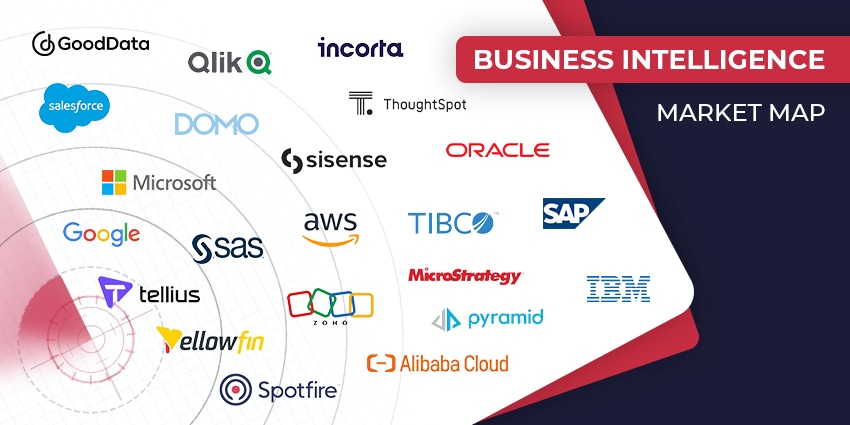
These are the top business intelligence vendors to know in 2025, what they do, how they’re evolving, and why they matter to enterprise CX.
Top Business Intelligence Companies
The Best Business Intelligence Companies for Smart Insights
The top business intelligence companies in 2025 aren’t just offering reporting tools. They’re building integrated platforms that combine artificial intelligence, real-time analytics, and cross-functional collaboration to drive outcomes across the customer journey.
This list spotlights the top BI vendors helping organizations cut through data noise and turn raw metrics into meaningful decisions. Whether you’re scaling a CX operation, automating insights, or rolling out self-service analytics across teams, the vendors below offer platforms that are ready for complex, high-volume enterprise environments.
Salesforce
Salesforce doesn’t lead with “business intelligence” as a headline, but make no mistake, it’s everywhere in the ecosystem. At enterprise scale, it’s often the glue between data, decisions, and delivery. With Salesforce, companies can discover new ways to enhance the sales pipeline, improve customer journeys, and enhance service delivery.
The company’s comprehensive Tableau platform allows organizations to automate discovery and analysis, leveraging AI models to surface deeper insights from huge volumes of data. In 2025, the real shift is Tableau Pulse, a feature that doesn’t just track metrics but flags them when something changes.
It works well with Data Cloud, Salesforce’s unified data engine, which pulls customer data from CRMs, commerce platforms, and service records. That foundation powers things like AI recommendations, Agentforce strategies, customer journey forecasting, and real-time decisioning across sales and support channels.
Microsoft
Power Technology vendor, Microsoft makes drawing insights from business data simple, with the intuitive Power BI platform.
The solution ensures companies can draw valuable information from multiple sources, including Microsoft platforms like Teams. Plus, it works with intelligent automation and workflow building tools, allowing company to automate a range of discovery processes.
For teams already using Excel, Outlook, Teams, or Dynamics 365, Power BI just slides in. No awkward integrations. This year, Microsoft added more AI to the mix. Copilot for Power BI is getting better at writing reports and visuals based on a quick prompt.
There’s more under the hood, too. Governance controls are stronger now. Admins can tag sensitive data, set access levels, and audit who’s pulling what. That’s a plus for teams dealing with compliance-heavy industries like finance, healthcare, or government.
Qlik
Delivering a host of solutions for business analytics and intelligence, Qlik specializes in data integration, data quality, and reporting. The customizable platform offered by the company can integrate with a huge selection of business tools and cloud services.
Qlik tends to land in two types of enterprise environments: those swimming in fragmented data, and those trying to do something useful with it. The platform works well in both. That’s partly why it keeps showing up on lists of the top business intelligence companies.
In 2025, the big push is around Qlik Staige, the company’s AI and ML suite, now baked into its analytics platform. It helps teams automate insights and even nudge actions through real-time alerts.
Qlik Cloud has also matured. It handles hybrid data architectures better now, and supports direct query, in-memory, or both. This matters for large CX teams juggling cloud warehouses, on-prem data lakes, and operational CRMs all at once.
Domo
Cloud software company, Domo, is responsible for a comprehensive range of business intelligence tools, data integration solutions, and AI applications.
In 2025, the platform has doubled down on self-service analytics, prebuilt apps, and embedded workflows, tools that get insights in front of people without hand-holding from IT.
The UI leans simple, which helps. CX teams can track ticket trends, sales velocity, or voice-of-customer sentiment with drag-and-drop tools. Managers can push those dashboards into Slack or email with scheduled updates. Field teams can access KPIs on mobile without waiting for VPN access.
It’s also worth noting Domo’s push into App Studio, which lets companies build custom analytics tools on top of the BI layer. That means everything from contact center scorecards to account health monitors, tuned to specific workflows and roles.
ThoughtSpot
Technology company ThoughtSpot produces business intelligence analytics software, intended to streamline access to useful insights. The AI-powered platform benefits from a convenient search-engine-style interface, ensuring teams can ask questions of their data without complex coding.
The latest version of ThoughtSpot Sage lets users ask things like, “Which customer segments are dropping in satisfaction this month?” and get a chart, explanation, and suggested action, all in one go. It’s meant for business users who need answers quickly, without chasing analysts or building SQL queries.
Underneath, ThoughtSpot connects directly to cloud warehouses like Snowflake, Databricks, or Google BigQuery. That means the data is always live and updates automatically. Plus, the ThoughtSpot team also offers step-by-step guidance and consulting options to beginners, as well as intuitive webinars.
Sisense
Like many leading business intelligence companies, Sisense supports organizations in building AI-driven insights into their existing systems and processes. The company’s platform supports pro-code, low-code, and no-code solutions, to suit a wide range of companies. Plus, Sisense gives organizations a range of ways to make the most of their data.
In 2025, Sisense is leaning harder into its Fusion Embed platform. This lets teams bring analytics straight into web apps, internal tools, or customer-facing portals. If a CX platform wants to show account health scores to agents in real time, Sisense makes that possible, no platform switch required.
Companies can leverage visualization tools to create graphs and charts about important business processes. Plus, there’s an intelligent alerting system, which ensures businesses can automatically monitor essential KPIs and spot changes quickly.
One standout feature this year is Sisense’s Knowledge Graph, which maps relationships across multiple datasets. This helps surface connections that aren’t obvious at first glance.
Oracle
Technology giant, Oracle, produces a huge range of technology solutions for business leaders. The company’s comprehensive portfolio covers everything from customer relationship management, to data storage and discovery.
The current offering, Oracle Analytics Cloud (OAC), isn’t trying to be the most intuitive platform for brand-new users. It’s built for teams who already live in Oracle environments, finance, operations, logistics, or enterprise CX. That tight coupling gives OAC access to a wide range of data: ERP, HCM, marketing automation, and CRM all under the same roof.
Oracle is focusing on augmented analytics in 2025. The platform surfaces predictions, not just trends, using embedded machine learning models. A CX director, for example, can receive alerts when customer sentiment shifts outside the norm, along with projected impacts on churn or upsell.
Oracle also supports natural language querying now, along with visual data storytelling. These tools are helping non-technical teams dig into data faster.
Looker used to be the BI platform for data teams. Now, under Google Cloud, it’s positioned as something bigger: a semantic layer for enterprise-wide intelligence. In practice, that means CX, sales, ops, and marketing teams can all work from the same definitions.
In 2025, the most interesting evolution is how Looker now connects with Gemini. This allows users to ask questions in plain English, “Which regions are behind on NPS this quarter?” and get clean, visual answers pulled straight from live BigQuery tables. There’s less toggling, fewer exports, and more alignment between teams.
Looker also plays well with non-Google tools. It integrates with Tableau, Power BI, and Sheets, meaning it doesn’t force teams to abandon their habits.
Companies can leverage BigQuery for multi-cloud data warehousing, Looker for business intelligence and embedded analytics, and Connected Sheets for comprehensive analysis.
SAP
Software company SAP competes with leading business intelligence companies with the “BusinessObjects” suite. This centralized suite of solutions combines data reporting and visualisation, with report development and sharing. While the BusinessObjects offering is an on-premises BI layer for data analysis, there are cloud solutions available.
In 2025, SAP has also been shifting attention to SAP Analytics Cloud, a more modern, cloud-based solution that brings together planning, business intelligence, and predictive analytics in one interface.
The real value for CX teams lies in connected data models. These allow sales, service, and marketing teams to forecast outcomes based on real-time inputs from other systems. Want to know how support ticket surges impact retention in retail? Or how delivery delays affect NPS in logistics? SAP ties those threads together.
With built-in features like natural language queries, predictive modeling, and integration with SAP HANA, the platform works well for teams who already rely on SAP for core processes.
TIBCO
Focusing on the development of business intelligence solutions for the digital age, TIBCO supports organizations in accessing historical reports, and real-time dashboards.
The TIBCO platform delivers industrial-strength solutions for tracking performance metrics. Plus, companies gain access to a solution that can adapt to suit their need, in the cloud, on-premises, and at the edge.
TIBCO Spotfire, has evolved from classic dashboarding into a full suite for AI-powered analytics, visual exploration, and real-time event monitoring. One feature that’s getting more use? Streaming analytics. TIBCO can process live data from sensors, CRM logs, or digital interactions and trigger alerts or visual updates in seconds.
Spotfire also comes with built-in data wrangling, geo-analytics, and Python/R integration. That makes it a flexible option for teams who want both visual tools and hands-on access to the guts of the data.
SAS
Analytics software and technology vendor SAS ensures companies from all industries can transform raw data into comprehensive business intelligence. The company’s augmented analytics and business intelligence software is an interactive, AI-driven offering which takes advantage of next-level automation, as well as large language models and generative AI.
The core BI platform, SAS Visual Analytics, offers advanced data exploration, automated insights, and rich storytelling features. It’s not aimed at casual dashboard users. It’s designed for teams that want to model complex scenarios, validate assumptions, and build out predictive use cases that stretch beyond basic KPIs.
With the SAS Viya offering, companies can gain real-time insights into crucial metrics and KPIs, and leverage predictive analytics for rapid business decision making. Plus, the company’s offering works seamlessly with a huge variety of cloud solutions, from AWS, Google, and other market leaders. There’s even the option to build reporting tools into existing software systems.