The Arup incident in Hong Kong stuck with a lot of CX leaders. An employee gets pulled into what looks like a normal internal video call. Familiar faces. Familiar voices. Urgent request. Money moves. Around $25 million later, everyone realizes the “leadership team” wasn’t real.
What really hits home here isn’t the “Wow, AI is scary” headline; it’s that businesses are facing a real management problem. Authority plus realism turns common sense into a paper shield.
Contact centers run on that same trust muscle: fast decisions, empathy, the quiet pressure to just fix it. That’s why deepfake voice fraud is so worrying. It’s evidence that trust in voice is collapsing, even as voice remains the most crucial channel for contact center teams.
If you’re running a contact center risk model like it’s 2019, you’re budgeting for yesterday’s weather. It’s time to adapt to the current climate.
Further reading:
- Is Your CX Platform Secure Enough?
- Are Your Customer Conversations Protected?
- How Secure is Your Customer Experience in 2026?
What Is Deepfake Voice Fraud?
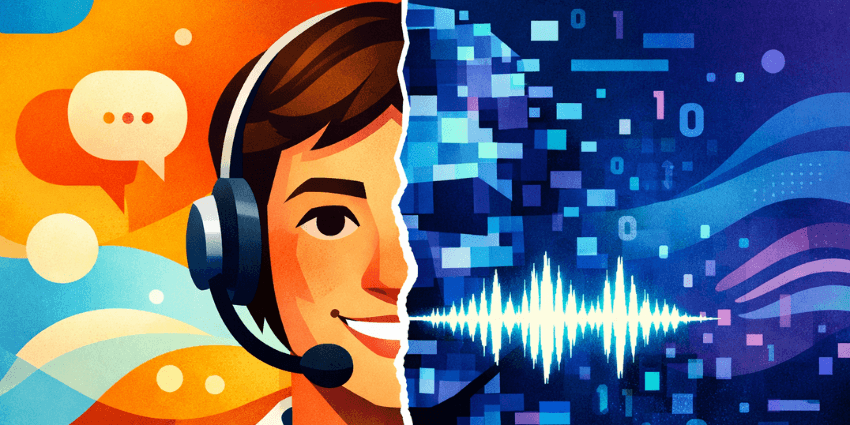
Deepfake voice fraud is the main issue driving the “voice trust collapse” today. It’s a form of cyber attack that uses AI to clone a person’s voice, convincing people that they’re actually speaking to someone they know or trust, like a colleague or family member.
It’s a complicated threat. For decades, voice has quietly functioned as a soft proof of identity. Familiar cadence. The right pauses. Emotional timing that feels human. That instinctive trust has been baked into call flows, agent training, and escalation logic, and now it’s a liability.
Traditional vishing relied on spoofed numbers and shaky stories. Deepfake voice fraud goes further. It targets identity cues themselves, like tone, rhythm, and confidence, short-circuiting human judgment before systems ever get involved. The threat doesn’t defeat controls first. It persuades people.
That’s why the deepfake voice fraud contact center problem cuts so deep. Contact centers aren’t just support desks. They’re identity factories. Password resets. Account recovery. Profile changes. Payment rerouting. High-impact decisions made quickly, under emotional pressure, with success measured in resolution speed.
The attack surface keeps widening. Two-thirds of U.S. adults have sent voice notes, and 41% report using them more frequently, an expanding pool of clean voice data available for misuse. Another widely cited study shows deepfake content growing 245% year over year in 2024, while “detectable” deepfakes in the UK rose 45%, even as reported fraud fluctuated.
Contact center identity verification can’t hinge on “they sounded legitimate” anymore.
How Common Is Deepfake Voice Fraud?
Deepfake voice fraud has already crossed the line from novelty to background noise. In 2025, Pindrop released a report showing deepfake fraud attempts jumped 1,300%+ in 2024, moving from something that showed up once a month to multiple attempts per day. Another Pindrop analysis, based on more than 1.2 billion calls, found deepfake activity up 680% year over year, with roughly 1 in every 127 retail contact center calls flagged as fraudulent.
Business exposure is climbing just as fast. A 2025 update from Experian shows UK organizations reporting AI-driven fraud attempts jumping from 23% in 2024 to 35% in early 2025.
What makes this a leadership issue, not just a security one, is that the response isn’t happening only inside contact centers. It’s happening at the infrastructure level. Reporting from the Financial Times shows telecom-enabled fraud now accounts for 17% of all fraud cases in the UK, but nearly 29% of total financial losses, with fraud overall representing 40%+ of recorded crime. That imbalance explains why networks are finally intervening.
Ofcom has moved to shut down “global titles” leasing, a loophole used to intercept calls and messages, with all existing agreements required to end by 22 April 2026. Meanwhile, Virgin Media O2 has disclosed that it flags around 50 million scam calls every month. Those numbers are evidence that voice trust is being rebuilt from the ground up.
For contact centers, the answer isn’t assuming every caller is malicious, but voice can’t be treated as neutral anymore. Contact center identity verification measures need to adapt to a new baseline where realism is cheap, scale is constant, and trust has to be earned continuously.
Why Are Contact Centers Vulnerable to Voice Deepfakes?
Contact centers sit in a strange position in the modern security landscape. They’re both a customer service channel and a control point for identity. That combination creates some very specific weaknesses when it comes to fraud.
- The phone still unlocks high-value actions. In many organizations, a phone call can still trigger password resets, account recovery, payment destination changes, or new authorized users. Fraudsters know that if they can win the conversation, they can win the outcome.
- Agents are trained to resolve problems, not interrogate callers. Support culture rewards empathy, speed, and de-escalation. Attackers lean into that environment by creating urgency or distress. A convincing voice asking for help can push agents toward resolution before suspicion has time to kick in.
- Voice data is everywhere now. Podcasts, webinars, TikTok videos, voice notes, Zoom calls, and customer service recordings all provide clean training material for cloning models. A CEO who speaks publicly or a customer who leaves voicemail messages is effectively publishing voice samples.
- Fraud blends into normal call traffic. A contact center handling millions of calls a year will naturally see strange conversations. Fraud attempts hide inside that noise, especially when attackers test scripts repeatedly until one works.
- Authority plays differently on the phone. When someone sounds confident and claims to be an executive, a lawyer, or a long-time account holder, the instinct to comply kicks in fast. Deepfake voices amplify that effect by making the authority sound legitimate.
The systems contact centers still use were designed for a world where sounding human meant something. Deepfakes remove that assumption, and once that trust signal disappears, the entire interaction model has to change.
Threat Model Reset: Adapting to Deepfake Voice Fraud
The old fraud playbook treated calls like a two-step dance: verify up front, do the work, investigate later if something seems off. Deepfake voice fraud flips the table. The persuasion is the intrusion. The “authentication moment” isn’t a moment anymore; it’s the whole conversation.
That’s the heart of conversational fraud prevention. It treats risk like a dimmer switch, not a light switch. When the caller’s intent drifts toward high-impact actions: reset credentials, change payout details, take over recovery, controls tighten.
When intent stays low-risk, the experience stays light. That’s the only way to survive the voice trust collapse without turning every customer call into an interrogation.
Identity = Context + Intent + Behavior (Not Voice)
Voice can still be useful. It just can’t carry the burden of proof on its own. Modern contact center identity verification has to combine three things, continuously, as the call unfolds:
- Context: who’s calling, from where, through which channel, and how that compares to history
- Intent: what the caller is actually trying to do right now
- Behavior: how the interaction evolves when the stakes rise
That shift sounds abstract until the numbers force the issue. Research published by Pindrop puts the average deepfake fraud exposure per contact center at roughly $343,000. That’s the cost of running outdated trust models at scale.
Intent-Based Authentication: Tier by Action, Not by Channel
The phrase “frictionless CX” has done real damage here. Friction is only a problem when it’s misapplied. When friction aligns with risk, customers often expect it.
Low-risk intents like status checks, appointment changes, and basic FAQs should stay fast. That’s good CX. Medium-risk intents, like contact detail updates and preference changes, deserve light verification.
High-risk intents like credential resets, account recovery, payout changes, and ownership transfers deserve a deliberate pause. Risk doesn’t spread evenly across the journey. Most losses pile up around a handful of actions with outsized impact. That’s exactly where orchestration earns its keep.
Behavioral Signals: Seeing the Shift Before it’s Too Late
Static checks miss the moment fraud actually happens. Orchestration watches for changes:
- Interaction anomalies: pressure spikes, emotional pivots, inconsistencies
- Journey anomalies: sudden clustering of high-risk requests
- Process anomalies: override patterns, unusual escalation timing
The need for this layer becomes obvious once QA reality sets in. Manual review often covers less than 5% of calls, leaving most near-misses invisible. Without behavioral signals, teams learn only from losses.
The Trust Stack: Rebuilding Voice Trust End to End
Orchestration works best when it’s layered:
- Network trust: Call provenance, spoofing reduction, traceability
- Channel trust: Policies tied to high-risk intents and escalation norms
- Identity trust: Intent-tiering and step-up logic
- Human trust: Agent behaviors that reward pause and escalation
- Governance trust: Monitoring drift, auditing overrides, reviewing near-misses
This layered approach matters because voice trust isn’t being repaired in just one place. It’s being rebuilt everywhere. Regulators and carriers are already reworking the plumbing of telecom itself, pushing for stronger provenance and fewer places for spoofing to hide.
Privacy-Preserving Verification: The Next Unlock
One promising direction is reducing the value of stolen identity data altogether.
Google has demonstrated how Zero Knowledge Proofs can verify attributes (like age or eligibility) without exposing underlying identity. That kind of approach strengthens trust while collecting less data, not more.
It’s not a silver bullet. But it points in the right direction: stronger verification without turning every interaction into surveillance.
Worried about customer privacy? Here's how leading CX teams actually protect customer data.
The CX Dilemma With Deepfake Voice Fraud
The argument usually sounds like this: add more security, and customers will hate it. Slow things down, and CX scores drop. Keep things fast and friendly, and risk creeps in.