The top CRM vendors are reshaping customer service at a bigger scale than ever before. The software is evolving fast. What used to be little more than a database for contacts and deals is now the brain of the entire customer operation.
In 2025, the best CRM software doesn’t just track leads, it fuels sales intelligence, orchestrates cross-channel journeys, and gives teams the visibility and automation they need to scale smarter.
Now a crucial cornerstone of the CX stack for businesses of all sizes (91% of companies with more than 11 employees use CRM software), this tech is crucial to business success.
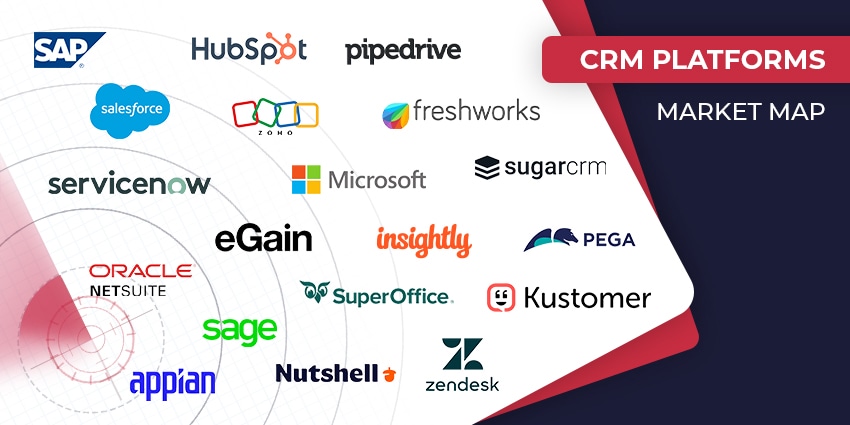
As the market continues to grow, towards a projected value of $262.74 billion by 2032, choosing the right partner can be challenging. This guide introduces a snapshot of some of the top CRM vendors featured in our CRM marketplace, and what they’re really doing for enterprise brands.
The Top CRM Software Vendors in 2025
The Top CRM Software Vendors in 2025
Choosing the right CRM is about more than just “comparing features”. Companies need to consider fit. How well the platform slots into existing systems, supports remote and hybrid teams, and adapts as business needs change.
In 2025, top CRM vendors aren’t just selling contact databases. They’re helping organizations rethink how customer relationships are built, measured, and scaled. The list below highlights some of the best CRM vendors available right now.
Salesforce
With a dominant 21.7 percent share of the market, Salesforce is often the first brand that springs to mind when weighing up the top CRM software vendors.
Its CRM solutions include Service, Sales, Market, and Commerce Cloud, alongside individual platforms for nine specific industries.
Salesforce connects all its CRM apps with Data Cloud, its customer data platform (CDP), unifying data across the customer experience ecosystem. In 2024, it launched Agentforce, allowing customers to implement autonomous AI agents across that ecosystem, turning its data and insight into action.
In doing so, Salesforce led the AI pivot from copilot to autopilot. Salesforce also offers Tablaeu, MuleSoft, and Slack, each bringing unique benefits to its CRM ecosystem.
Yet, despite its broad portfolio, Salesforce maintains the rapid development of its core CRM apps.
For instance, last year, it introduced new product discovery tools, an updated contact center integration program, a personalization decision engine, and so much more.
Meanwhile, the vendor also completed acquisitions of Own Company, PredictSpring, and Tenyx.
HubSpot
HubSpot’s come a long way from its startup roots. The 2025 version of the platform is designed for scale, with new tools built not just for marketers, but for enterprise sales, ops, and CX teams too.
The recent update includes over 100 new features, most notably AI Agents, smarter data hygiene tools, and a complete refresh of Sales Hub with forecasting, scoring, and automation upgrades. There are both free and premium versions of the CRM software available.
Plus, companies get built-in collaboration tools to unify and align CX teams.
More advanced versions of HubSpot’s CRM technology come with various intuitive solutions for ad scheduling, integrated customer communication, lead management, and sales funnel analysis.
HubSpot also gives users access to numerous generative AI tools that assist with the development of creative marketing campaigns and the delivery of rapid self-service.
Like Salesforce, HubSpot has shifted to a multi-CRM strategy to provide that all-encompassing customer experience environment.
Additionally, its Founder, Dharmesh Shah, is developing a network of AI Agents, which – as of January 2025 – already had 250,000 users. Shah hopes that this platform will – in time – become part of HubSpot’s core offering.
Zoho
Zoho is unique in building out its own infrastructure to host its enterprise technologies, including its CRM platform.
Ultimately, this strategy has helped the vendor lower its costs and – as a result – reduce the total cost of ownership (TCO) for its customers. That’s a massive plus.
In terms of its feature set, Zoho CRM enables businesses to deliver omnichannel experiences with embedded tools for segmentation, predictive intelligence, and KPI analysis.
There are AI-powered bots (Zia) to support both agents and customers, as well as rich workflow automation capabilities.
Beyond AI, new features include rollup summaries for quick pipeline metrics, custom scripting for deeper UI control, and expanded Voice‑of‑the‑Customer tracking with review and kiosk integration.
Zoho CRM is also highly customizable, with one-click integrations for leading tools like Shopify, Zoom, and MailChimp. Like some other top CRM software vendors, Zoho also offers specialist solutions for specific business needs, such as a Google Workspace CRM, help desk, and social CRM solution.
Microsoft (Dynamics)
Known for its mammoth stack of enterprise software, Microsoft is a prominent global vendor of customer relationship management platforms, thanks to Dynamics 365.
The solution integrates with other tools in the tech company’s portfolio, such as Microsoft Power BI, Teams, and Outlook. Teams can easily collaborate without shifting across so many apps.
Customers can leverage Dynamics 365 alongside the Power Platform to create comprehensive automated workflows and link distributed technologies throughout their ecosystems.
Plus, Microsoft Dynamics 365 is currently reinventing itself through AI. The 2025 update brings Copilot baked into Sales, Customer Service, and Field Service apps, making CRM feel more like a personal co-worker.
Coupled with a unified Dataverse data model and low-code Power Platform governance, it gives enterprises the foundation to build custom Copilot agents and unified workflows, all under corporate control.
Finally, like Salesforce, Dynamics offers industry-specific CRMs. As more customers request preconfigured automation across common industry workflows, these CRM apps will come into their own.
Oracle NetSuite
Powered by Oracle Cloud Infrastructure (OCI), NetSuite is a comprehensive CRM solution.
Its software toolkit combines collaboration, accounting, ERP, and business management tools into a single environment, along with traditional CRM capabilities.
That single environment gives Oracle many customers access to data from across the enterprise, bolstering their data and AI strategies.
In terms of its individual CRM apps, Netsuite covers sales force automation, marketing automation, customer service management, and partner relationship management.
Oracle also ensures sales, marketing, and service teams can leverage shared dashboards for real-time insights into opportunities and crucial customer pain points.
Meanwhile, its mobile CRM offering is strong, making Oracle a firm favorite among top CRM software vendors in sectors like healthcare, real estate, delivery services, etc.
SAP
SAP’s CRM platform is now deeply woven into its broader Business AI and data strategy, making it one of the top CRM software vendors to watch in 2025. Like Oracle, Microsoft, and Zoho, SAP benefits from its broad ecosystem, which includes its widely-utilized ERP solution.
SAP has put significant time into solidifying the connection between its CRM and ERP solutions to drag more data into the customer experience ecosystem.
Now, with Joule, SAP is reaping the rewards, as its AI agents can leverage that data to better inform sales proposals, personalize marketing campaigns, and automate customer communications.
SAP is also a vendor highly regarded for building CRM solutions with a modular architecture that allows for high customization and extensibility.
Altogether, SAP offers CRM solutions for eCommerce, marketing, customer service, and sales teams, all featuring end-to-end automation capabilities and robust reporting capabilities.
Pegasystems
Pegasystems isn’t only a well-known CRM provider. It’s also a highly regarded enterprise workflow automation and low-code applications provider.
In early 2025, Pega was named a Leader in The Forrester Wave for CRM, with analysts highlighting its “AI for summarization, insights, knowledge, coaching, and agentic workflows” as standout strengths.
In combining these strengths, Pegasystems considers all the processes within customer experience alongside those that extend into the broader enterprise environment.
From there, the vendor aims to help organizations mine, optimize, and automate those processes.
Now, with the rise of agentic AI, Pega has proven ahead of the game, as this work will help its customers put AI to work faster.
The PegaWorld announcement of Agentic Process Fabric means customers can now connect intelligent agents across systems, pulling insights from legacy apps, documents, video, and wrap governance around every action
Alongside the vision, Pega also offers impressive functionality, as evident in its CRM’s “Customer Decision Hub”. Here, customers can analyze live conversations and journeys to predict customer needs. Pega’s unified platform also uses APIs and integrations to bridge the gap between multiple resources in the CX technology stack, without compromising on security.
ServiceNow
ServiceNow only recently entered the CRM market, but its quickly gaining attention as one of the top CRM software vendors. The ServiceNow CRM, introduced in May 2025, provides companies with a “system of action” for sales, fulfillment, and service.
At Knowledge 2025, its new AI‑powered CRM became its fastest-growing workflow business (over $1.4 B ACV, +30% YoY). The new AI Control Tower gives enterprises a governance dashboard to track agent performance and compliance.
ServiceNow also launched AI Agent Fabric, which stitches third-party and internal agents together, making workflows smarter and more fluid.
That lets CRM act less like a silo and more like a single solution, connecting sales, order management, customer service, and field operations.
ServiceNow also connects CRM solutions with its broader stack, which includes enterprise-grade workflow automation, inventory, and order management systems.
Plus, ServiceNow is a firm favorite of IT teams, thanks to its ITSM software. Now that generative and agentic AI is coming to the fore, IT is increasingly being pulled into the CX software-buying conversations. That will benefit ServiceNow’s play in the CRM space to no end.
Zendesk
While it has a sales CRM solution, Zendesk focuses primarily on the customer service space.
There it differentiates by offering differentiative functionality, like the workforce engagement management (WEM) suite it released in early 2024.
Zendesk’s technology overlaps with many traditional contact center providers, helping businesses to converge their customer service stacks.
Elsewhere, Zendesk hit the headlines in 2024 for its innovative pricing approach, mixing outcome-, usage-, and seat-based models. This makes the company one of the top CRM software vendors for those in search of budget-friendly models.
As companies eventually lower their seat counts, thanks to the influence of AI, such moves are critical for the future of the CRM industry.
Speaking of AI, at Relate 2025, Zendesk unveiled its Resolution Platform, a suite of AI agents built to reason, learn, and adapt across email, chat, and service interactions.
Recent updates also include Action Builder, a no-code orchestration tool that pulls workflows together across CRM, WFM, and third-party tools.
Finally, on that sales CRM, Zendesk supports sales teams with various pipeline management, lead qualification and tracking capabilities.