
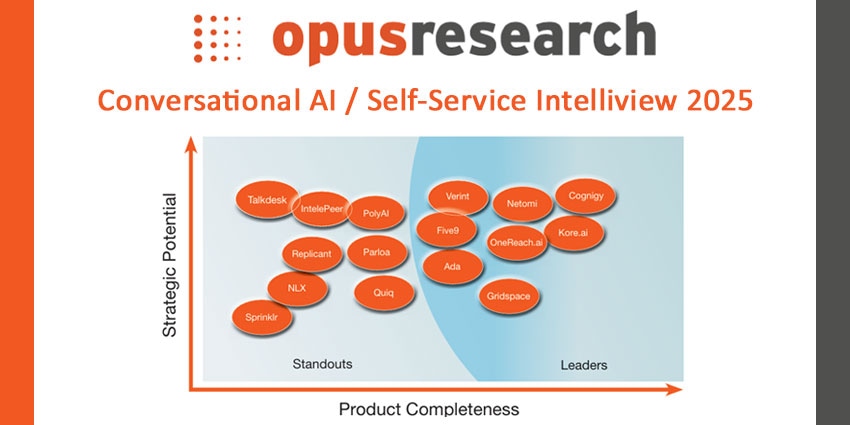
The Opus Research Intelliview is a coveted market report that informs enterprise conversational AI / self-service buying decisions.
Like similar market studies, it features a vendor evaluation, taking 16 prominent conversational AI providers and dissecting their solutions, strategy, and services.
Ultimately, that informs the title graphic, which typically attracts most attention.
Yet, the evaluation is just one part of what’s included. The report also unpacks key market trends and considerations for selecting the best-placed vendor.
Ultimately, that sets the stage for the top takeaways below. Yet, let’s first reflect on the evaluation and how Opus placed the vendors on the matrix as it did.
The Opus Research Intelliview Methodology
The Opus Research Intelliview includes 16 global conversational AI players. Each had the opportunity to share details on their products and strategies. From there, the analysts conducted research and observed demos.
As they did so, the analysts focused on each vendor’s product offering, integrations & analytics, safety & trust posture, deployment & maintenance options, and strategy & execution.
That helped Opus formulate scores, while it gave extra credit for unique capabilities and vision.
From there, it placed providers on the following matrix, considering two fundamental questions: How complete is the product? And how strong is the strategy?
However, the research firm stressed that this captures only a snapshot in time. Ultimately, the Intelliview underscores which vendors are doing interesting, differentiated work, without pretending there’s a single “right” way to win in this fast-moving space.
Given that background, here’s how each vendor performed.

Top Takeaways from the Opus Research Intelliview 2025
As noted above, the Opus Research Intelliview not only interrogates prominent conversational AI vendors on their self-service solutions but also offers market commentary and unpacks trends.
The six top takeaways below offer an overview of the study’s major talking points, including extra insight from one of its authors, Ian Jacobs, VP and Lead Analyst at Opus Research.
1. Conversational AI Vendors Are Building Solutions for Two Distinct Buyer Groups
Consider the current customer service landscape. On one end of the spectrum, there is human support, which is relatively high cost but can handle nuance, emotion, empathy, and complexity. On the other, there are entirely scripted, inexpensive chatbots that can’t manage nuance or complexity.
Large language models (LLMs) and generative AI are emerging as the bridge between those extremes, and all three models are still present in the market.
In that dynamic, Jacobs suggests that conversational AI vendors face one massive strategy question:
Should they cater to those ready to go all-in with LLMs and agentic AI, or to those who need incremental steps toward that future?
That divide between all-in and incremental adoption is perhaps the biggest split in the vendor landscape today.
Both approaches are valid, targeting different audiences. Yet, those taking the slower route are often depicted as behind in technology, when that’s not necessarily the case. They simply focus on helping customers start small.
For instance, they might take a five-year-old scripted chatbot and add generative capabilities to the interaction layer, while keeping back-end processes locked down. That’s not massively transformative, but it can deliver significant efficiency gains and build confidence in the tech.
2. Tech Leaders Are Accelerating the Transformation of No-Code Builders
Traditionally, conversational AI vendors emphasized “no-code” flow builders, where businesses plot a step-by-step process for the virtual agent to follow.
These builders were predictable but inflexible, and often time-consuming to master.