
Recent research from Citizens Advice reveals that customer satisfaction in the energy sector has reached its lowest level since its records began.
Yet, the problem extends far beyond the energy sector. A 2022 study – "Voice of the Contact Centre Consumer 2022" – highlights how service standards have flatlined since 2021, despite many operations at the time being deeply entrenched in pandemic-induced uncertainty.
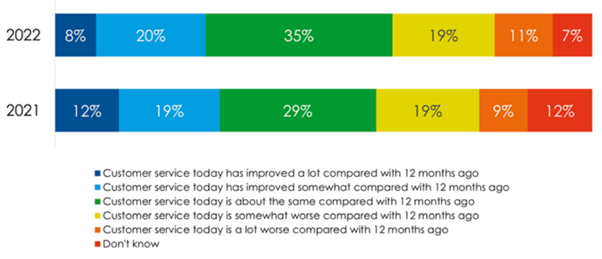
Indeed, the following graphic shows that only 28 percent of contact centre leaders believe that the service they offer has improved since 2021. Alternatively, 30 percent state that it is worse.
Of course, with service teams settling into new hybrid environments, contact centre systems evolving, and self-service coming to the fore, it is easy to assume customer support would advance.
However, the same problems – such as long wait times, limited contact centre knowledge, and minimal agent coaching - continue to rear their ugly heads.
Why is this happening? Many point the finger at ill-conceived digital transformation programmes.
Is Digital Service Not Delivering?
Recent studies suggest that many initiatives to improve digital service experiences are not having the desired impact in increasing customer satisfaction and lowering contact centre strain.
Excellent examples of this phenomenon include:
- Proactive Outreach Woes - Gartner research highlights that two-thirds of customers have contacted customer service after receiving proactive notifications from a brand, primarily as they caused confusion.
- Underwhelming Contact Automation - Conversational AI has reduced call volumes by as little as two percent, according to a recent example shared by CX analyst Andrew Moorhouse.
- Poor Call Deflection Strategies - As a Forbes article suggests: “When your digital customer support focuses on deflection, everyone loses.”
Yet, perhaps the most staggering statistic into the plight of digital service comes from the CCMA study, which uncovers a drop in self-service satisfaction across numerous contact reasons.
Take customer complaints as an example. Just 28 percent of customers are now willing to self-serve them, compared to 34 percent just 12 months ago.
As referenced within the report, Anita Renyard, Senior Manager at TSB, believes that this concerning trend may indicate declining levels of customer trust. She states:
Some of the self-serve solutions that were offered during the pandemic weren’t great and sometimes you feel like ‘no, I want to almost see the whites of the eyes of the people and get a commitment.
Of course, the temptation to automate service more and more is often overwhelming. Yet, Renyard reminds us of the significance of striking the ideal balance of human and automated assistance. Get it wrong, and familiar service issues will arise.
Not only will these take the wind from the service team’s sails, but customers will grow increasingly angry, taking it out on the unfortunate agents.
What do Customer Service Leaders Think?
Of course, half-baked digital transformation initiatives are not the only potential cause of customer service woes. Recruitment struggles, knowledge sharing failures, and budget limitations are additional obstacles that many contact centres must still overcome.
However, perhaps this is still only scratching the surface. Digging deeper, the CCMA report notes the thoughts of several customer service leaders.
For example, Andy Davies, Head of Service and Delivery at Virgin Wines, believes that many brands have been slow to pivot from the pandemic and adjust to the new status quo. He says:
Customers across retail can become frustrated when they still hear providers say ‘we’ve got a COVID problem, and we’ve got a staff problem.’ Also, some customers are going through financial difficulties which could only contribute to their frustration.
Indeed, these tricky times may increase the strain on service teams, forcing them to engage in more emotionally challenging calls that take their toll on agents and increase handling times.