Customer service, sales, and marketing teams are catching on: they're part of a bigger front office.
As they begin to collaborate, they’re recognizing overlap in their toolkits.
Indeed, while traditional service, sales, and marketing tech suites may have different core strengths, they are converging at the center.
ISG has grasped this trend and believes a new market is forming at that center: the customer experience management (CXM) market.
How Does ISG Define Customer Experience Management?
Across contact center, sales, and marketing toolkits, ISG spotted five areas of functional overlap.
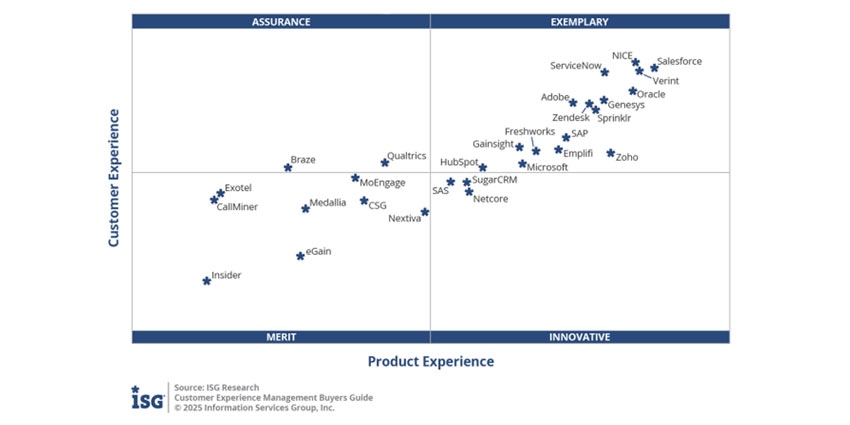
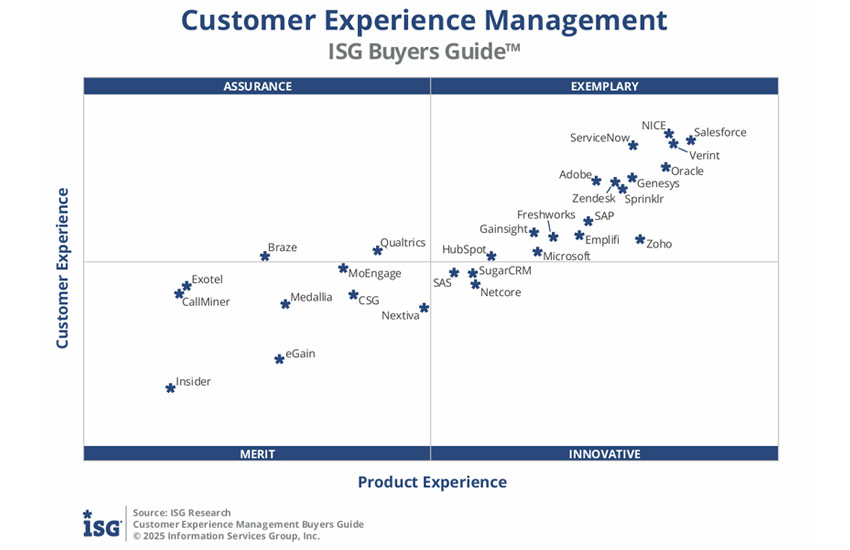
The tech providers that perform best across these areas, as denoted by their place in the Buyer’s Guide quadrant, appear well-positioned for the age of customer experience technology convergence.
1. Interaction Handling
Think channels, routing, screen sharing… any feature facilitating conversations between employees and company reps.
2. Resource Management
Resource management includes scheduling and supporting people. Yet, equally critically, it’s about managing knowledge, data, and digital content.
3. Process Orchestration and Automation
AI and machine learning have gravitated in this direction, automating various workflows, including those that spread information from one team to another.
4. Insights and Analytics
There's significant overlap here as teams transition from function-specific KPIs to enterprise-wide analytics focused on revenue growth, loyalty, and other desired results.
5. Customer Journey Management
At first, journey management solutions focused on the contact center experience. However, their use is expanding to offer a more holistic view of the customer experience.
ISG’s Inclusion Criteria and Methodology
 ISG only included tech providers that sell products and provide support in at least two continents. They must also have 25+ customers and at least $50 million in annual or projected revenue.
While ISG factored out "interaction handling", as it has a separate piece of research coming soon, it stipulated that participating providers must have capabilities in at least three of the four other areas highlighted above.
The research firm then evaluated those capabilities using the ISG Value Index, scoring vendors across seven categories. The first five relate to “product”:
- Usability
- Manageability
- Reliability
- Capability
- Adaptability
Meanwhile, the final two categories relate to “customer experience”:
- Total Cost of Ownership (TCO) / Return on Investment (ROI)
- Validation of the Vendor
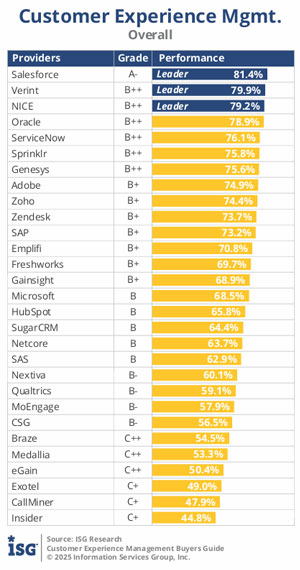
During its evaluation, ISG scored 29 vendors and placed them on the following matrix to highlight how well each performed. The table on the right offers another view of these rankings.
Top Takeaways from the ISG Buyers Guide 2025
The ISG Customer Experience Management Advanced Buyers Guide dissects each vendor’s performance. However, it also spotlights key industry trends, shares advice for selecting the best-placed provider, and offers more market commentary.
The seven top takeaways below touch on all this and include additional insight from the study’s author, Keith Dawson, Director of Research for Customer Experience at ISG.
1. CX Teams Need to Think Further Beyond Their Functional Domain
"What I would encourage readers to take away from this report and similar ones is the urgency of thinking beyond their own functional domain," said Dawson.
Look left and right at what’s happening in other parts of the customer journey or lifecycle. Try to understand how other departments’ actions impact you and vice versa. Look for ways to smooth the bumps between silos. Increasingly, that’s both possible and necessary.
As function leaders do so, they’ll naturally consider adjacent technologies and tools. That expands the vendor set beyond the traditional comfort zone for many people. Yet, it provides an exciting opportunity for co-innovation that considers the customer journey’s full scope.
Contact center leaders should be particularly watchful of this trend. After all, they have long operated in isolation as part of a purpose-built domain that does its job well, but doesn’t always get the enterprise-wide attention it merits. As such, these leaders aren’t always fluent in enterprise language. Expect that to soon change.
2. Contact Center Providers Are Struggling to Connect with CIOs
As noted, contact centers still often operate in isolation. Part of this is because they deal with voice, phone numbers, and other tricky components that CIOs just don't want to get bogged down in.
Sure, they excel in interaction handling and measuring those interactions. Yet, as Dawson noted: “Contact centers haven’t fully convinced other parts of the enterprise that their solutions are a suitable foundation for broader enterprise CX.
Enterprise CX is about thinking through the outcomes you want and then executing the steps to achieve them. There’s a tension: contact centers are reactive by nature, while the rest of the enterprise needs to be proactive.
Dawson emphasized that this tension isn't the contact centers' or their vendors' fault. Contact centers were designed for high-volume, repetitive, cost-effective interactions and do that well. Now, they're being asked to shift their role.
3. AI Needs to Deliver Beyond Beginner Contact Center Use Cases
AI has helped pull many contact centers out of their siloes, as business leaders have encouraged the implementation of various AI technologies: transcription, summarization, quality management, agent assist, and guidance.