
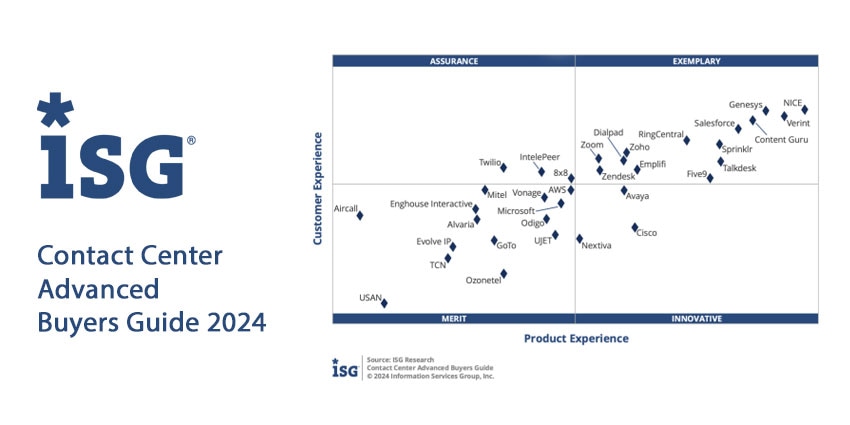
The Contact Center Advanced Buyers Guide 2024 from ISG Research evaluates the product and customer experiences provided by 34 tech vendors.
That’s a huge number of providers, reflecting two critical contact center trends.
First is the explosion of deployment options. Indeed, contact center provisioning was historically straightforward: a brand purchased on-premise equipment from a limited set of vendors.
However, now buyers can consider premise-based, cloud-based, or hybrid options. That has brought new entrants into the market while legacy vendors adapted.
The second significant trend is the diminished role of the Automatic Call Distributor (ACD).
After all, businesses can now provision a contact center starting from various points in the tech stack, whether that’s a CRM, a helpdesk system, a digital routing platform, or even unconventional tools like marketing technology (MarTech).
Hyperscalers like Amazon, Microsoft, and Zoom also play a role with their quasi-CPaaS platforms.
As such, contact center buyers have numerous options when considering a contact center partner. The ISG Buyers Guide recognizes this, putting forward an extensive evaluation.
ISG’s Contact Center Buyers Guides
ISG presents two Buyers Guides for the contact center space, a "basic" and "advanced" edition.
The basic edition reflects the traditional provisioning model where an ACD system remains the core, catering to the mid-to-lower end of the market where lightweight solutions dominate. These vendors typically focus on fundamental capabilities and straightforward implementations.
Then, there’s the advanced edition, which fixates on those helping to redefine the provisioning model by bringing systems to market without an ACD.
As such, it considers how brands can leverage CRM systems - like Salesforce, Zendesk, or Zoho – or case management systems – such as ServiceNow – to act as the operational hub. These solutions integrate routing engines from partners like Amazon Connect or Twilio.
In doing so, ISG brings in vendors traditionally outside the contact center space, enabling a focus on enterprise customer experience (CX) rather than just handling interactions.
ISG’s Inclusion Criteria and Methodology
 ISG only analyzed contact center vendors that have operations in more than one country, over 50 customers, and have launched a major release over the past 18 months.
The analyst also noted that participating providers must have a "good" financial and ethical standing – alongside at least $25MN in projected annual revenues.
In addition to all the core functionality, from multichannel routing to agent scheduling and forecasting solutions, ISG evaluated the following "advanced" aspects of the platforms:
- AI in quality measurement and self-service
- Native and integrated data management systems, like CDPs
- Knowledge management
- Advanced interaction analytics
- Customer feedback solutions
- Workflow automation
These capabilities helped inform ISG’s Value Index, alongside a questionnaire sent to each participating vendor.
That questionnaire includes seven categories. The first five considered "product experience":
- Usability
- Manageability
- Reliability
- Capability
- Adaptability
The final two categories considered "customer experience":
- Total Cost of Ownership (TCO) / Return on Investment (ROI)
- Validation of the Vendor
Finally, ISG gathers product verification via documentation and – where possible – demos.
In doing so, ISG ranked each vendor on its core contact center offering, scoring the 34 participants and spotlighting insights into their suites.
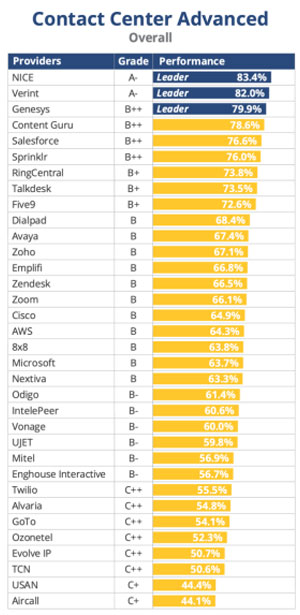
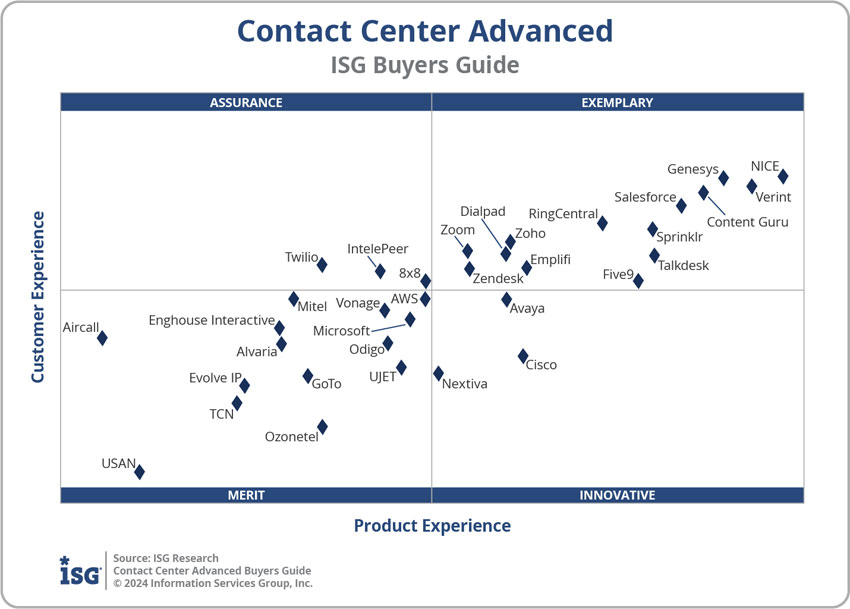
The matrix below showcases how each performed, while ISG also breaks down its rankings in the table to the right.
The Top 10 Takeaways from the Advanced Buyers Guide 2024
The ISG Contact Center Advanced Buyers Guide 2024 offers more than a vendor analysis. It also puts forward a process for selecting the best-placed provider, market commentary, and projections.
Below are ten top takeaways, alongside additional insight from report author Keith Dawson, Director of Research for Customer Experience at ISG.
1. CCaaS Is an "Increasingly Problematic" Term
Initially used to describe cloud-based contact centers, "CCaaS" is now a term that’s becoming "increasingly problematic" and outdated, according to Dawson.
"It excludes on-premise and hybrid models and fails to capture the expanded role of non-traditional vendors," he told CX Today.
Contact center buyers today prioritize orchestration and data usage over traditional routing.
Indeed, modern contact centers integrate customer data into marketing, sales, and commerce, focusing increasingly on proactive CX strategies.
"Communication infrastructure, such as routing calls or chats, has become a commodity," continued Dawson. "The real differentiators lie in areas like data management, enterprise integrations, and workflow automation."
As such, the analyst concludes that vendors investing heavily in these areas are helping to drive innovation while those focusing solely on routing are falling behind.
2. Competitive Pressure Has Driven Significant AI Progress
Unsurprisingly, the report underscores the rapid advancement in AI applications.
Initially, vendors focused on building a platform approach to AI rather than honing in on specific use cases. As such, it took time to define relevant outcomes, ROIs, and realistic expectations.
However, as Dawson suggests: "Competitive pressure accelerates progress.
When one vendor introduces a new AI capability, others quickly catch up.
Yet, that doesn’t mean all AI is equal. Indeed, the model orchestration, engineering, and data management strategies behind AI use cases help providers differentiate.
Take data management. Contact center vendors employ different strategies to manage their customers' data and power AI.
Some are taking a more data-centric approach, focusing on solidifying knowledge management back-ends, which are crucial for ensuring reliable outputs from GenAI-based solutions.
Meanwhile, others are working on creating controlled, contained data hubs, like customer data platforms (CDPs), to train their models effectively.
Yet, those leading the Buyers Guide are tackling multiple fronts simultaneously because that's what the market now demands, as per Dawson.
3. AI Is Bringing IT Teams Into the Buying Conversation in a Much Bigger Way
The study highlights how the industry-wide significance of AI is shifting buying decisions back toward the IT team.
Such involvement from IT changes how organizations approach RFPs, governance, and the integration of contact center tools with broader CX applications. It’s become a more complex conversation, according to Dawson.
"I suspect traditional CCaaS vendors will face challenges in having these deeper, enterprise-wide conversations during purchasing periods compared to vendors with broader capabilities or legacy foundations," he noted.
For example, if an IT team aligns with ServiceNow, they'll likely prioritize integrating contact center tools with that ecosystem rather than the other way around.
"That said, there’s still a lot of outdated thinking in the market—what I’d call a "2005 mindset"—when it comes to provisioning and operating contact centers," concluded Dawson. "This mindset clashes with the flexibility needed to address modern requirements."
4. The Contact Center Functionality Gap Closes
ISG underscores how the functionality gap between top and middle-tier vendors is narrowing.