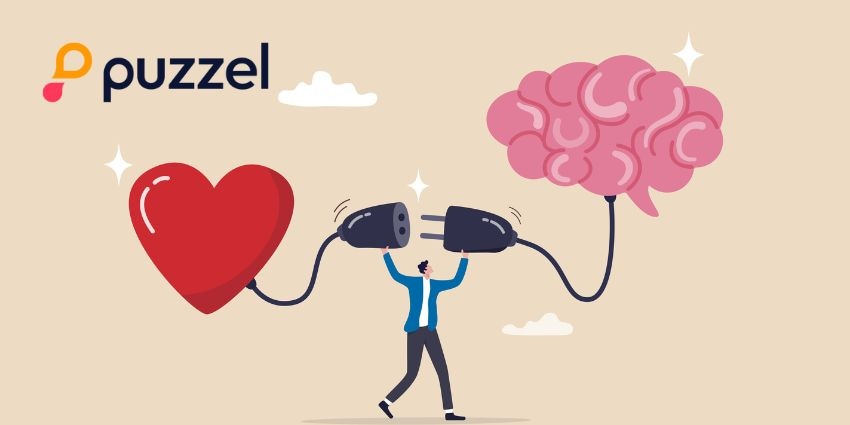
In customer experience, efficiency and empathy have often been treated as opposing forces.
Like Harry Potter and Voldemort, Superman and Lex Luthor, and Kendrick Lamar and Drake – it can often feel like the two cannot coexist.
The drive for faster resolutions, lower handling times, and cost efficiency has historically pulled in one direction, while the desire to provide genuine, human-centered service tugs in another.
However, as AI continues to mature, a growing number of CX leaders are re-evaluating that divide.
“When the AI boom kicked off, it was reasonable to assume you could only have one and not both,” said Will Penn, Senior Sales Engineer at Puzzel.
“You say things like ‘chatbot’, and people picture a big metal robot: heartless, delivering your customer service.
"But that’s a false choice. Efficiency and empathy can be complementary, but only when the right parts of the journey are automated, and the right moments are reserved for the human part of the experience."
It’s a sentiment backed by fresh data.
In Puzzel’s recent survey of 1,500 CX leaders, 43 percent said a hybrid model – blending AI efficiency with human empathy – represents the future of the contact center.
That finding reflects a wider trend across the industry: companies are beginning to automate more strategically, not more blindly.
The False Dichotomy: Efficiency vs Empathy
The assumption that faster means colder, or that human warmth comes at the cost of productivity, stems from the way many organizations still measure success.
Traditional QA metrics such as average handling time (AHT) and first-contact resolution (FCR) – while invaluable for assessing service efficiency – can sometimes overlook the emotional context of a customer interaction.
Penn argues that these metrics should be complemented with new forms of insight that capture empathy and emotional connection.
“When we lead with empathy, we see agents who connect with customers on a personal level and address their needs in ways AI just can’t do on its own,” he said.
“If you combine that with metrics that reward empathy, not just handling time, you start creating an environment where agents can truly do their best work.”
While finding metrics that can measure empathy may sound like a tall task, advances in speech and text analytics are making it a reality.
Organizations are now able to analyze 100% of customer interactions. The insights they extract – such as intent, sentiment, and emotional peaks – reveal not just what customers are asking, but how they’re feeling.
This shift from anecdotal QA sampling to comprehensive emotional insight is quietly redefining the concept of efficiency.
From Automation to Orchestration
The next evolution of CX isn’t about replacing people with bots; it’s about orchestrating them together.
Penn argues that “automation should take care of the routine, repeatable, boring tasks, so that the human agent can focus on the listening, problem-solving, and empathy.”
That principle applies differently across sectors. In insurance, for instance, bots might accelerate claims intake while ensuring complex or sensitive cases are escalated to humans.