

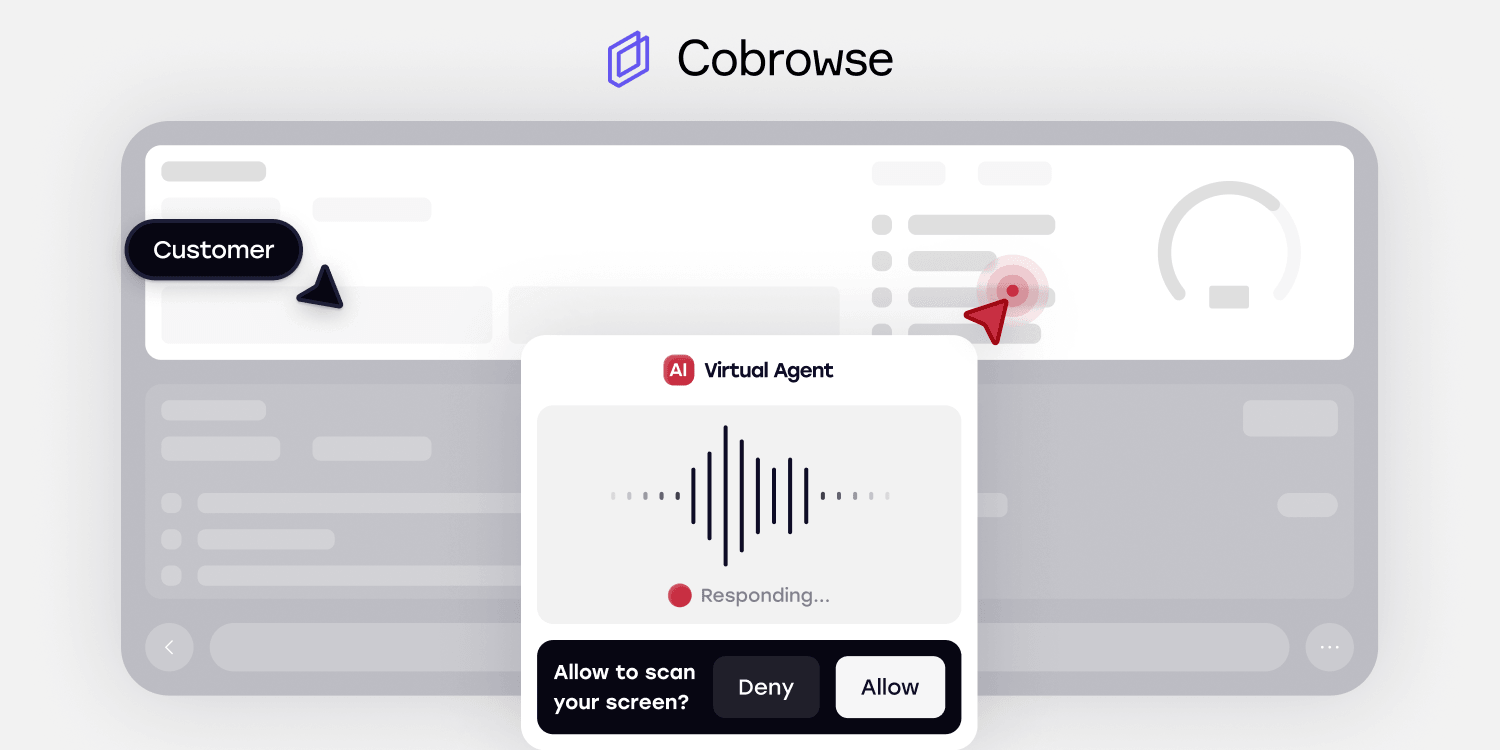
Cobrowse has introduced a new AI-powered visual intelligence product designed to give virtual agents full real-time awareness of the customer’s digital experience – a capability long considered the missing piece in CX automation.
The new release allows AI agents to view the customer’s screen, interpret on-page elements, spot friction points, guide users with on-screen annotations, and hand off to human agents with complete contextual history.
It combines these capabilities with enterprise-grade redaction, auditing, and privacy controls, positioning the solution as a major leap in safe, context-driven AI support.
Indeed, Corbrowse believes that only after outlining these capabilities does the core problem become clear.
As Zac Scalzi, Director of Sales at Cobrowse, told CX Today:
“AI agents transformed how customers communicate, but they still lack the context required to actually solve problems. Until AI can see what the user sees, every answer is an educated guess.”
The “Context Gap” Holding AI Back
Large language models allow virtual agents to understand intent and deliver increasingly natural conversations.
But as Scalzi notes, “they still don’t see the actual user interface, what the user is doing, what errors are shown, or the UI obstacles encountered.”
This lack of grounding is what Cobrowse calls the “context gap”: the fundamental reason AI often sounds helpful yet fails to deliver meaningful resolution.
Customers end up repeating themselves, agents resort to guesswork, and support escalations pile up.
Cobrowse’s official product page argues that “LLMs can interpret and relay information, but without visual context they cannot reason. They behave like a searchable knowledge base, not an intelligent support agent.”
The vendor is emphatic that solving this gap is essential for businesses to thrive in the next era of agentic AI.
What Cobrowse AI Actually Brings to Virtual Agents
The new Cobrowse AI platform introduces capabilities traditionally reserved for human-assisted cobrowsing, but now fully integrated with automated support flows. These include:
Real-Time Visibility into UI State
Virtual agents can observe the customer’s web or mobile session, enabling them to identify errors, locate confusing elements, and understand exactly where a user is stuck.
Situation-Aware Guidance
Cobrowse notes that AI can now “visually direct customers with drawing and annotation tools,” giving step-by-step guidance instead of generic instructions.
Intelligent Analysis of Friction
The product interprets UI behavior and friction points in real time, giving AI agents the context needed to provide precise and timely instructions.
Seamless Escalation
If a case requires human intervention, the AI hands over with full visual and conversational history – eliminating the need for the customer to restate the issue.