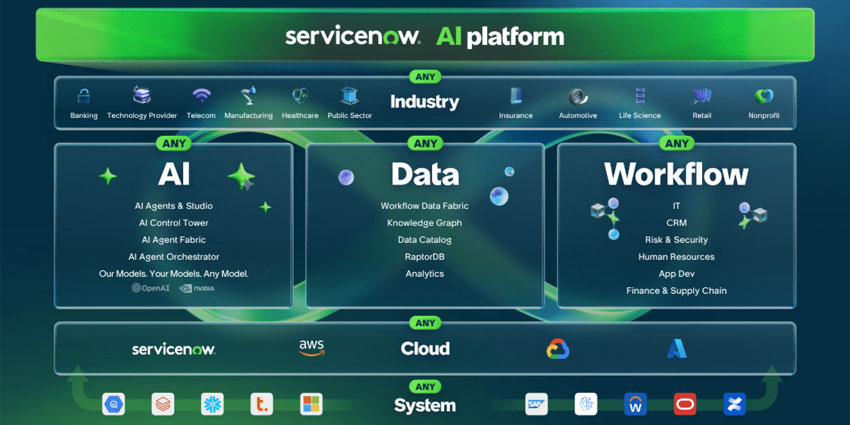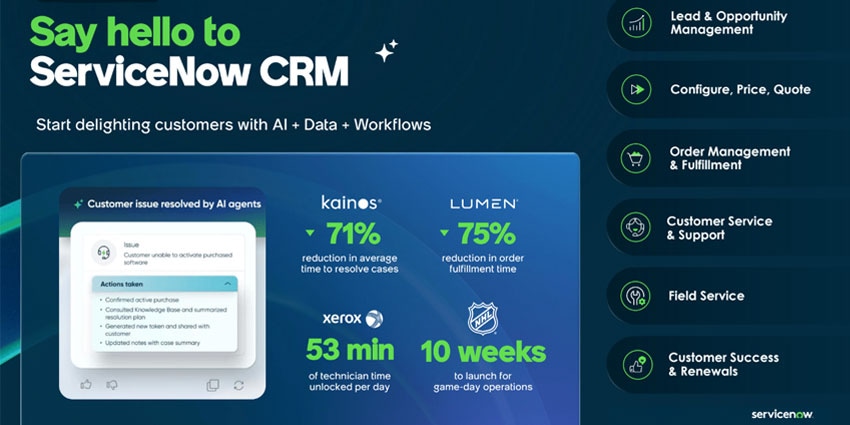
ServiceNow has unified its CRM solutions on one platform: ServiceNow CRM.
Those apps include ServiceNow Customer Service Management (CSM), Sales and Order Management, and Field Service Management.
The tech giant has also packaged industry-specific extensions to bolster the platform across numerous verticals, including banking, healthcare, and retail.
In uniting its CRM portfolio, ServiceNow presents a "system of action" to sell, fulfill, and service.
As Terence Chesire, VP of CRM & Industry Workflows at ServiceNow, said prior to the platform’s launch at ServiceNow Knowledge 2025:
You and your customers can start delighting your customers by uniting data, AI, and workflows to service, sell, and deliver, all on one unified platform.
The news comes after ServiceNow officially entered the CRM market in January 2025. Since then, it has bolstered its capabilities by acquiring Moveworks, Logik.ai, and CueIn.
Now, it pledges to "disrupt an industry built on outdated systems."
ServiceNow’s Plan to Disrupt the CRM Industry
When announcing ServiceNow CRM, Chesire criticized industry stalwarts that sold a 360-degree view and omnichannel as the "Holy Grail".
Instead, he highlighted the need to solve "the real pain points in customer experience."
"For example, in customer service, you need more than just a great omnichannel view of a request," said Chesire. "You also need to orchestrate and automate the hard part, which is the resolution and fulfillment."
Historically, that has proven tricky. After all, the resolution and fulfillment journey spans systems and departments, requiring workflows, automation, and tailored experiences.
That’s where ServiceNow aims to disrupt the CRM market.
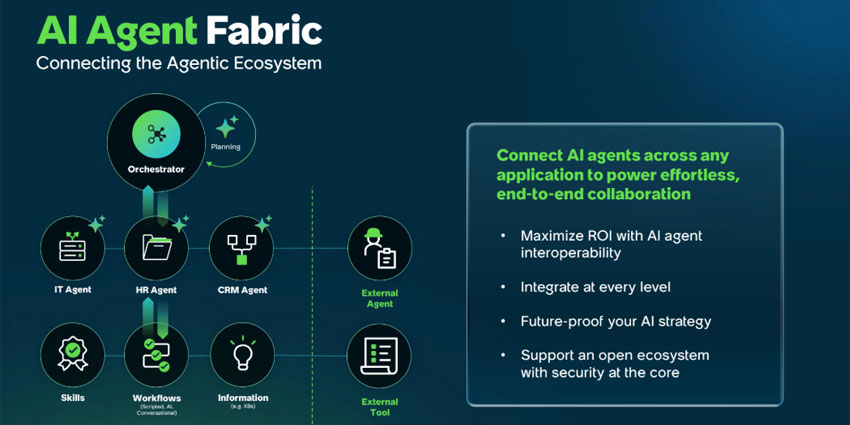
Indeed, it already owns the back and middle office in many enterprises. As such, it can map workflows across enterprise systems, run AI agents across them, and automate more of the customer experience.
Consider a customer trying to resolve a financial dispute, a business ordering new telecom services, or a manufacturer managing a product recall.
Today, spreadsheets, inboxes, and human middleware hold many of these processes together.
Yet, with ServiceNow, CX teams can utilize AI agents to pass data between systems, complete workflows, and do more of the hard yards.
Meanwhile, they can pull more information into the view of live service agents, sales reps, or field service personnel, enabling a more data-rich CRM user experience.
"By leveraging data, AI, and workflows, we create better experiences for both customers and agents—whether for servicing, selling, or delivery," summarized Chesire.
Will ServiceNow Be Able to Disrupt the CRM Market?
ServiceNow has its doubters in the CRM space. Some point to the general complexity of its products. Others may observe that its individual CRM solutions cost more than competitive offerings.
Yet, ServiceNow will argue that its complexity enables deeper connections across the front-office and beyond – paving the way for that data-rich experience and increasing the scope for automation.
Moreover, the tech giant claims it has reduced complexity by unifying its CRM solutions on one platform. Chesire noted:
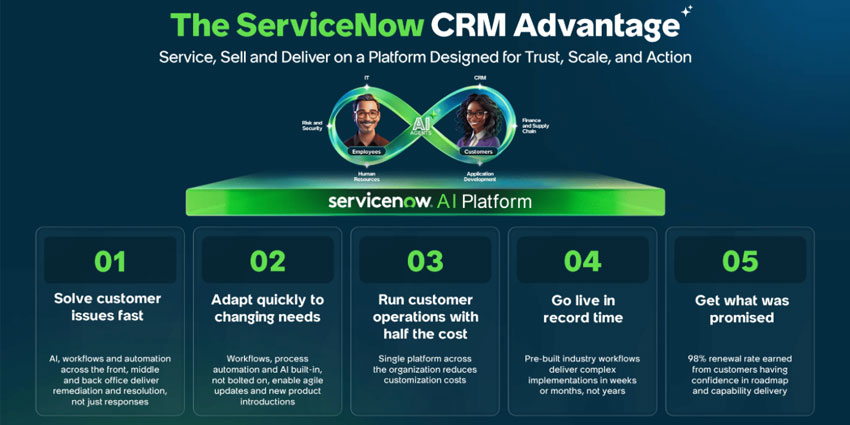
We offer a modern platform that can be easily configured without custom code or objects, allowing businesses to quickly adapt to new products and services.
With little front-office configuration necessary, "It’s much cheaper to maintain and operate, leading to a lower total cost of ownership (TCO)," claimed Chesire.
Chesire also suggests that ServiceNow's industry-specific product extensions, which include oven-ready best-practice workflows, data models, and integrations, can deliver faster time to value.
Still, some may argue that ServiceNow must build out its relationships with service and sales leaders to earn CRM market share.
However, with AI coming to the fore, IT teams are becoming more involved in buying decisions; IT teams that leverage ServiceNow’s IT service management (ITSM) software.
Often, these IT teams are big ServiceNow champions, with the vendor boasting an enterprise retention rate of 98 percent.
Additionally, ServiceNow is trying to build stronger relationships with CCaaS partners to engage a new type of buyer: customer service directors. Its recent big announcements with Five9 and Genesys are a testament to this.