
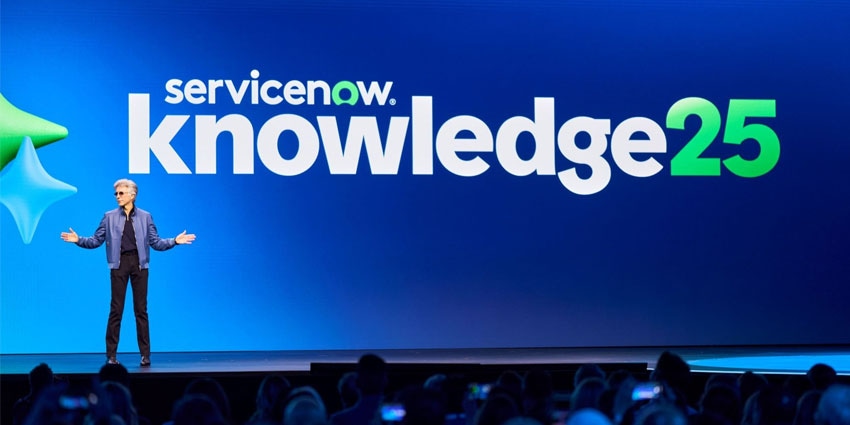
ServiceNow Knowledge 2025 made a splash with a series of massive announcements.
First, the tech giant reintroduced the ServiceNow Platform as the "ServiceNow AI Platform". It then announced several new partnerships, products, and even an acquisition.
In total, ServiceNow made 11 major moves.
Yet, beyond the headlines, Knowledge 2025 provided additional insight into ServiceNow’s vision and direction.
With that in mind, here are five top takeaways from the event.
1. ServiceNow Beckons a More Connected, Autonomous Enterprise
Historically, businesses have functioned in silos as if, for example, marketing doesn’t need access to supply chain data.
ServiceNow challenged this at Knowledge 2025 by launching its Workflow Data Network and AI Control Tower.
The Workflow Data Network extends ServiceNow’s Workflow Data Fabric. How? By connecting data from third-party systems and making it actionable within the ServiceNow AI Platform.
In doing so, it frees up the data available within solutions like Snowflake, so businesses don’t have to move data to power AI. They can leverage their existing investments.
The AI Control Tower then provides business leaders with the place to action that data.
Indeed, it offers business leaders a view of their entire enterprise systems so they can create new workflows between systems and deploy AI agents that share data and automate processes.
That lays the foundations for a more connected, autonomous enterprise.
Liz Miller, VP & Principal Analyst at Constellation Research, made this point in an interview with CX Today. She said:
The Data Fabric allows you to build on a composable architecture that spans the whole organization. So, whether it's a core business application or something more niche, everything can now plug into a common data foundation. That enables true agent-to-agent handoffs without system interruptions.
ServiceNow’s new AI Agent Fabric, which allows businesses to not only leverage first-party AI agents but also agents from other vendors via the Control Tower, boosts this further.
Critically, it allows these agents to communicate, collaborate, and learn from each other.
2. "Knowledge" Takes on a New Meaning
ServiceNow brought Jensen Huang, CEO of NVIDIA, onto the stage to introduce a new AI reasoning engine. The "Apriel Nemotron15B" model allows AI agents to process feedback and self-learn.
Yet, perhaps most interestingly, the model can reason between the types of knowledge materials it takes information from and factor that into its decision-making.
So, the model scours emails, chats, PDFs, and documents and deciphers what’s most relevant.
Just as fascinating, the model may even suggest where that knowledge content should live.
In this sense, ServiceNow isn't only actioning knowledge; it's disseminating it. As Miller noted:
Imagine combining Adobe Acrobat AI with that reasoning engine—suddenly, you’re summarizing, translating, editing documents, and distributing knowledge seamlessly across platforms.
Miller then went on to suggest that, by introducing this solution, ServiceNow and NVIDIA are challenging enterprises to rethink what "knowledge" means.
It’s not just an FAQ or self-service tool anymore. Knowledge is enterprise-wide.
Indeed, the best answer to a customer query might be buried in someone’s email, not in a formal database. As such, businesses need to start thinking of knowledge as both structured and unstructured data: accessible, remixable, and distributed across different formats and channels.
That’s what ServiceNow is likely aiming for. "It’s looking at knowledge as an enterprise-wide asset, not something confined to specific functional silos," said Miller. "And that’s a shift more vendors need to make."
3. ServiceNow CRM Is the "Missing Piece" In ServiceNow’s Strategy
ServiceNow announced a new unified CRM platform, promising a "system of action" for customer support, sales, and field service.
Yet, the move is much more significant than ServiceNow entering a new market.
Indeed, ServiceNow has always focused on aligning organizations - integrating functions like HR, finance, supply chain, etc. - so everything flows within the same framework.
CRM allows ServiceNow to bring the customer into the center of the equation. That’s according to Miller, who noted:
Adding CRM centers the customer in those business actions and realigns CRM to what it was always supposed to be: something helpful, not something that makes people miserable.
In too many cases, CRM systems have made people miserable.