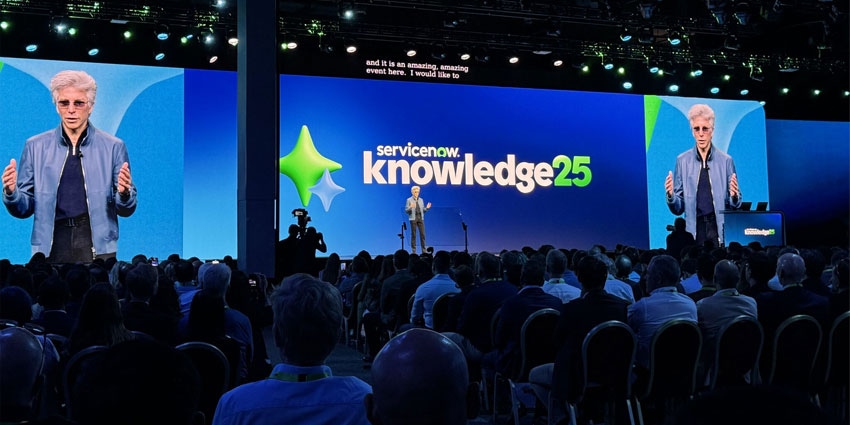
ServiceNow Knowledge 2025 represents the tech juggernaut’s biggest-ever live event.
With 25,000 people watching in Las Vegas and thousands more online, the stage was set.
"So why are we here?" Bill McDermott, CEO of ServiceNow, asked. "Because now is our time.
With AI, the traditional application stack will collapse. The number of apps will shrink while the number of AI agents will grow exponentially.
"These agents will be fed by your databases and orchestrated by the ServiceNow platform, where the real work gets done."
That journey has already begun, with ServiceNow launching thousands of agents earlier this year, bringing agentic AI to "every corner" of the enterprise.
Its next step is to reframe the ServiceNow Platform, which leads to the first of ten massive announcements from ServiceNow Knowledge 2025.
1. The ServiceNow AI Platform
Knowledge introduced the "next chapter" for ServiceNow. Signaling this, the ServiceNow Platform is now the "ServiceNow AI Platform".
In making this shift, ServiceNow stresses that its platform is purpose-built for the world of AI agents.
Already, it hosts thousands of "ready-to-work" AI agents that reason, adapt, and automate, paving the way for a more autonomous enterprise.
These AI agents don’t work in silos. Instead, they operate within the ServiceNow platform, enabling simpler orchestration, governance, and scale.
That includes third-party AI agents from ServiceNow’s partners, including NVIDIA, Microsoft, and Google, all working within the confines of ServiceNow’s platform.
At the head of the platform is ServiceNow’s new AI Control Tower…
2. ServiceNow Launches an AI Control Tower
Earlier this year, ServiceNow shared its vision of being a "control tower" from which customers can scout, deploy, and manage enterprise-wide AI agents.
Now, it has made that vision a reality by introducing a tangible AI Control Tower.
The Control Tower offers one dashboard that gives business leaders a view of their enterprise systems, the AI agents running across them, and how they are performing.
That insight helps CIOs, CFOs, and others track adoption across departments, monitor value metrics, and get to grips with agent ROI.
Additionally, this new level of visibility supports governance and enables brands to scale agentic AI while ensuring compliance with internal best practices and external regulations.
3. "The Backbone of the AI Ecosystem": ServiceNow Releases an AI Agent Fabric
As noted, ServiceNow allows businesses to orchestrate first- and third-party AI agents across the enterprise ecosystem.
The new ServiceNow AI Agent Fabric allows these agents to communicate, collaborate to complete tasks, and even learn from one another.
By enabling this, ServiceNow is standardizing agent-to-agent communication.
Additionally, it’s standardizing agent-to-tool integrations, allowing AI agents to natively interact with various systems.
Referencing these capabilities, ServiceNow described its AI Agent Fabric as "the backbone of the AI ecosystem", empowering agents to connect the enterprise and distribute knowledge.
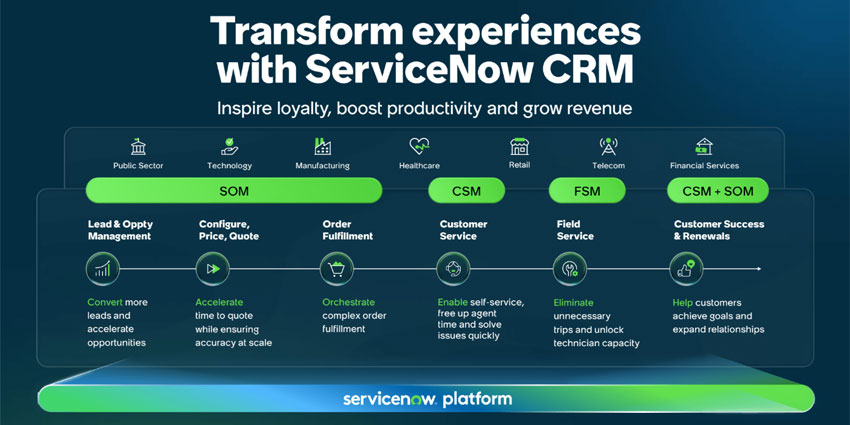
4. ServiceNow Unifies Its CRM Solutions on One Platform: ServiceNow CRM
ServiceNow is making a big play for the CRM market, releasing the ServiceNow CRM.
The offering centralizes its CRM apps - ServiceNow Customer Service Management (CSM), Sales and Order Management, and Field Service Management – on one platform.
ServiceNow packages industry extensions to strengthen the platform and improve time to value.
CX Today wrote a deep dive on the ServiceNow CRM launch, highlighting how it comes together as one "system of action" to sell, fulfill, and service.
Since then, ServiceNow has revealed the packaging of its CRM, IT Service Management (ITSM), and Zoom CX in one central offering: Unified Engagement from Zoom CX and ServiceNow.
In doing so, ServiceNow and Zoom pledged to enable an AI-first experience for customer service teams "right out of the box".
5. ServiceNow Debuts a Core Business Suite to Break Down Business Silos
The ServiceNow Core Business Suite centralizes the systems and data sources used by back-office teams, such as finance, facilities, HR, legal, and procurement.
From there, businesses can map out cross-department processes between those systems.
They can then consider how to streamline and automate more of those processes with AI-powered workflows and help back-office teams work faster and smarter.
As such, ServiceNow automates case management requests - which can extend into supplier systems, too – and eliminates more manual work.