
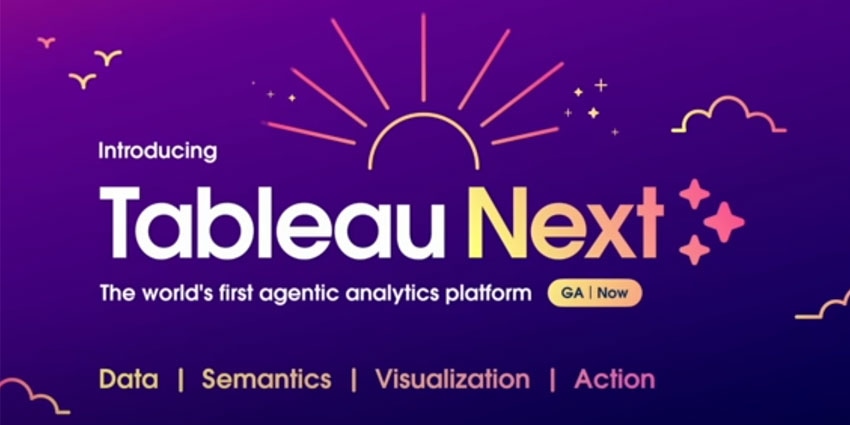
Salesforce has debuted Tableau Next, the "world’s first agentic analytics platform".
Yet, this is no new platform announcement. Instead, it signals a new vision for Tableau.
Shared during last week’s Tableau Conference 2025, this vision frames the solution as a place where users can collaborate with AI agents to accelerate the "entire data-to-action workflow".
As they do so, users should think of Tableau as comprising four layers: data, semantics, visualization, and action – as evident in the graphic below.

The bottom data layer connects to any source, with businesses pulling data into Tableau – via zero-copy – to provide the foundation.
Then, the semantics layer establishes consistent data definitions and context, enabling a unified understanding of that business data.
"[The semantic layer] means getting the most trusted insights from your data — no matter what organization you’re in, no matter what department you belong to," said Ryan Aytay, CEO of Tableau, during his keynote.
Then, there is a visualization layer to translate data from the semantic layer into actionable insight for various business users: analysts, decision architects, agent forces, organizational leaders, CXOs, etc.
Users can also store and reuse these visuals via a new marketplace (more on this later!).
Finally, there’s the integrated action layer. "It’s a bit of a tongue-twister, but it’s so important," said Aytay. "What it means is getting insights wherever you are.
On a plane? On your phone? At your desk? In Tableau. In Slack? In your workflow? Maybe in Workday or Box? It doesn’t matter. Insights should meet you where you work.
AI agents, native to Tableau. will deliver those insights. Meanwhile, brands can also use Agentforce to create agents that leverage insights to kickstart business flows.
However, those native, out-of-the-box agents make for the first big talking point.
1. Tableau’s Concierge & Inspector Agents Steal the Show
The Concierge Agent in Tableau allows employees to interact with their data "in a way that business people speak."
Indeed, the Agent takes a question, applies context from the semantic layer, and sends it down into the data layer. It then comes up with a response.
However, it’s not just a text-based response; the Concierge Agent can also present visuals.
For Southard Jones, Chief Product Officer at Tableau, that’s key. "We don’t just want to hear the answer; we want to see and understand what’s happening in the data," he said.
Lastly, on Concierge, there's also a "Sources" feature. Think of it like a citation in a research paper. It presents the reasoning behind the agent's actions and where the semantic data came from.
Then, there's the Inspector Agent. It tracks the data in Tableau continuously, monitoring sudden shifts, spotting trends, and making predictions.
Critically, the Inspector Agent also offers proactive alerts on key data trends, such as a sudden drop in customer satisfaction.
As Jones explained:
I think of Inspector a little bit like an omniscient caretaker working behind the scenes.
Salesforce shared an example of how the Inspector Agent could help track the performance of a campaign while also keeping an eye on budgets.
It could then send alerts to the campaign leader, like: "Hey, you're exceeding your target and still have $25,000 left. What do you want to do? Do you want to double down?"
Yet, that’s just one of many possible use cases.
Alongside the Concierge and Inspector Agents is a Data Pro Agent. This helps teams clean and change data, offering smart suggestions on how to do it and automating some of the work.
2. Tableau’s New Blueprint, Slack Channel, & Marketplace Catch the Eye
Salesforce has released several support resources to help businesses find success with Tableau Next.
First is Tableau Blueprint, which offers a framework for agentic analytics. It answers the following questions: How do I get started? How can I create a vision for it? How do I build processes around it? How do I design the right organizational structure to support it? And so on.
With this, businesses may define their data and AI strategies, execute, and – according to Salesforce – "cultivate their data strategies".

Then, there's a new Slack workspace for the Tableau community. Rekha Srivatsan, Chief Marketing Officer at Tableau, introduced this: "You can create your own channels, keep the discussions going, and stay connected.