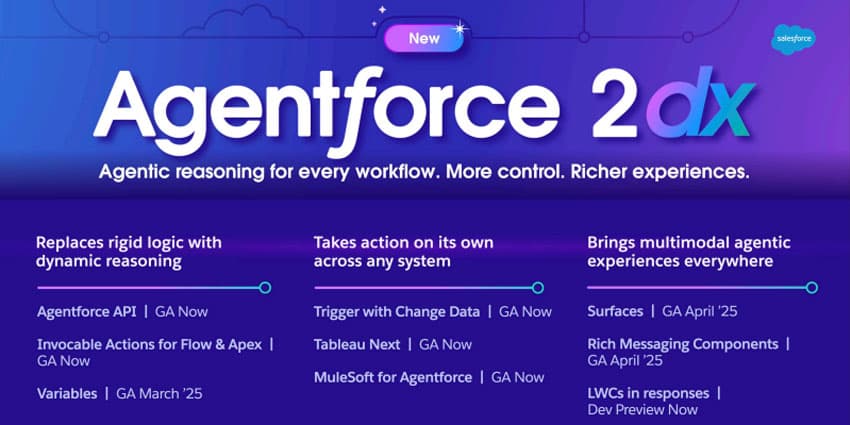
Salesforce has launched the next generation of Agentforce: Agentforce 2dx.
Following the December announcement of Agentforce 2.0, Salesforce’s AI agents now go beyond its CRM ecosystem, automating processes across departments and systems.
That's a significant step for Salesforce. No longer is it talking just about the front office; it's also taking its AI agents into the back office.
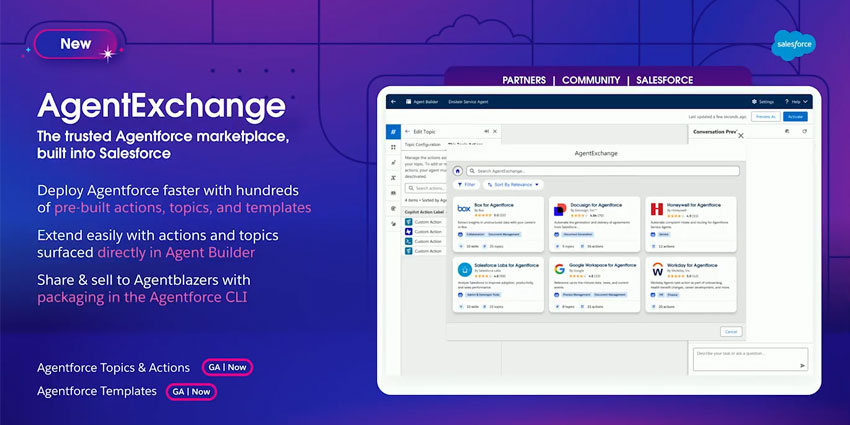
Agentforce 2dx will support developers with a new set of low-/no-code tools to configure, test, and deploy AI agents that span the enterprise.
Yet, the release offers much more than new developer tools. It also helps shine a light on the direction of Salesforce as it advances its agentic AI platform.
Given that, here are five major talking points from the release.
1. Salesforce Enables More Proactive AI Agents
"Agentforce APIs" and new MuleSoft APIs are a critical part of the 2dx release. These enable the integration of Agentforce into back-end processes and applications.
Alongside this are new Invocable Actions that automate actions based on business events.
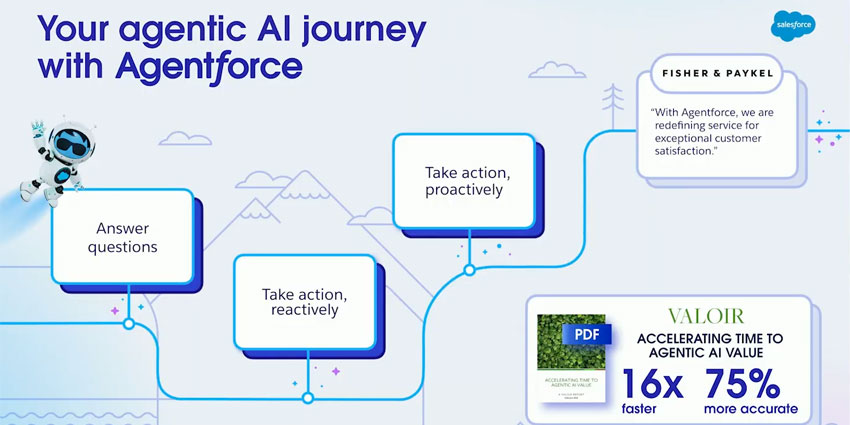
While such developments are significant in taking Agentforce beyond the Salesforce ecosystem, Adam Evans, EVP & GM of Salesforce AI, also highlights how they support new, proactive AI agent use cases.
"Agents can be triggered from any platform event," he said. "So, any time a record is changed, a new case comes in… anything inside the Salesforce unified platform can begin an agent to do work in the background.
"This change is significant, as… Agentforce now has the ability to be proactive."
Consider an example of a proactive Agentforce agent in telecommunications. It could monitor network outages and – when one occurs – proactively warn affected customers.
Yet, this is just one of many possible examples spanning the enterprise.
2. Agentforce 2dx Self-Diagnoses Data Gaps
If an agent fails to complete a task accurately, Agentforce may pinpoint whether the issue is due to missing data or unclear instructions.
Such reverse engineering – enabled by Salesforce Atlas - allows brands to optimize AI agent performance.
With a new Agentforce Interaction Explorer module, 2dx builds on this further.
Referencing this, Evans noted:
With advanced analytics, we’re now getting real-time insights into agent performance and recommendations about how to improve them as we move forward. This gives CIOs and IT leaders more confidence than ever to measure the ROI of their AI.
3. Slack Becomes the Center Point for a Human-AI Hybrid Workforce
Last month, Salesforce introduced Agentforce for Slack, presenting the platform as a hub for a hybrid human and AI workforce.
Now, Salesforce has added an "Agentforce Steps in Slack Workflow Builder" tool that allows developers to trigger automations in other systems based on Slack events.