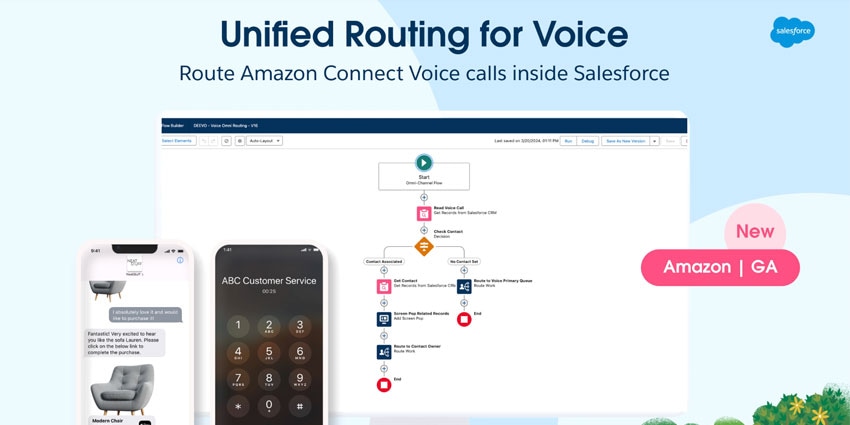
The Salesforce Omni-Channel engine is a unified routing solution that directs incoming customer interactions to support reps across contact center channels.
However, until recently, it had a glaring gap: voice.
As such, many businesses route calls in the telephony system and digital contacts through the Salesforce Omni-Channel engine.
Not only does that make routing configurations more fiddly, but it makes channel blending across digital and voice difficult.
Thankfully, Salesforce now promises that Service Cloud can route to all channels via its Omni-Channel engine, voice included.
In doing so, it enables smoother work distribution, skill-based and direct-to-agent routing for the channel, alongside centralized configuration.
However, there is a catch: it's only available to contact centers using Service Cloud together with Amazon Connect, with AWS supporting the behind-the-scenes.
That said, Salesforce has confirmed that it's also working with "several" more contact center providers to eventually make this capability more widely accessible.
Wait... How Does Salesforce Voice Routing Work?
Amazon Connect initiates the call, managing the IVR flow and establishing the phone line connection.
As the call comes in, it alerts Salesforce, transmitting key data points such as IVR selections, dialled numbers, and customer responses to inform the routing process.
Salesforce Omni-Channel leverages these inputs to drive CRM-powered decisions through Unified Routing, determining the best agent match based on defined logic.
While Salesforce processes the request, Amazon Connect temporarily holds the caller in the queue to prevent delays or misroutes.
From there, the Omni-Channel engine identifies the ideal agent, considering those key data points, and communicates the selection back.
Amazon Connect then bridges the caller to that agent, completing a seamless handoff driven by real-time intelligence and a unified routing architecture.