After a steady stream of high-profile pre-event announcements, Dreamforce 2024 is officially underway.
Unexpectedly, the new Agentforce platform, which empowers front-office teams with autonomous agents, dominated the keynote – as it did much of the build-up.
Why? Because it marks a significant shift in Salesforce’s thinking. It highlights how the CRM giant has pivoted from "human in the loop" copilots to "human at the helm" autonomous bots. These bots can perform tasks across customer-facing functions without human assistance.
For instance, in customer service, they can deal with customer queries of varying complexities without pre-programmed responses.
Earlier this year, Marc Benioff, Chair & CEO of Salesforce, repeatedly warned against such autonomous use cases. In March, he called many existing solutions "very confident liars, producing misinformation and hallucinations."
He continued by suggesting: "There’s a danger for companies, for enterprises, for our customers, that these are not trusted solutions."
Given these public warnings, Benioff had to take to the Dreamforce stage and send out a clear message that Agentforce is different from previous autonomous offerings.
Eventually, this message came, but only after an overview of Salesforce's transformation from a suite to a platform company – and the overall significance of that change.
1. The Switch from Suite to Platform Is Complete
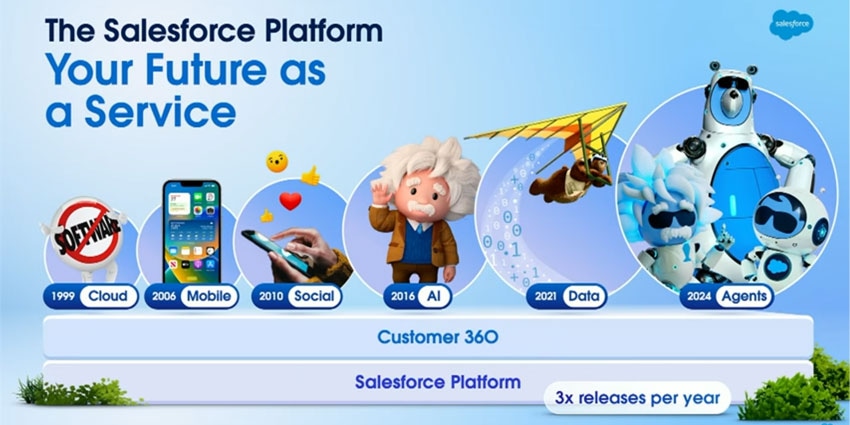
Salesforce is best known for its Customer 360 apps. Yet, in recent years, the CRM giant has rewritten all of these – including those it has acquired – to develop a series of clouds that run natively together as part of a consistent, unified platform.
The goal for Salesforce moving forward will be to sell that complete platform instead of cross-selling different 360 apps. As Benioff confirmed during his keynote:
This platform, which we're all familiar with and that gets three releases a year, is the key strategic focus of Salesforce.
Now this platform has come together, Salesforce can release offerings that scale all its CRM apps, Slack, and Tableau. Without that platform foundation, Agentforce wouldn’t be possible.
Alongside this ability to introduce cross-CRM innovations in one fell swoop, the platform will enable more seamless cross-function data sharing and deliver greater multi-cloud value.
As such, Salesforce hopes that the power of its platform will extend its CRM leadership and potentially demote isolated, competitive CRM apps to enterprise systems of record.
One competitor that Salesforce may aim to take down a peg or two - with this "bigger than CRM" vision - is ServiceNow. Benioff's recent comparison of Salesforce vs. ServiceNow to McDonald's vs. Weinerschnitzel - whether fair or not – seemingly suggests this.
2. Data Cloud Binds the Platform Together
Within the Salesforce platform, Data Cloud is the heartbeat, taking data from across Salesforce Clouds and funneling it into a unified customer record.
Yet, Data Cloud also enriches those records by pulling insight from external data lakes and warehouses, supporting Snowflake, Databricks, Google BigQuery, Amazon Redshift, and IBM mainframes.
Moreover, it channels metadata from across various teams within the enterprise.
As Benioff summarized: "We can take all that data and integrate it into the Customer 360, which has been our vision for the last 25 years." The following slide from Benioff’s keynote highlights this point.

The CEO also discussed how Salesforce has added support for unstructured audio and video, more pre-built connectors for data ingestions, and new governance features to Data Cloud.
Nevertheless, the critical message is that for Agentforce to fly, the data engine must hum – and, for Salesforce, Data Cloud is the ideal solution to supercharge its autonomous agents and enable multi-cloud CX innovation.
3. Accuracy Is Everything In Salesforce’s AI Adventure
As noted in the intro, after bashing autonomous agents earlier this year, Benioff had to put a stake in the ground and tell the audience why now is the time to release Agentforce.
Unsurprisingly, the answer is that the platform - powered by Data Cloud – can enable the "least hallucinogenic" implementations of GenAI-enabled technologies.
"Why are our agents so accurate and reliable? It’s because of the platform," he said. "We have the data, metadata, workflows, business processes, security models, and sharing models.
It turns out that these elements make for a more accurate AI with minimal hallucinations.
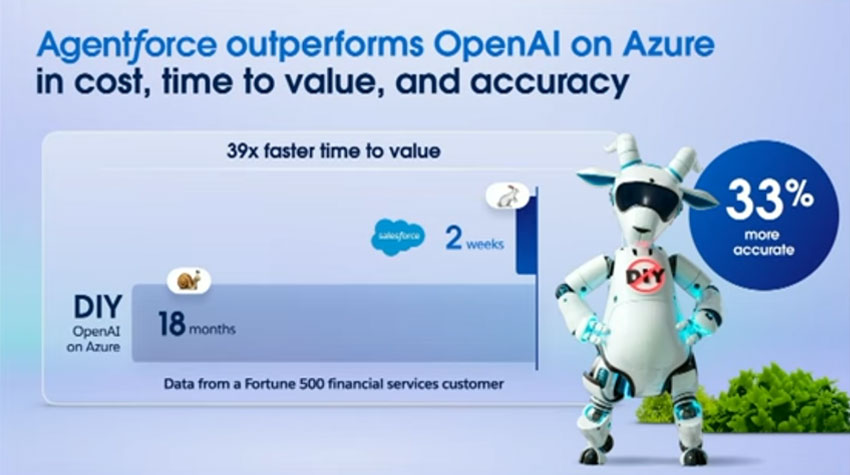
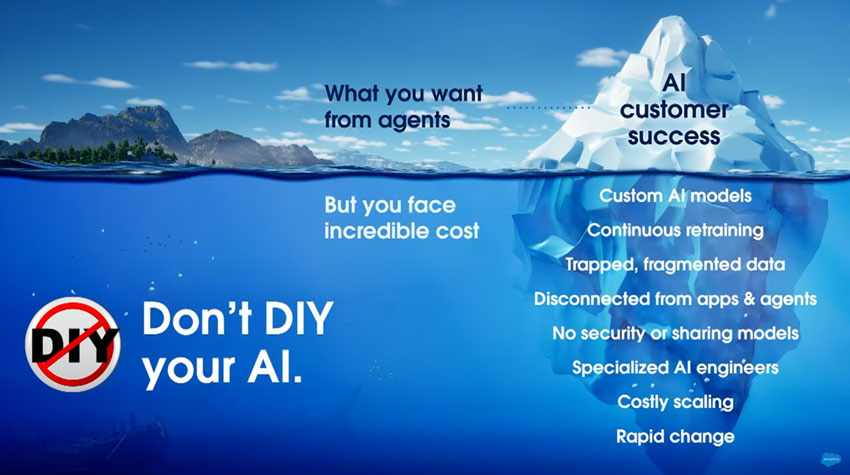
To bring the point home, Benioff – fresh from his swipes at ServiceNow and Microsoft – didn’t shy away from emphasizing how Agentforce outperforms OpenAI on Azure. Indeed, he put that fact up in lights with the following slide.