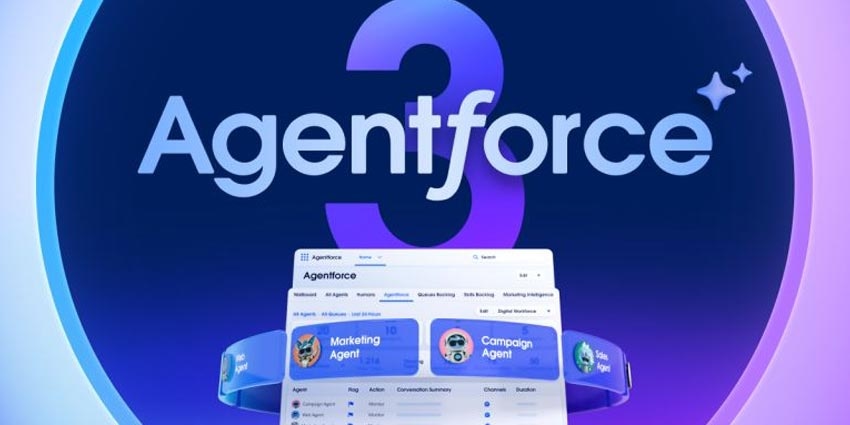
Salesforce has released Agentforce 3, less than a year since it launched the first iteration of its digital labor platform.
The most notable new feature is the Agentforce Command Center, an observability solution to monitor, scale, and optimize AI agent deployments across the enterprise.
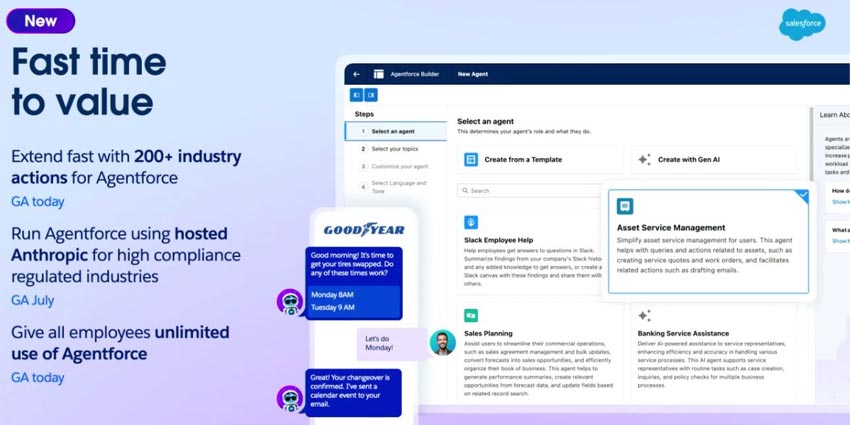
Moreover, Salesforce announced agent interoperability, supporting open standards like Model Context Protocol (MCP).
Thanks to this new level of interoperability, Salesforce enables "plug-and-play" agent-to-agent flows spanning the enterprise, with 100+ new pre-configured industry actions to accelerate time to value.
Supporting these flows, the tech giant has teamed up with 30+ partners - including AWS, Cisco, and Google Cloud - and connected their AI agents. These are now available in the AgentExchange.
Then, there's the updated Atlas architecture, which ensures lower latency, more context-aware outputs, and global availability. It also allows businesses to natively host large language models (LLMs), including those offered by Anthropic, on the Salesforce architecture.
"Agentforce 3 [is] a major leap forward for our platform that brings greater intelligence, higher performance, and more trust and accountability to every Agentforce deployment," commented Adam Evans, EVP & GM of Salesforce AI.
Agentforce 3 will redefine how humans and AI agents work together, driving breakthrough levels of productivity, efficiency, and business transformation.
Yet, beyond the new product capabilities, the launch raises several significant talking points, as dissected in the top five takeaways below.
1. The AI Agent Conversation Shifts from Product to Ecosystem
The AI agent conversation has hit an inflection point. Moving forward, the big story will be about multi-agent orchestration, not just how multiple Agentforce agents work together but how different platforms' agents - including those from Microsoft, Google, and ServiceNow - interact.
Salesforce hasn’t said that outright, probably because it doesn’t want to highlight competitors. However, the future is multi-agent and multi-platform. Agentforce 3 implies the company's recognition of this reality.
In line with this, the orchestrator inside the Salesforce Command Center will likely evolve to eventually manage agent interactions and support telemetry across ecosystems, not just inside Agentforce. That's according to Martin Schneider, VP & Principal Analyst at Constellation Research.
"They hint at it, but I think they should be more explicit," he said. "Don’t be afraid of agents from outside platforms; embrace them.
Salesforce can be the control panel, managing the hybrid workforce no matter where the agents come from.
In this sense, much of the Agentforce chatter will soon expand beyond platform features to the surrounding ecosystem.
This is already happening, with Salesforce placing more emphasis on partnerships and co-innovation in this Agentforce release than previously. Yet, expect its partnerships to flourish faster than ever.
2. The Command Center Shows Promise, But More Analytics Should Come
The Command Center provides tools to pivot from agent pilots to production faster and at greater scale. It also gives companies observability of business-wide AI agent implementations.
That observability allows leaders to understand where they’ve employed agents while tracking adoption, success rates, costs, and more.
Over time, that analytics capability – while advanced – must become deeper. Indeed, as multi-agent orchestration takes hold, business leaders will want a better understanding of agent performance.
As Schneider said: "Think of it like HR for digital workers: what’s their impact, where do they add value, and how do we measure success?"
After all, digital agents don't behave like humans. They're 24/7, always on. That means they require different performance standards and management models, which Salesforce and its customers need to think through.
Alongside analytics, Salesforce can go further to improve the setup and development of agents, per Schneider. He said: