AI is taking the world by storm, with exciting innovations emerging daily.
In the enterprise, it's agentic AI that's especially catching the eye, and Salesforce is one of the first companies showing organizations what this new form of AI can do with Agentforce.
Agentforce, according to Salesforce, is "what AI was meant to be". It offers a low-code platform that allows businesses to create, fine-tune, and deploy autonomous agents across multiple business functions.
Salesforce Atlas is the brain behind this platform, the reasoning engine that enables Agentforce agents to engage in complex decision-making tasks just like a human being.
Just like a human brain, Atlas improves over time, learning from outcomes and evolving in real time.
But let's get into the weeds, considering how it works and why it may prove a game-changer for enterprises.
What Is Salesforce Atlas? The Agentforce Reasoning Engine
Salesforce Atlas is the "reasoning and learning" engine that powers Agentforce agents.
Think of it as a feedback loop that corrects and refines an agent's decision-making process.
If an AI agent reaches a point where it needs to make a decision, the reasoning engine asks: "Do I have enough data to ensure a certain level of accuracy?"
If the answer is no, it either requests more data or acknowledges that it can’t provide an answer.
As such, Atlas empowers AI Agents to take initiative, self-learn, and deliver more reliable results.
Those results are significant, with Atlas coming to Agentforce 2.o. When first teasing the addition, Marc Benioff, CEO of Salesforce, stated:
We are seeing more than 90 to 95 percent resolution on all service and sales issues with the new Atlas.
That's massive and shows the power of AI agents thinking critically about what needs to be done to achieve a specific goal instead of just following orders.
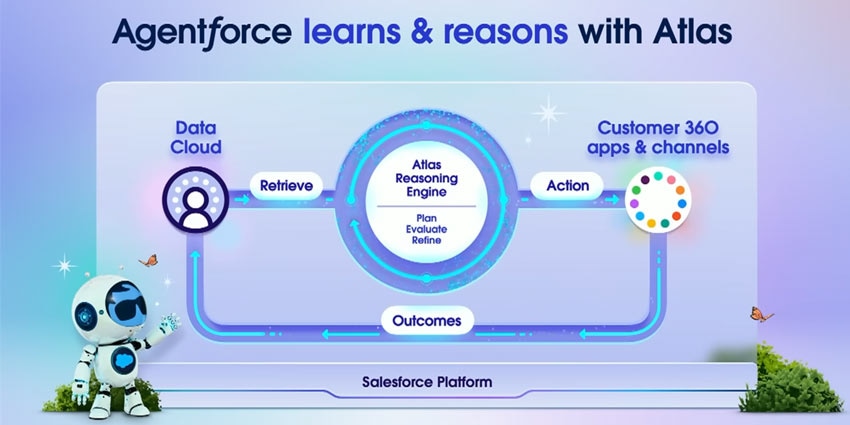
To enable this critical thinking, Atlas engages in a "flywheel" chain of thought process. More on this below.
How Does Salesforce Atlas Work?
As noted, Atlas works by using a methodical "flywheel" of reasoning. That process involves:
- Data retrieval: Salesforce Atlas starts by pulling structured and unstructured data from the Salesforce Data Cloud.
- Evaluation: The system then processes the data, generates a plan of action, and assesses whether that plan will drive the right outcomes.
- Refine: If the initial plan isn’t good enough, Atlas loops back, revisiting the data and refining its approach until it’s confident it can deliver results.
The reasoning engine then continues "looping" around that process over and over, until it’s confident that it can achieve the goal set by the organization.
After finally completing a task, Atlas then learns from the results, allowing it to improve over time.
The Core Capabilities of Salesforce Atlas
Atlas stands out for its combination of advanced reasoning, data retrieval, built-in safeguards, and ability to consistently and dynamically improve from every interaction.
Here’s a closer look at what makes the Salesforce Atlas Reasoning engine unique.
1. Comprehensive Reasoning Capabilities
Advanced reasoning is at the heart of what makes Salesforce Atlas so special. It allows the system to think, plan, and act autonomously, just like a human being.
Indeed, Atlas doesn’t just follow instructions; it figures out the right way to approach each task by diving into the details and the most relevant data.
Unlike static systems, Atlas also evaluates its actions in real time, refining them to make sure that it’s taking steps that take users closer to their end goals.