Salesforce has teased the Einstein 1 Platform, a relaunch of its Salesforce Platform.
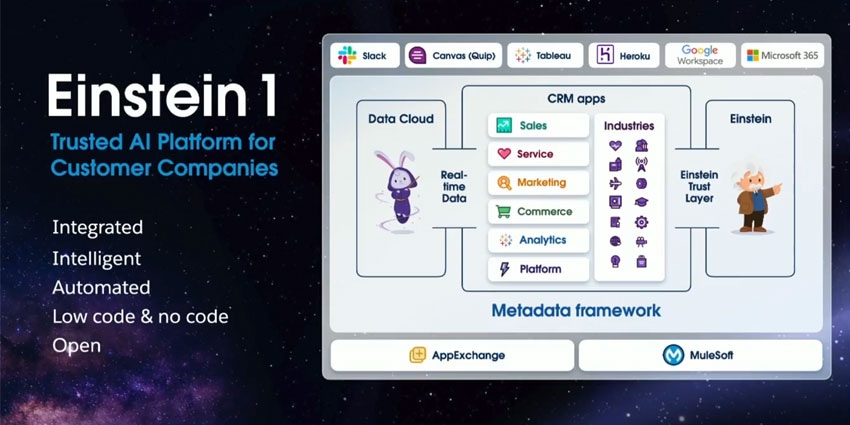
The solution – given the tagline: "A Trusted AI Platform for Customer Companies" – houses all of the vendor's CRM apps, Data Cloud, Einstein apps, and more – as per the screenshot above.
When introducing the platform at a press conference, Patrick Stokes, EVP of Product and Industries Marketing at Salesforce, stated:
[This is] one platform where you can build all of your customer experience in one place, with all of the data and AI you need.
Alongside this, Stokes promised an integrated, intelligent, and automated platform.
The EVP also revealed that the platform will – like the Salesforce Platform – remain low-code.
Yet, perhaps most crucially, it will be an open platform that supports many data, LLM, and independent software vendors. Stokes continued:
We have our AppExchange enabling ISVs to extend the platform, Mulesoft enabling you to connect to outside (legacy) vendors, and - of course - we have a suite of productivity and additional developer tools, from Slack to Canva.
All this helps Salesforce as it strives to provide one platform that allows customers to pull all their data together.
Ordinarily, these projects involve many applications, building data lakes, and fusing disconnected APIs from many vendors. That had stalled transformation projects.
As Einstein 1 is an open platform, Salesforce aims to overcome such issues. Yet, it may also do so, thanks to its broad metadata framework.
The framework ensures that when a business puts data into Salesforce, it shows up everywhere. It also allows the CRM leader to upgrade its platform without breaking existing implementations.
Already, Marketing and Commerce Cloud sit on top of this core metadata framework – with the rest of Salesforce's CRM apps soon to follow suit.
Finally, within Einstein 1 is Data Cloud, formerly known as Genie. That ensures that Salesforce has a hyper-scale data engine that sits inside the platform, connecting all customer data.
As such, any data in Salesforce becomes available as Salesforce metadata, so businesses can access it across any application – whether that's Sales, Service, Commerce, Marketing etc.
Sharing more, Stokes added:
The way this works is by bringing data in from across data lakes, warehouses, Salesforce apps, and it unifies all of that data into one customer record.
All this data will help Salesforce customers ground AI, build new CX workflows with Salesforce Flow, and empower employees with new insight.
Salesforce Offers Data Cloud & Tableau for Free
Alongside Einstein 1, Salesforce also announced that it will give its Data Cloud and Tableau solutions away for free to customers with up to 10,000 profiles and two Tableau Creator Licenses.