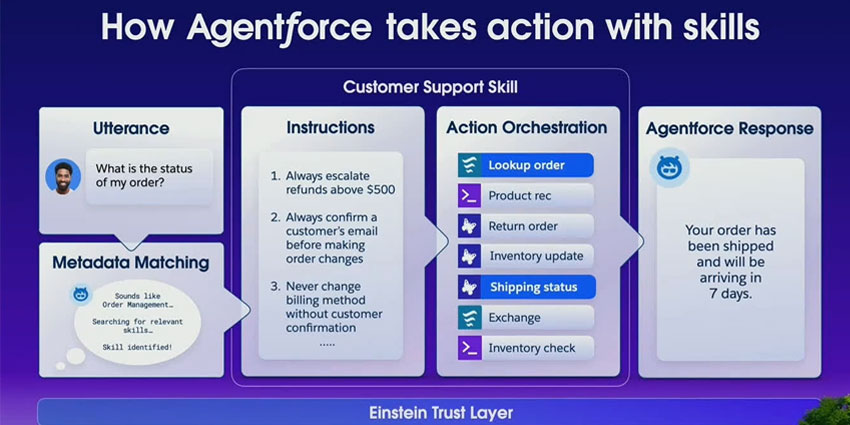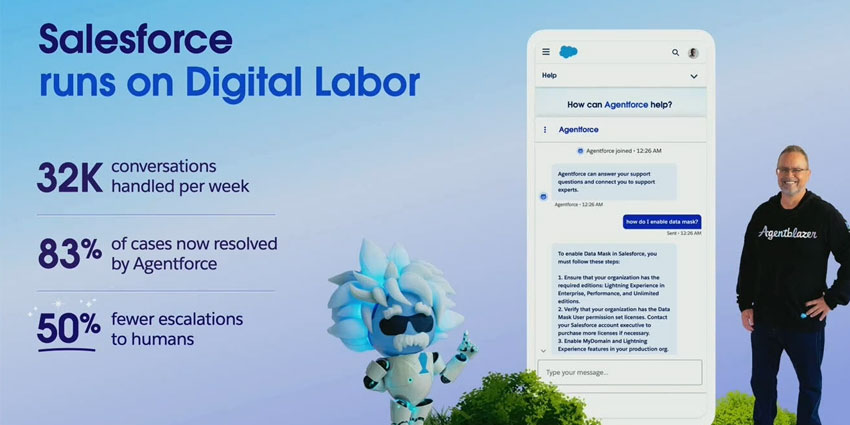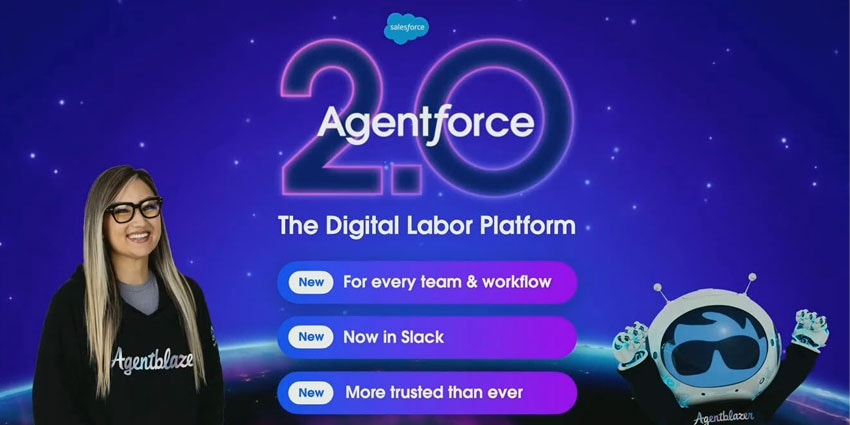
Salesforce has unveiled Agentforce 2.0, lauding it as "The Digital Labor Platform".
The CRM leader introduced the new terminology to clarify that Agentforce doesn’t just manage information; it manages digital labor as well.
Yet, the Agentforce 2.0 announcement isn’t just a rebranding exercise. Instead, it signals an evolution of the platform, which allows users to build and deploy AI Agents that perform tasks autonomously.
That evolution includes an expanded vision, new capabilities, and more, as the following five big talking points explore.
1. Salesforce Takes Agentic AI Beyond CRM
Agentforce 1.0 introduced the many possibilities of AI Agents automating workflows and sharing insights across the Salesforce ecosystem.
For instance, in Sales Cloud, AI Agents help users follow up with leads, qualify opportunities, and practice pitches tailored to specific opportunities.
In Service Cloud, AI Agents resolve tier-one tickets, "achieving 90%+ resolution rates". They also escalate when necessary to live agents, preserving context and saving time.
As a final example, in Marketing Cloud, AI Agents create personalized campaigns by analyzing customer interactions, improving segmentation, and driving campaign effectiveness.
Yet, as Adam Evans, EVP & GM of Salesforce AI, claimed when unveiling the next-gen platform:
Agentforce 2.0 isn’t just about CRM; it’s about the entire enterprise.
As such, Agentforce 2.0 is automating workflows that run beyond its ecosystem.
Case Study: How Adecco Took Agentforce Beyond CRM Flows
Early-adopter Adecco built a Recruitment Agent on Agentforce 2.0.
The AI Agent scans resumes and identifies the top candidates for specific roles, notifying recruiters in Slack with pre-qualified candidates ready to review.
Recruiters can ask the AI Agent to schedule interviews directly from Slack. It then handles availability, contacts candidates via email, and updates calendars automatically.
Finally, before interviews, the Agent generates tailored questions based on the job description and candidate's background, ensuring recruiters are well-prepared.
The Three Enablers of "Beyond CRM"
Ultimately, there are three central enablers of Agentforce 2.0. First is Data Cloud, which unifies structured and unstructured data inside and outside the core Salesforce ecosystem.
Second, a new Atlas Reasoning engine enables semantic understanding of that data through techniques like knowledge graphs and recursive trees (more on this later!).
Third is MuleSoft's library of out-of-the-box connectors, which allow AI Agents to work across widely-utilized enterprise platforms. Meanwhile, via MuleSoft, customers may also integrate custom APIs using natural language.
With all this, Evans suggests Salesforce will enable "any team and any workflow to take action across the enterprise."
2. Slack Becomes the "Natural Place" for Agentforce
"Slack is the place where every company can bring digital labor to every employee and team," said Denise Dresser, CEO of Slack.
Why? Because it’s the first app that Salesforce-centric brands open up every morning, and – according to Dresser – that makes it the "natural place for Agentforce to exist."
Just think of it as an operational center point for businesses. From there, employees can work with AI Agents to surface information across Salesforce apps and external systems.
Moreover, from that center point, employees can put AI Agents to work across the enterprise. That’s the picture Dresser painted before sharing how Accenture is bringing it to life.
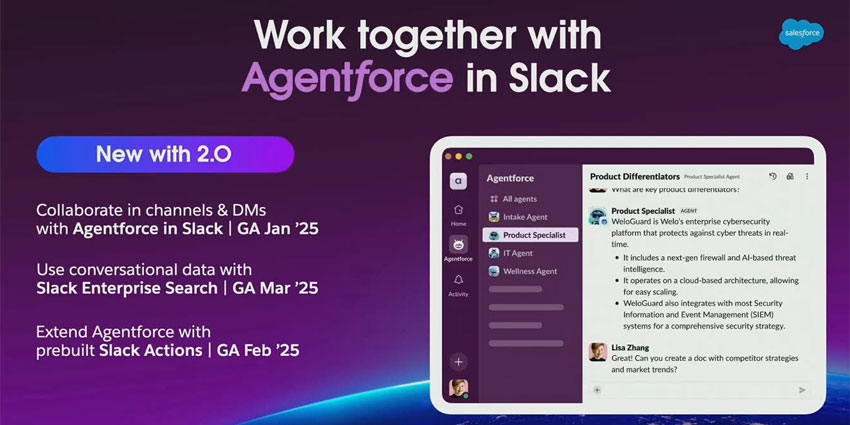
Case Study: How Accenture Leveraged Agentforce to Transform How Teams Work In Slack
As part of a live demo, Dresser shared several examples of how Accenture utilizes Agentforce and Slack - as a digital HQ - to work smarter, faster, and more efficiently.
Indeed, Accenture actions AI Agents within the collaborations platform to empower employees with:
- Instant Updates: AI Agents provide real-time updates on critical accounts, like missed meetings, business reviews, and key insights.
- Automated Document Retrieval: Instead of digging through emails, drives, or folders, Agents surface the right documents—like a QBR (Quarterly Business Review)—instantly using federated search capabilities.
- Proactive Recommendations: Agents analyze data from conversations, CRM systems, and documents to identify business challenges and suggest solutions, like engaging specialists or providing relevant success stories.
- Proposal Creation and Visualization: Agents streamline the creation of proposals by combining CRM actions, customer data, and Tableau skills. Executives can even ask Agents to convert proposal data into visualizations - like a Tableau dashboard – "within seconds".
- Employee Collaboration: Like a traditional copilot, Agents can answer questions, update account insights automatically, and schedule meetings.
After the live demo, Dresser summarized: "If your employees can do it, Agentforce can do it too."
3. Agentforce 2.0 Reasons with Atlas & Data Cloud
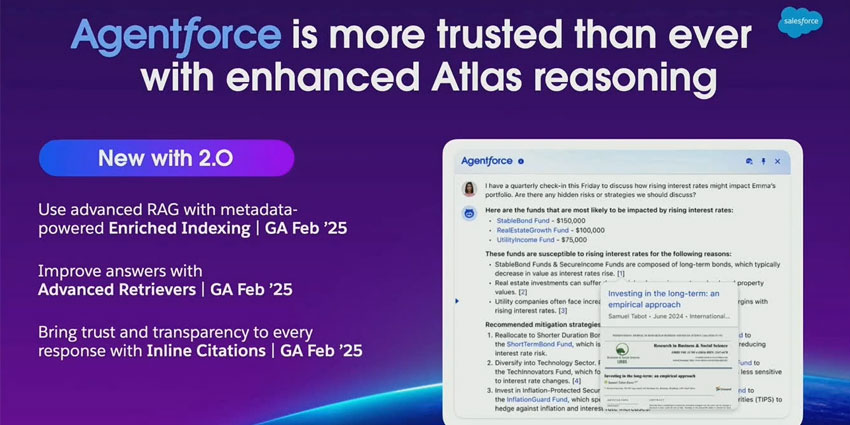
The Atlas reasoning engine is new to Agentforce. It promises to turn "tasks into trusted outcomes."
How? Through a deeper reasoning process that comprises three elements:
- Enriched Indexing: Salesforce has improved the way it indexes data with multi-intent reasoning.
- Advanced Retrievers: Tech like data and knowledge graphs enable more accurate and comprehensive data retrieval.
- Inline Citations: Responses from AI Agents will include citations for visibility, ensuring accuracy and trust.
All this is critical to ensuring the accuracy of Agentforce, which is a priority for Salesforce, having promised the "least hallucinogenic" implementations of agentic AI.
Alongside Atlas, Data Cloud is key here. It integrates all Salesforce data, binding the platform. It also allows companies to bring their own data lakes with zero-copy and centralize CX data.