
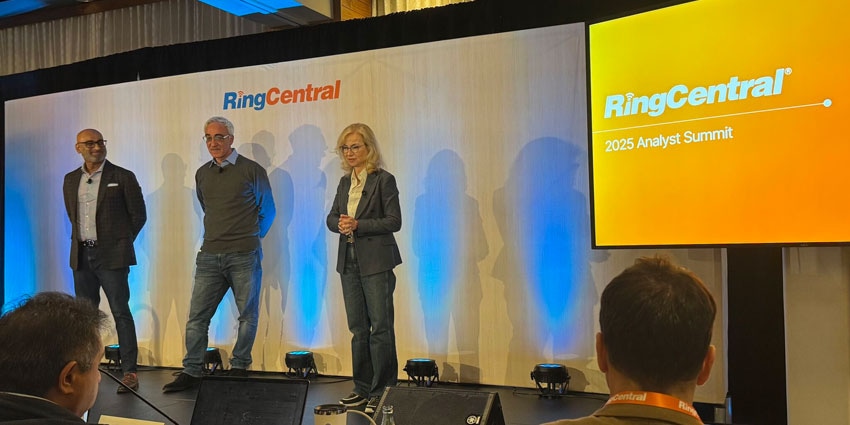
Last week, RingCentral held its annual analyst summit in Napa Valley.
While this event, and ones like it, set the stage for vendors to provide a look at where their products are and what the roadmap looks like, there is also a fair amount of chatter regarding the industry more broadly.
Given this, it’s fascinating to reflect on the keynotes and discussions to consider their implications.
Below are five key takeaways from the event.
1. AI Pricing Is Still in Flux
One question that comes up at every analyst event is: how will AI services be priced?
Currently, that question appears to have no answer. Vendors have suggested they are currently looking at per-seat, utilization, and even outcome-based pricing.
At the event, Kira Makagon, the newly appointed President & COO of RingCentral, highlighted that while utilization-based pricing might seem simple, there are several complications.
From a customer perspective, it would turn contact center pricing from predictable to unpredictable.
Also, defining "utilization" isn’t trivial. By the message? Character? Conversation? Minutes? There are many options.
Makagon said the company is leaning towards bundles. For example, customers could purchase a certain number of minutes for a virtual agent and then pay an overage charge if exceeded.
Yet, ultimately, many vendors will likely offer multiple options to meet the demands of different types of customers.
2. In CX, Voice Is the New Text
Those with many years of experience in communications may remember Cisco pitching the concept of "video being the new voice."
Eventually, that happened as knowledge workers use meeting technology far more than phones, although it did take a pandemic to get there.
In the CX space, there has been a shift from voice to messaging, as IVRs and voice automation provided a less-than-stellar experience.
As such, instead of beating their heads on the wall screaming "agent", many consumers shifted to messaging apps.
Yet, with virtual agents, such as RingCentral’s recently announced AI Receptionist (AIR), the quality has gotten so good that voice seems set to return to the preferred interface.
The AIR demo from the event was good, although there was too much latency in the interactions, which the RingCentral team acknowledges with the promise it will get better faster.
Nevertheless, look for voice to surge in contact centers. Eventually, every app and most devices will be accessible through a voice interface.
3. The Rebirth of Voice Plays to RingCentral’s Core Strength
While the communications landscape is crowded, many vendors are best known for a specific aspect of the overall technology spectrum.
For example, Zoom is a video vendor with a growing voice business first. Microsoft Teams is a great chat application, but its voice and voice capabilities are still maturing. RingCentral came to market in 1999 as one of the first cloud voice providers.
At that time, the market was still in doubt, and RingCentral’s reliability was spotty.
Since then, the company has invested heavily in all aspects of communications but has created an ultra-reliable and secure voice platform.