

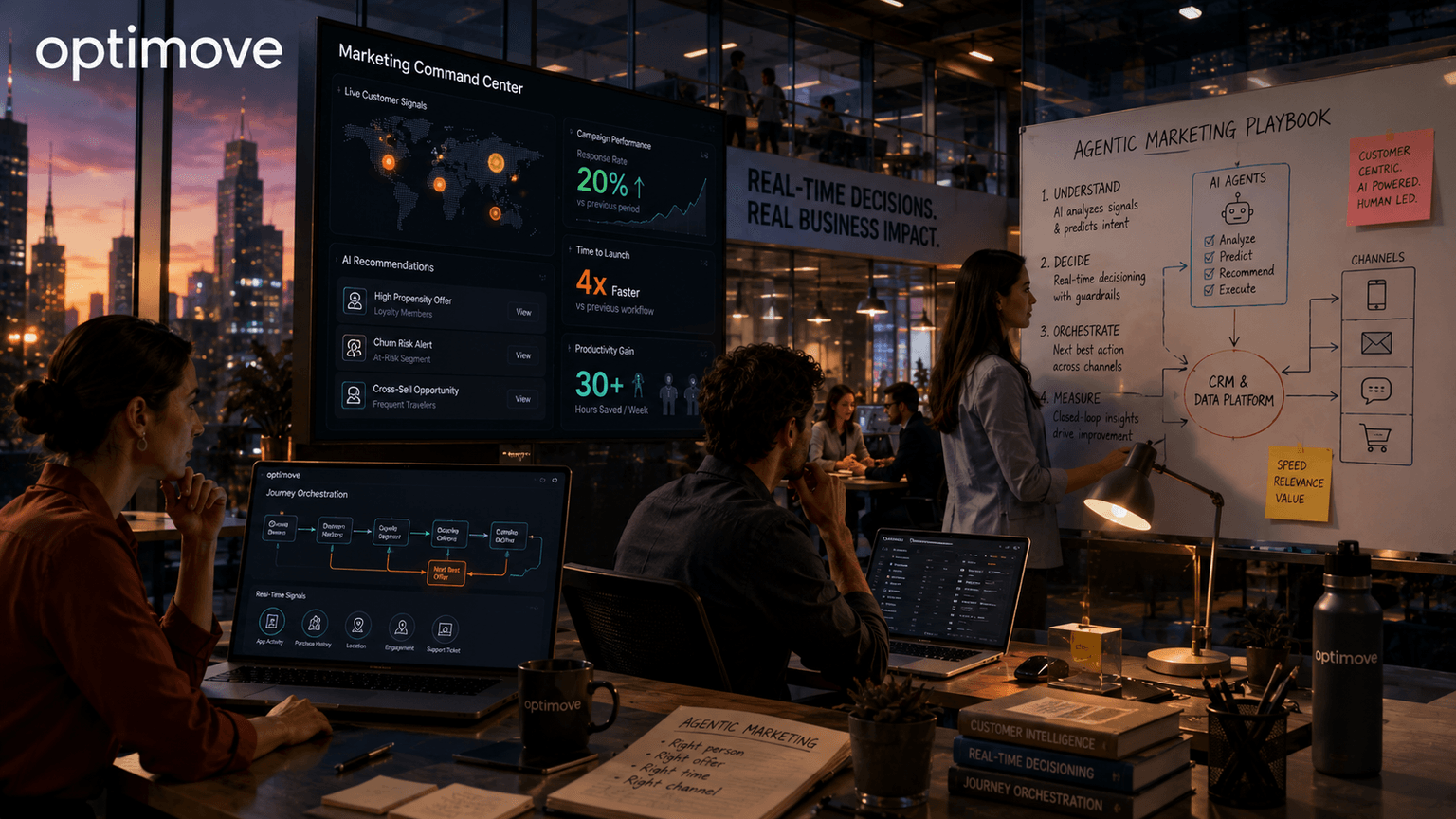
Optimove AI is betting that agentic marketing belongs inside a governed CRM and customer-data platform, where customer context, decisioning, activation, and measurement can stay connected. Marketing has spent a lot of money teaching AI to write. The harder job starts when the machine wants to interact with a customer.
AI is already eating 15.3% of marketing budgets, according to Gartner’s May 2026 survey of 401 marketing leaders in North America, the UK, and Europe. At the same time, only 30% say they’ve reached mature or fully developed readiness, despite 70% calling AI leadership critical. And nobody’s suddenly swimming in extra cash either. Marketing budgets remain at 7.8% of company revenue.
Getting a model to explain campaign results or suggest copy isn’t especially difficult anymore. The headache comes afterward. Is the audience right? Can you contact them? Did another campaign get there first? Did any of this actually make money?
The data problem is getting harder, too. Forrester’s March 2026 CDP analysis says AI adoption is increasing marketers’ need for accurate, complete, timely customer data as CDPs move closer to orchestration and activation. So Optimove’s idea of “Agentic Marketing” is interesting.
Optimove AI combines Native AI, an MCP for marketing, and Custom Apps, while keeping identity, approvals, customer journey orchestration, and measurement tied to the CRM. The question is whether an agentic CRM can turn ideas into controlled customer actions without creating fresh chaos.
TL;DR: Is Optimove Building the Future of Agentic Marketing?
- Marketing AI spending is rising faster than most teams’ ability to turn it into governed, customer-facing execution.
- Optimove AI connects Native AI, an MCP for marketing, and Custom Apps to one CRM execution environment.
- Optimove has credible proof for established decisioning and CRM workflows, while newer Native AI, MCP, and Custom App capabilities sit at different maturity levels.
- Buyers should test permissions, end-to-end latency, decision reconstruction, feature availability, and the portability of Optimove-owned Custom Apps.
Why Is Marketing AI Investment Still Failing To Reach Execution?
Marketing AI still struggles when the work reaches a real customer. Drafting is easy enough. The harder job is deciding who qualifies, what else they have seen, and how the result will be measured without losing the customer context that made the decision sensible.
Forrester Consulting’s May 2025 study commissioned by Optimove makes that hard to shrug off. Among 153 marketing decision-makers in the US and UK, 82% used AI for budgeting and planning, but only 14% used it to build audiences and segments. The survey predates Optimove AI, so it’s still a workflow benchmark rather than proof of the suite.
The headline adoption figure is less interesting than the 14%. Building an audience is where agentic marketing runs straight into real customer data, including records that don’t match, consent that changes, suppression rules, and campaigns somebody else has already sent. And teams are already struggling with that work.
The same study found 82% of marketers were getting insights too late to improve live campaigns. Another 80% still had to wait on data teams for audiences, and 76% said cross-team dependencies were slowing execution. Optimove’s August 2026 World Cup analysis puts that problem into sharper focus. Across roughly 26 million monthly active bettors, acquisition rose while bets per bettor fell. More people came in, but they weren’t necessarily doing more. A CRM that reads both as the same kind of growth is missing half the story.
Key Takeaways
- AI investment outpaces operational readiness.
- Audience creation and timely data remain choke points.
- Acquisition volume and customer value are different CRM questions.
- An AI decisioning platform matters when it can move from insight to action without loosening the controls around the customer.
What Is Agentic Marketing, And What Must The CRM Still Own?
Agentic marketing lets AI complete connected work against a defined goal, from finding an audience to preparing a journey or offer. The CRM still needs to own customer identity, consent, campaign history, eligibility, permissions, measurement, and the rules that keep automated decisions consistent when several agents are working on the same customer.
Calling a copy assistant “agentic” is marketing inflation. Assistance produces an answer. Workflow agents create usable objects inside the platform. Full execution means the system can coordinate decisions across customer journey orchestration, offers, timing, and channels while staying inside the company’s limits.
BCG’s June 2026 survey of 300 global CMOs found that 96% described AI as driving end-to-end marketing transformation. Yet 42% still used generative AI only for isolated assistance, and just 8% were running campaigns where several agents operated autonomously. That’s a remarkable confidence gap, even by marketing’s usual standards.
The CRM can’t become a passive filing cabinet while the agents roam elsewhere. Forrester’s March 2026 CDP analysis explicitly points toward agentic targeting, decisioning, and journey orchestration. In practice, the resolved profile, live behavior, permissions, suppression rules, journey priority, and control-group logic need to travel with the decision, not arrive afterward. Buyers should judge every AI decisioning platform on that ownership question.
Key Takeaways
- Agentic marketing begins when AI creates or coordinates usable marketing work.
- The CRM must remain the source of customer permissions and execution rules.
- Multi-agent autonomy is still rare, despite sweeping transformation claims.
- Agentic CRM needs a decision record buyers can inspect after the campaign runs.
Learn more about the future of AI in marketing in this guide.
How Does Optimove AI work across Native AI, MCP, and Custom Apps?
Optimove AI splits the work across three surfaces: Native AI inside the platform, the Optimove MCP for external AI clients, and Custom Apps for company-specific workflows. Each works from the same Optimove customer data, campaign, decisioning, and governance foundation, which is the important part for CRM buyers.
Native AI carries the main decisioning work. Optimove’s July 2026 guide lists Journey, Offer, Send-Time, Content, and Audience agents, while AI Decisioning Studio brings their activity into one strategy view. Optimove says its models process one billion real-time events a day across seven million campaigns annually.
The MCP goes beyond the usual ‘ask your CRM a question’ setup. Optimove’s July 2026 technical reference documents read access plus constrained safe writes for campaign building blocks and drafts. It inherits the authenticated user’s permissions, while campaign activation still requires a human inside Optimove.
Custom Apps tackle workflows that standard SaaS features don’t cover. Optimove says its AI Engineers build them inside the tenant on the same platform layers as the core product, then Optimove owns and maintains them. That’s convenient, although portability and exit terms deserve attention before an app becomes business-critical.
Availability is a bit uneven across Optimove AI right now. The July Native AI guide still has Product and Game Affinity in closed beta, with several other agents listed as coming soon. MCP is further along. It launched publicly in May, then picked up broader OpenAI, developer-tool, and Microsoft Copilot support in July.