
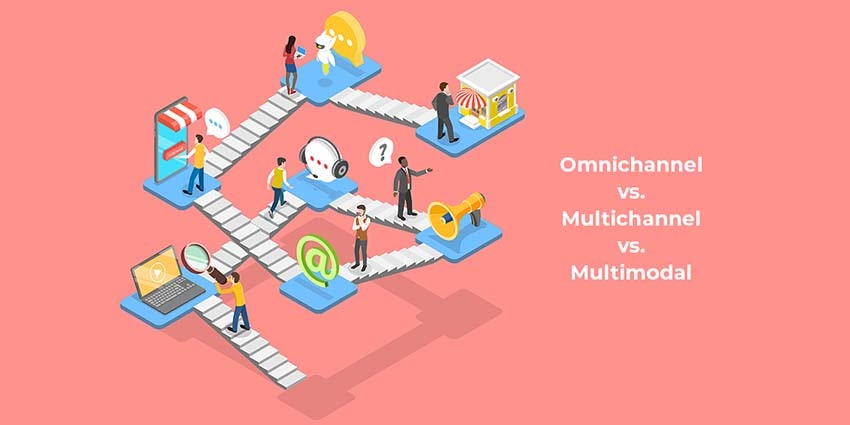
Many fear that omnichannel is overly complex and accept issues such as a lack of visibility into customer interaction history, clunky channel shift, and cumbersome technology additions.
Yet, many studies underline the value of omnichannel. For example, an Aberdeen Group report (via Internet Retailer) finds that companies with the best omnichannel customer engagement strategies retain an average of 89% of their customers. Meanwhile, those with weak approaches only retain 33%.
Perhaps there are other factors at play in this example. Nevertheless, it highlights the stark customer benefits of a closely considered omnichannel approach.
However, there are alternatives to omnichannel. These are multimodal and multichannel contact centers. All three strategies imply that a company is present across more than one channel. Yet there are three clear-cut benefits between each approach.
1. The Degree of Integration
Omnichannel - All channels are interconnected so that there is a single source of customer data informing every interaction.
Multimodal - There is partial integration between channels, as customers can interact via two channels simultaneously. But it is not possible to shift a conversation across all channels and maintain context.
Multichannel - There is no integration between channels. Therefore, customers enjoy the flexibility of choosing a convenient channel without any continuity in their experience.
2. Contextualised Support
Omnichannel – When switching between channels, the context of the conversation moves with the customer. As such, they do not have to repeat information.
Multimodal - Agents may move customers across channels during an interaction and continue a conversation. However, there is not a contextual trail. So, if the customer escalates a contact to a human agent, the rep will not have any information to work with.