
Nuance Communications is ending its support for its on-premise contact center IVR solutions.
While Nuance hasn't made any public announcements on the matter, its partners and customers have shared statements from the company with CX Today.
The first dates to the start of August, when Nuance gave the following announcement to insiders:
We will discontinue the sale of Nuance Enterprise hosted and on-premise license products on August 9, 2024. This decision supports our commitment to providing maximum value to our customers through Dynamics 365 Contact Center and Azure AI services.
Amongst those products is the Dialog module, which will most interest Nuance’s contact center customers. It forms the basis of many worldwide natural language, on-premise IVR implementations.
That module comprises of two primary solutions: Recognizer, an automatic speech recognition (ASR) engine, and Vocalizer, a text-to-speech (TTS) solution.
Now, CX Today’s sources have noted that "sustaining support" for these on-premise solutions will end in June 2026. Meanwhile, support for hosted offerings will end in December 2025.
The sources sent the following screenshot from a Nuance Product Availability Notice to confirm the validity of their comments.
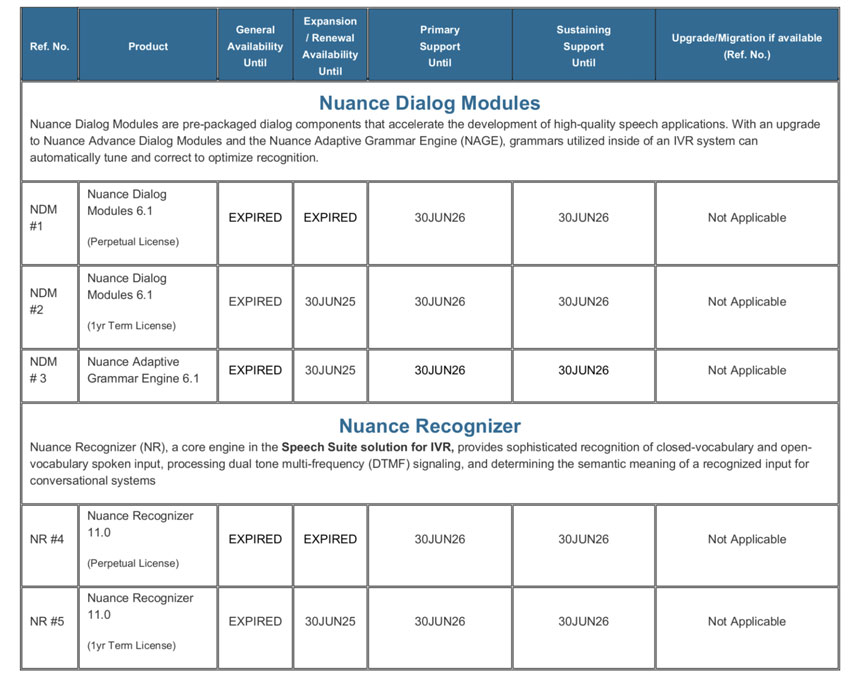
For its part, Nuance recommended customers turn to Microsoft Azure, the Dynamics 365 Contact Center, or Copilot Studio as upgrade paths.
That is unsurprising, given that Microsoft acquired Nuance in 2021 for $19.7BN. Since then, former Nuance employees have spearheaded the release of the Dynamics CCaaS platform.
However, customers have raised concerns over the limited upgrade options, the little guidance on actioning them, and the overall lack of transparency.
Sharing this feedback, David Macias, an Independent Contact Center Consultant, noted:
I've had on-prem customers where upgrades take over a year to perform. Having to switch out Nuance is going to be painful, and June 2026 just doesn't feel like enough time for some of these massive call centers and their self-service IVRs.
Nuance has historically attracted many of those massive contact centers as the market-leading on-premise ASR and TTS provider. It enjoyed that status for almost two decades since its 2005 merger with Scansoft.
With limited alternatives, it has established a deep contact center customer base, which has remained resolute, as estimates suggest two-thirds of contact centers are still on-premise.
While there are many next-generation providers based in the cloud, especially when it comes to TTS – think Deepgram, Otter.ai, and Speechmatics - Lumenvox is perhaps the only on-premise and hosted alternative with a robust market presence - and that company recently got acquired, too.
As such, these under-the-radar customer announcements have a significant global impact.
Nevertheless, Nuance has yet to provide a public statement on the matter, and its support for aiding customers after the end-of-life has proven minimal.
Macias hopes that will now change. "I would not be surprised if they are coming up with some "super deluxe super-secret super-expensive support" option due to all the backlash," he said.
But, it's Microsoft; they can probably irk a lot of people and not care, especially if it means more D365 (Dynamics 365) conversations.
CX Today has contacted Nuance for a comment but has not received a response.
On its website, Nuance now only houses healthcare AI and its Dragon dictations portfolio under its "solutions" banner as the contact center technology and voice AI stalwart slows its operations.
Why Now, and Now What?
Microsoft may have chosen this as the ideal moment to end-of-life Nuance Dialog as it shortly follows the Dynamics 365 Contact Center’s release. After all, it now has an offramp that some customers may consider.
However, it may also like to focus its energies on supporting the next generation of voice AI, which – as it's cloud-based – could offer the chance to lower support costs and expand margins.
The next generation of voice AI will leverage large language models (LLMs). The latest iterations of these LLMs – including GPT-4o and Gemini – can engage in conversation, share advice, and perform actions with little training.