

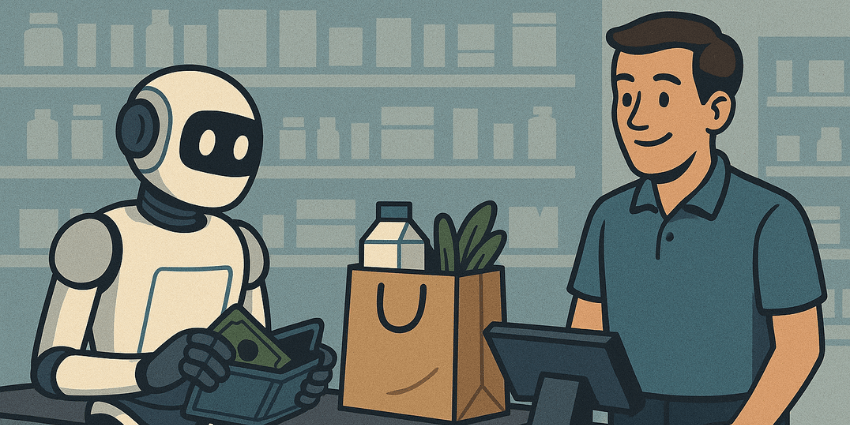
Sales never really stays the same for long, but we rarely experience a change as big as the one we’re encountering right now. Across industries, revenue leaders are discovering their customers don’t fit the carefully-designed profiles they built out for them anymore. In fact, a good percentage of them aren’t even human; they’re bots.
Machine customers and sales are officially colliding, and honestly, a good portion of businesses have no idea what to do. They’re used to human emotion being the biggest driver of buying decisions. So, what happens when one of the biggest opportunities of the next decade rests on connecting with machines? About 50% of CEOs are already sketching strategies for this new buyer persona, but they’re already behind.
"AI assistants are already shopping, making decisions, and skipping the traditional 'funnel' altogether."
Selling is starting to feel a lot less like persuasion and more like infrastructure management.
Further Reading:
- The 5 Superpowers of Copilots for Sales
- Sales Automation Without Sales Alienation
- Sales Team Upskilling for Enterprise AI Adoption
What are Machine Customers?
Our guide to machine customers covers all the essentials you need to know, but basically, machine customers are the new buyer every sales team needs to prepare for.
You might assume consumer bots are just nuisance traffic or scraping tools, but really, they’re actually systems that research, compare, and make decisions on behalf of real buyers. They’re not noise; they’re potential revenue wearing a very untraditional face.
That “potential revenue” is enormous. Gartner says machine customers will have direct influence over about $30 trillion in purchases over the next decade. That’s not a small number.
Right now, these tools come in a few different “species”. You’ve got personal shopping assistants, like Alexa, Siri, ChatGPT, and even Amazon’s assistant with the “Buy for Me” feature. Then there are IoT devices that shop for themselves, like printers that automatically order toners, or industrial machines that schedule maintenance as needed.
Plus, you’ve got the B2B “agents” that do all the work of comparing suppliers on price, SLA stability, ESG data, and delivery reliability, so actual humans can skip calls with sales teams entirely.
For now, most of these tools are still “human-led”, responding to directions given by real people. Soon, they’ll be as autonomous as your new AI coworkers, setting goals, adapting, and making real choices without a person’s input.
How Will Machine Customers Change the Sales Process?
Most sales leaders still believe the “buyer journey” starts when a human lands on their homepage. Unfortunately, the real journey now begins inside an AI tool that’s already sorted through ten vendors before your analytics even register a blip.
This is the part of machine customers and sales that feels genuinely disorienting: we spent decades fine-tuning messaging for humans, and suddenly, the first entity judging you might be a model that doesn’t care about brand voice at all.
From emotional selling to logic-driven buying
Humans can be talked into things by a good story, good rep, and good timing. Machines are immune to charm. They’re basically spreadsheets with spending power. They weigh your prices against your competitors’, watch your delivery performance like hawks, and keep score when your stock levels wobble. Miss too many beats, and you get buried in their ranking logic. No warm relationship will save you.
This isn’t a complaint; it’s a wake-up call. AI in sales isn’t just your internal tooling anymore. It’s the thing that evaluates you.
Gatekeeper bots: the new inbound channel
We’ve been talking about this for a while: your first touchpoint is increasingly a bot rummaging through structured data, API endpoints, FAQs, and product feeds. Humans show up later, if they show up at all. With AI assistants eating into discovery, traditional search is losing its gatekeeper status. Gartner and BCG are essentially predicting a collapse in organic search visibility as buyers lean into AI-recommended shortlists.
So the “inbound lead” isn’t your ad click; it’s whether an agent thinks your catalog is consistent enough to include.
Sales shifts from people to programming
Despite all this, reps aren’t disappearing. They’re just sharing the stage. Sales AI now has two audiences: your team and the buyer’s AI. Internally, tools keep shaving hours off admin. Externally, assistant-driven buyers are doing the early qualification. Since these agents care more about SLAs, uptime, and pricing logic than webinars or charm, sales teams have to team up with product, ops, and data folks to influence the signals that agents actually read.
Humans still close complex deals, navigate politics, and handle nuance. The machines just run the opening act, and sometimes, honestly, most of the middle too.
How Will Machine Customers Reshape Revenue Strategies?
The funniest part of this whole machine customers and sales shift is watching perfectly competent revenue teams wrestle with tech that hasn’t caught up. CRMs still capture data about “people”, which is important, particularly since most machine customers are still trained by humans.
But it’s naive to think that every lead is a person with a pulse.
Traditional scoring models treat every form fill, trial signup, and demo request as a warm human hand waving in your direction. Except now AI agents do all of those things because they’re benchmarking vendors. They just want clean data for their decision engine. Plus, since no one ever calls them back (because, you know, they’re not people), the funnel starts looking like it’s full of ghost buyers.
Then we have the issue of systems misreading AI behavior. Bots behave weirdly. They test pricing endpoints several times in a row, complete a “journey” in seconds, and repeat an order pattern with unnerving consistency. Some security tools treat this like hostile scraping; marketing automation often treats it like a VIP bingeing content.
Also, without a machine flag, routing goes wild, a procurement agent lands in a rep’s queue, the rep calls and emails into the void, and everyone wastes time. Worse: a high-value machine signal, like a new supplier test, gets lumped in with bot noise and ignored. Companies that don't distinguish human from machine traffic end up reporting nonsense funnel performance.
On top of all that, attribution is becoming harder and harder. The “first touch” might’ve been an AI assistant scraping your API for consistency. The “last touch” might’ve been a machine submitting the order at 3:07 a.m. None of that reality appears in a typical CRM.
How Should Cros Prepare For Machine-Driven Purchasing Decisions?
The most important thing to learn right now is that you can’t treat machine customers like “odd humans”. They’re programs doing exactly what they were designed to do. Unless you build a funnel that acknowledges their existence, your reports will keep lying to you.
Step 1: Add “machine identity” to your data model
First you need to admit that machine customers exist, and make sure both your employees and tech knows that. Your CRM needs a way to tell humans from machines, so add simple fields: customer_type, machine_type, parent_account, and some version of a confidence score. Once you see the patterns, everything else gets easier.
For authentication, treat machines with the same seriousness you’d give a human login. API keys, OAuth, mutual TLS, it depends on your maturity, but the point is control. A lot of leaders forget that machine identity is identity. Especially now that AI in sales workflows depends on clean, predictable signals.
Step 2: Expose machine-specific surfaces (APIs > forms)
Most websites are still built like every visitor is a human with a mouse. You still need to design for people, but remember that agents don’t care about your beautifully designed CTA. They want:
- Clean pricing,
- Stock data,
- Shipping rules,
- SLAs,
- And anything else that helps them rank suppliers.
If that information is hard to find or inconsistent, machines treat you like an unreliable narrator. A buyer’s assistant will happily skip right over you.
Step 3: Build machine-aware intent & lead scoring
The old scoring frameworks don’t apply to bots. A human reading three whitepapers in one night looks interested. A machine doing the same thing looks normal.
So break the scoring into two tracks:
Human scoring: opens, clicks, recency, multi-touch engagement.