
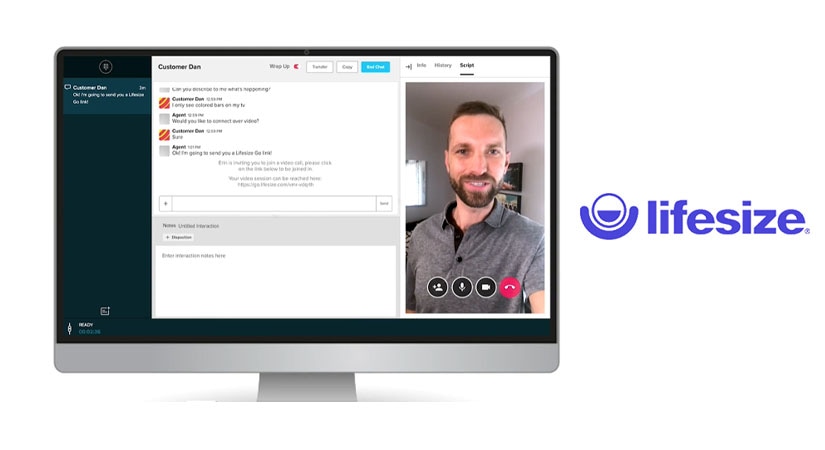
As the COVID-19 pandemic has caused people to stay at home, ruling out many traditional face-to-face interactions, the idea of enabling video in the contact centre is gaining traction. Video is being increasingly adopted for applications such as telemedicine but other markets are also starting to use video for activities such as title closing on house purchases and other legal procedures. These higher-touch virtual interactions have the potential to replace face-to-face meetings.
Other businesses are set to benefit, too. Organisations are trying to work out how to maintain social distancing for their workers and reduce “truck roll” to customers’ homes for maintenance and repair tasks that have the potential to be addressed by video. This not only protects workers but can substantially reduce operational costs for organisations.
To address these needs, Lifesize has launched CxEngage Video, a native video solution for cloud contact centres that enables agents to initiate video-based conversations from any support channel, including phone, email, chat, SMS and social media. CxEngage Video provides a single interface to enable organisations to deliver value-added remote services and is especially useful for complex interactions such as technical support, financial advice and telemedicine.

“You have people socially distancing everywhere and, at the same time, high quality video is available to fill the void,” said Bobby Beckmann, chief technology officer of Lifesize, the video conferencing specialist that merged with contact centre technology provider Serenova earlier this year. “For the call centre, use of video could be transformative and it will certainly enable organisations to save money.”
“People are far more willing to use video than they were and if you can offer chat, you can start to offer video,” he added. “If you’re on PSTN and you want to escalate to video, the challenge is how to do that cleanly – in the chat window, it’s super easy. In many cases that means not ending the call but keeping the audio going and opening a new channel on top of the audio.”