

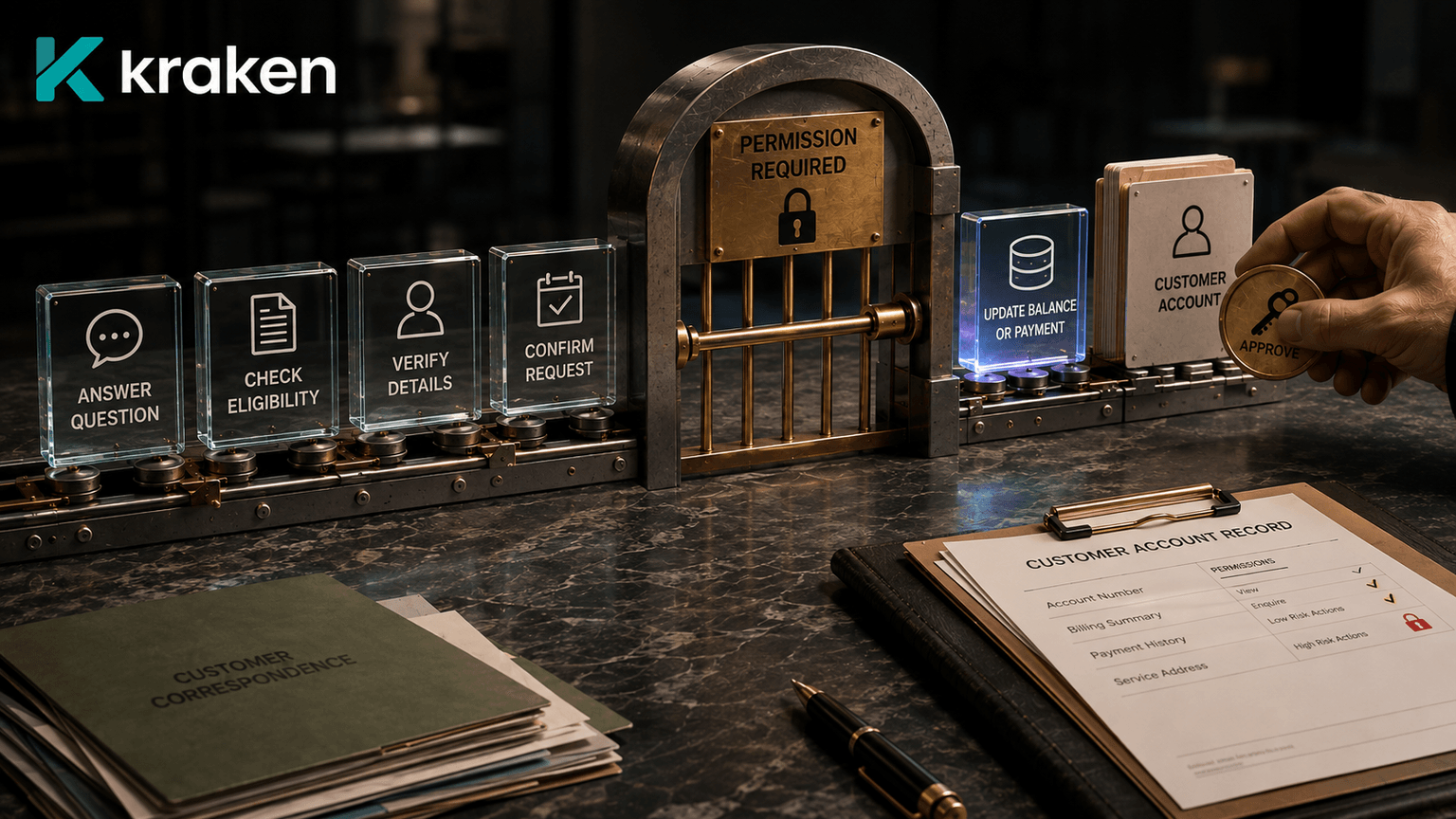
Kraken Autonomous Agents combines Sierra’s conversational AI with the Kraken utility platform’s customer, billing, meter, tariff, and workflow context. For shortlisted utilities, the decision rests on whether that generative AI service can be contracted, configured, governed, phased, stabilized, and measured without weakening customer protection or obscuring responsibility.
Autonomous agents are making their way into every contact center, even the more complicated ones, thanks to companies like Kraken. On June 11th, 2026, Kraken announced the launch of its Autonomous Agent platforms, specifically targeting utilities companies.
Currently, Kraken’s utility platform supports more than 90 million accounts in over 15 countries. In April, its Saudi Energy joint venture reserved licensing rights covering another 11.5 million accounts. The Autonomous Agents offer is still new, but Kraken and Sierra have already announced a four-week launch at an unnamed utility covering 1.3 million accounts.
That four-week claim makes the decision-to-deployment question unusually important. Buyers need to know what was live, which actions were enabled, how exceptions reached people, what stabilization was required, and which results survived after launch. Without those answers, speed is evidence of a release, not proof of a completed CX transformation.
Related Articles
TL;DR: What Should Buyers Know Before Deploying Kraken Autonomous Agents?
- Kraken’s scale is real and growing: 90 million+ accounts across 15+ countries, plus a Saudi Energy JV (April 2026) reserving rights to another 11.5 million.
- The Sierra partnership shows real deployment speed: Autonomous Agents went into production at an unnamed major utility within four weeks, covering 1.3 million accounts.
- Phased migration is non-negotiable, not optional: timelines range from Ergon Energy's 185 business days (750,000 accounts) to Origin Energy's 2.5 years (4.2 million accounts).
- The gap: most published results (Origin's $170M cost-to-serve cut, Ergon's 90% Happiness Index rise) come from Kraken's own case studies, with baseline and staffing details not always disclosed.
- How Should Utilities Evaluate a New Customer Platform?
- What Should Be Agreed Before a Utility Platform Contract Is Signed?
- What Resources Are Required for a Utility Platform Implementation?
- Why Are Utility Customer Migrations Completed in Phases?
- What Happens During Utility Platform Stabilization?
- What Must Be in Place Before AI Agents Can Act on Customer Accounts?
- How Should Utilities Measure Platform Implementation Success?
- FAQs
How Do the Kraken Utility Platform, Agentic Customer Service, and Autonomous Agents Fit Together?
The Kraken utility platform is the operating foundation, while Kraken Agentic Customer Service is the AI portfolio built on top of that foundation. Within the portfolio, Human Assist supports employees, and Kraken Autonomous Agents handle customer-facing journeys. Open Kraken provides a separate route for approved third-party AI agents and applications.
Kraken Customer is the AI-powered system sitting at the center of the utility platform. It brings together the customer account, tariff, meter history, bills, payments, contact history, and service record. Kraken also offers separate products for field operations, networks, generation, and energy flexibility.
| Kraken layer | Role | Why it matters |
|---|---|---|
| Kraken utility platform | Wider utility operating environment | Connects customer operations with billing, field work, networks, generation, and flexibility. |
| Kraken Customer | Core customer platform | Supplies the account data, workflow context, and approved actions AI tools need. |
| Agentic Customer Service | Umbrella AI portfolio | Includes Human Assist and Autonomous Agents. |
| Human Assist | Employee-facing AI tools | Supports drafting, summaries, knowledge retrieval, and complaint handling. |
| Autonomous Agents | Customer-facing agents built with Sierra | The specific product evaluated in this article. |
| Open Kraken | Third-party AI access through MCP gateways | Lets approved external agents and applications connect to Kraken capabilities. |
Autonomous Agents is the feature launched in collaboration with Sierra on June 11, 2026. Sierra provides the conversational layer, while Kraken supplies utility-specific context and access to approved actions. That combination can move service beyond drafting and summarization, but only across journeys the utility has configured, governed, and tested.
Assaf Biderman, Kraken’s Chief AI Officer, said in the June 11 launch announcement: “Energy is too important, too complex and too urgent for generic AI.”
Autonomous Agents only earn their place if Kraken’s context produces a better answer and the utility’s controls stop the agent from stepping beyond its authority.
Key Takeaways
- The Kraken utility platform provides the operating foundation, with Kraken Customer supplying the customer data and workflow context.
- Kraken Agentic Customer Service is the wider AI portfolio; Human Assist and Autonomous Agents serve different users and shouldn’t be treated as the same product.
- Autonomous Agents is the customer-facing product under review, while Open Kraken is a separate extensibility route for third-party AI.
How Should Utilities Evaluate Kraken Autonomous Agents?
Utilities should test Kraken Autonomous Agents on the journeys customers and employees already find painful, using their own data, rules, teams, and exceptions. A worthwhile proof of concept checks whether identity, account history, billing logic, permissions, escalation, and audit records hold together when the customer switches channels or explains the problem badly.
Start with a disputed bill, failed payment, missing meter reading, complaint, vulnerability flag, or complex account change. Then have operations build the journey, alter a rule near the billing date, and show what happens when the agent lacks permission or receives conflicting information.
Buyers also need a hard line between software they can deploy and features they’ve seen on a roadmap. Product Studio is available. Kraken’s Bill Editor remains in development, while its wider AI access layer is still described as forthcoming. Those distinctions affect the utility platform implementation plan, contract value, and expected launch date.
The best evaluation asks whether customer journey management still works when the neat path breaks. That’s the moment a utility CX transformation either starts to look credible or begins collecting expensive footnotes.
Key Takeaways
- Test the proof of concept against real, uncomfortable journeys: a collections change close to a billing date with an open complaint attached.
- Bill Editor and the wider AI access layer are still in development or forthcoming, not currently deployable, confirm what's actually live before pricing them in.
Learn more about the complexity of customer journey management here.
What Must Utilities Agree Before Signing for Kraken Autonomous Agents?
Before signing, utilities should define the first journeys, channels, customer cohorts, data fields, permitted actions, approval thresholds, and evidence required to expand autonomy. The contract must separate configuration, shadow testing, first live use, stabilization, and scaled rollout, while assigning responsibility across Kraken, Sierra, the utility, integrators, and relevant subprocessors.
Use separate contractual milestones for configuration complete, shadow mode passed, first customer live, stable operations, expanded action rights, and scaled rollout. One broad “go-live” date lets each supplier claim success at a different point. Any Kraken Customer migration, payment change, or other platform work should remain a named dependency rather than disappearing inside the Autonomous Agents milestone.
Supplier boundaries still matter. Kraken’s April 16, 2026 subprocessor list names cloud, monitoring, communications, AI, and support providers, including Sierra for conversational AI. The contract should specify applicable providers, processing locations, retention, optional services, audit access, incident response, service levels, and notice requirements when that chain changes.
Put these five answers in writing before giving a signature:
- Which journeys, channels, languages, actions, and customer cohorts are included in the first release?
- Who approves action rights, policy changes, models, prompts, and new cohorts?
- Who investigates, reverses, records, and reports an incorrect action?
- What evidence must be met before human approval is reduced?
- Can the utility export conversation history, evaluations, audit records, and journey logic on exit?
What Teams and Data Are Required to Deploy Kraken Autonomous Agents?
Deploying Kraken Autonomous Agents needs senior owners across customer operations, billing, metering, data, payments, security, privacy, compliance, workforce, and technology. It also needs verified identities, current account context, approved knowledge, vulnerability and complaint flags, tested exception paths, and employees who can take over immediately when the agent reaches its authority limit.
Kraken’s configurable tools can reduce some development work, but they cannot decide tariff logic, debt policy, vulnerability treatment, complaint handling, or who owns a broken journey. Each journey needs one accountable business owner and named configuration owners for thresholds, permissions, approval routes, and customer communications.
A utility can launch a bounded agent faster when Kraken Customer is already stable. Where the AI project depends on a wider platform migration, resource needs rise sharply. Capita’s March 2026 case study says it mobilized 77 people in one week and added another 100 FTE during an unnamed Kraken migration, exposing the support burden that can sit beneath an apparently simple AI release.