

Kore.ai has launched an "industry-first" dedicated generative AI (GenAI) application platform: GALE.
GALE empowers enterprises with a playground to build, test, and optimize GenAI applications that augment and transform business processes.
While Kore.ai is best known for its Magic-Quadrant-leading XO conversational AI platform, which is often implemented within contact centers, the use cases for GALE are much broader.
Indeed, enterprises can use the platform’s no-code interface to develop apps that streamline business-wide operations, increase productivity, and/or deliver enhanced customer experiences.
That goes far beyond customer service functions, as businesses may also build apps that streamline supply chain management, resource management, finance, etc.
Such apps may facilitate significant, long-term business value. However, GALE will also help in the delivery of disposable applications, which are speedily developed software apps that temporarily serve a specific purpose.
Businesses can build these for all types of use cases, such as provisional email services, outreach campaigns, or data transformation initiatives.
In addition, they may leverage, customize, and action preconfigured templates for generating conversation summaries, retail and sales content, email campaigns, and more.
Yet the possibilities extend much further, with Kore.ai referring to the platform as the "Swiss Army knife of the enterprise" not only because of its high ease of use but also because of its broad application.
What’s Inside the GenAI Playground?
GALE has four foundational elements: a no-code flow builder, Model Hub, Prompt Studio, and AI Agents.
The flow builder serves up a drag-and-drop flow interface – as shown below – to accelerate the creation of complex workflows and apps while lightening the developer load.
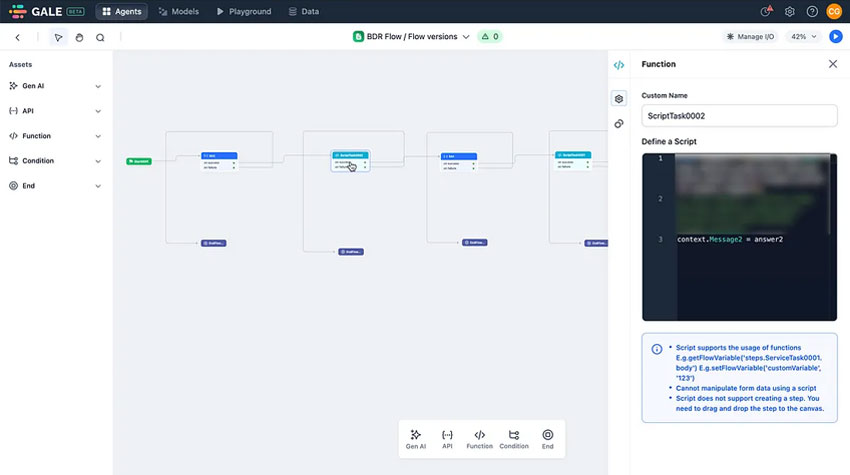
After designing those workflows and apps, users can leverage the Model Hub to apply, test, and refine their chosen GenAI model.
In doing so, they can choose from 30+ LLMs, including community, open-source, and finetuned models. Moreover, the vendor allows users to apply different models to different apps to optimize their performance.
The Prompt Studio also enables performance optimization – even across its library of preconfigured use cases – by allowing brands to create their own prompts and tailor GenAI outputs.
In addition, the Studio allows developers to test the performance of each prompt by utilizing in-house data for further enhancement.
Lastly, AI Agents help automate complex tasks within apps and workflows.