

Every year, leading contact centre research firm ContactBabel releases The UK Customer Experience Decision-Makers’ Guide.
The report dissects many aspects of CX in the UK, considering strategy, performance, operations, and technology.
Indeed, the analyst surveyed 218 senior CX and customer contact professionals between April and June 2022, alongside 1,000 UK consumers, to do precisely that.
As a result, ContactBabel – with the support of sponsors, including Enghouse Interactive – unlocked many thought-provoking insights.
Perhaps the most pertinent spotlight critical drivers of positive contact centre experiences.
What Drives an Excellent Contact Centre Experience?
Within the report, ContactBabel asked UK consumers: What are the top three most important factors to you when contacting an organisation by phone or digital channel?
Here are the results, with the various colours representing a specific age range.
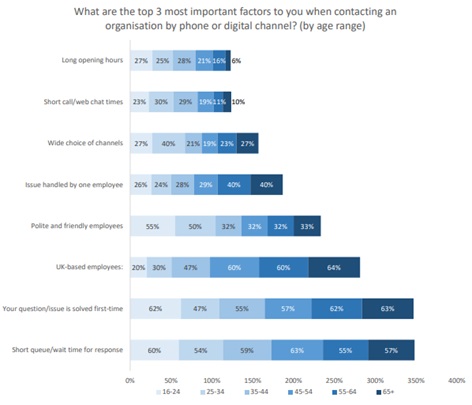
While fascinating in isolation, these findings become more enlightening when contrasted with the graph below. Here, CX professionals rank the same criteria in terms of their perceived importance to the customer.

By comparing and contrasting these graphs, many discrepancies emerge. Highlighting one prominent example, Steve Morrell, Managing Director of ContactBabel, states:
“The research shows that having UK-based employees is far more important to customers than many businesses believe, especially in the eyes of the older generation.”
Alternatively, it seems that businesses perhaps place too great an emphasis on ensuring only one agent handles an issue, alongside channel choice.
Thankfully, however, when it comes to what matters most to consumers, everyone is on the same page: first-time resolution (FTR) and short wait times drive the best contact centre experiences.
First Time Resolution Quandaries
Almost 90 percent of consumers consider FTR a critical element of the customer experience, placing it in their top three most important “factors”. Meanwhile, 54 percent of businesses believe it is THE most significant element of the contact centre experience.
However, brands often struggle with FTR – sometimes referred to as FCR (first contact resolution) - for three reasons. Each may contribute to the metric’s decline, as evident in the chart below.

First, it isn’t easy to track. Yes, there are many methods of measuring it, including monitoring repeat contacts, asking customers if the agent resolved their issue, and running a quality assurance initiative. However, each has significant downsides.
Second, as few as seven percent of senior executives consider FTR their most critical CX metric. As such, few operations reward and incentivize the metric – instead turning to customer satisfaction (CSAT) or the net promoter score (NPS) as their North Star KPIs.
Morell pinpoints issues in this approach, stating:
NPS and CSAT denote the what, not the why. Why are customers satisfied? We must look at what drives these two metrics, not the headline figure. Maybe that is getting their issues dealt with the first time.
Finally, FTR is also tricky to benchmark. Why? Because the plethora of methods to measure the metric often make external benchmarking data unreliable. Nevertheless, internal FCR benchmarking does sometimes deliver actionable insights.
3 Best Practices to Boost First Time Resolution
Overcome the three quandaries above by following these FTR best practices.
1. Harness Analytics for FTR Calculations
According to ContactBabel’s study, CX professionals consider automated interaction analytics the best FTR measurement method, with 51 percent describing it as "very useful".
Such a method detects the customer’s intent to see if it is the same as recent, previous interactions.
With this, contact centres can also surface insights, such as which contact reasons are causing the most callbacks. Then, they can take targeted actions to reduce FTR.
2. Assess Broken Journeys
After isolating the contact centre journeys that often result in repeat contacts, analyse the troublesome queries to find the root cause.
Hopefully, contact centres can isolate and fix the issue. Yet, if there is no easy solution, focus on providing agents with the necessary guidance to deliver the best possible customer outcomes.
3. Seize a Hold of Subject Matter Expertise
Swarming techniques connect the contact centre with subject matter experts (SMEs) across the enterprise, enabling agents to tap specialist insights and resolve more queries. UCaaS-CCaaS integrations – such as Microsoft Teams and Enghouse Interactive – allows this.
Also, asking SMEs to add and update content within the knowledge base is an excellent step to support agents with easy access to expert advice.