ISG has released its latest Buyer’s Guide for customer experience management.
As customer acquisition costs climb and retention becomes the more defensible commercial play, the old model of running contact center, marketing, and sales as separate functions with separate tools and separate KPIs is looking increasingly expensive. Boards want a unified view of the customer.
Customers want a seamless experience across every touchpoint. And the technology market is responding accordingly.
Customer experience management (CXM) has emerged as the category trying to bridge that gap.
Rather than its own product, CXM is an enterprise platform play, pulling together interaction handling, analytics, journey management, automation, and resource management into something coherent enough to actually serve the full customer lifecycle rather than just one slice of it.
The platforms competing in this space have arrived from very different directions: contact center infrastructure, marketing automation, CRM, and analytics.
ISG's 2026 Customer Experience Management Buyers Guide is one of the more rigorous attempts to assess how far each has actually traveled toward a genuinely unified capability, running the rule over 28 vendors across both product depth and customer experience quality.
Providers evaluated include Adobe, Genesys, Microsoft, NiCE, Oracle, Salesforce, SAP, ServiceNow, Sprinklr, Talkdesk, Verint, Zendesk, Zoho, and Freshworks, along with a range of more specialized platforms.
To qualify, vendors needed at least $100 million in annual revenue, operations across at least two continents, a minimum of 50 customers, and meaningful functionality across at least three of four core competency areas:
- Resource management
- Automation
- Analytics
- Customer journey management
Below are the six takeaways most relevant to CX, contact center, and customer service leaders.
1. Salesforce, NiCE, and Oracle Take the Top Three Spots
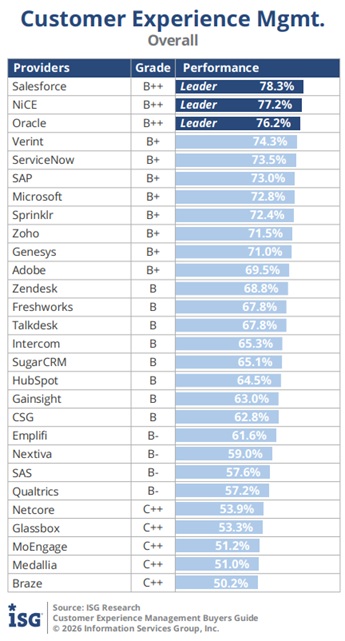
Salesforce topped the overall rankings with a 78.3% score and B++ grade, followed by NiCE at 77.2% and Oracle at 76.2%. All three were designated Leaders across the study.
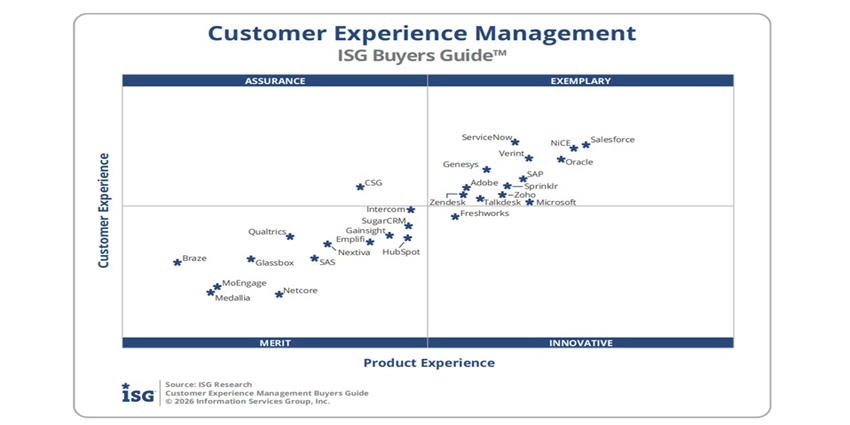
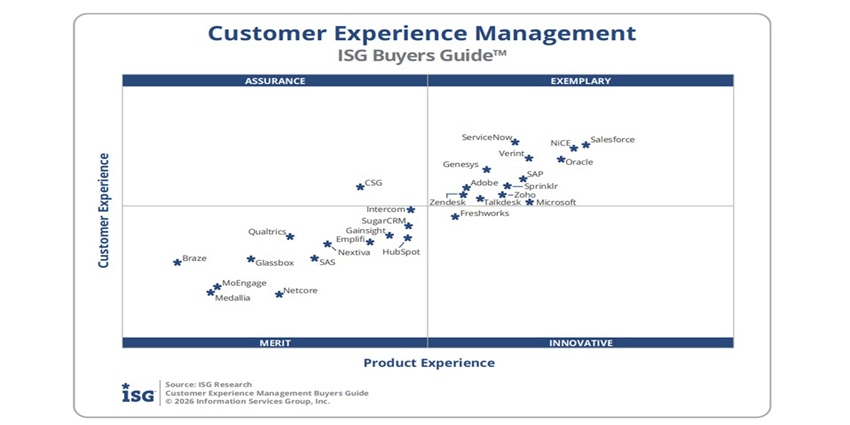
The Leaders were three of thirteen vendors that earned the top “Exemplary” classification, placing above the median on both Product Experience and Customer Experience: Adobe, Genesys, Microsoft, NiCE, Oracle, Salesforce, SAP, ServiceNow, Sprinklr, Talkdesk, Verint, Zendesk, and Zoho.
Elsewhere, Freshworks was the only “Innovative” provider, scoring above median on Product Experience but falling short on Customer Experience; CSG earned "Assurance" status for the reverse; while thirteen providers, including HubSpot, Medallia, Qualtrics, and Intercom, were classified as "Merit."
Salesforce led in five individual categories; NiCE led in four; Oracle in three.
That concentration at the top reflects the extent to which a small group of platforms has pulled ahead on enterprise-grade architecture and the breadth of capability that large organizations actually need, while much of the field is still playing catch-up.
2. CXM Is Being Repositioned as Revenue Infrastructure
Perhaps the most consequential framing in the 2026 guide is the language around why enterprises are investing in CXM.
As customer acquisition costs have risen, the commercial logic has shifted toward retention and expansion. The report captures this directly:
“CXM software is increasingly positioned as infrastructure for revenue enhancement rather than a collection of cost-center tools.”
That is a significant reframe, particularly for contact center leaders who have spent years fighting budget battles on the back of cost-per-contact metrics.
The guide makes the case that the convergence happening across contact center systems, marketing automation, customer data platforms, and analytics is a commercial play as much as a technology one.
The vendors that have grasped this shift are building accordingly. Those that haven't, particularly those still optimizing around individual interaction handling rather than the broader customer lifecycle, are likely to find the gap closing between themselves and the Exemplary tier harder to bridge.
3. Agentic AI Is the New Baseline, and Governance Has Become the Differentiator
AI appears throughout the 2026 guide, but the discussion has matured since previous years. The emphasis is no longer on whether platforms support AI; it is on the depth and reliability of that support.
As the report puts it: “As generative and agentic AI evolve, CXM platforms are increasingly expected not only to recommend actions but to execute them within defined constraints.”
That shift to execution, rather than recommendation, carries real implications for contact centers. Automation of service requests, routing, proactive engagement, and real-time agent guidance is increasingly expected to operate within guardrails rather than requiring a human sign-off at each step.
Getting there requires data quality, compliance infrastructure, and governance frameworks that many platforms are still building out.