
Since its inception in 2003, the Net Promoter Score (NPS) has been a constant fixture in many customer experience reports, internal and external.
However, lately, more and more customer experience leaders are questioning whether it’s still fit for purpose.
In particular, the long-held belief that NPS can predict long-term loyalty and future revenue growth has been called into question.
A recent study from the Journal of Empirical Generalisations in Marketing Science analyzed data across four industries (automotive, supermarkets, airlines, and fast-food restaurants) over a ten-year period. The results are on display below.
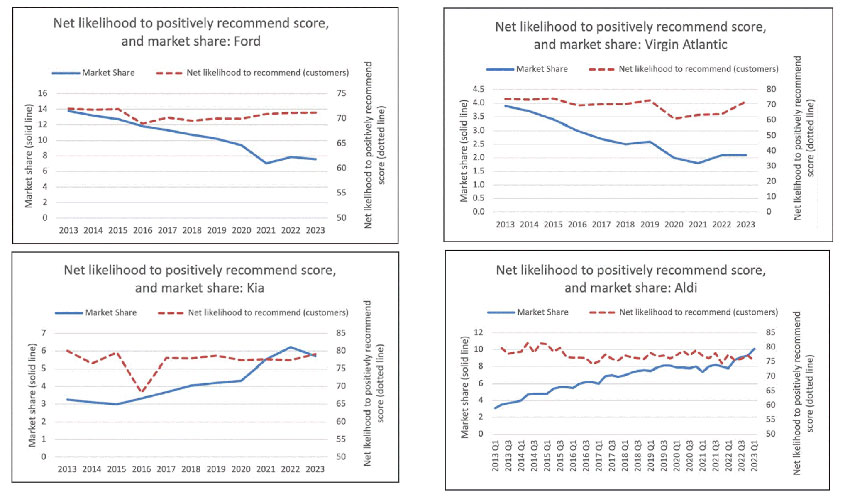
The research concluded that there is "no clear association between likelihood to recommend (positive or negative) scores for firms, and their future growth or decline across the four categories.
"The managerial implication is that firms should be wary of predicating growth on high or improving recommendation/NPS scores."
In a LinkedIn post referencing the study, Vikkas Mittal, Faculty Director of the Center for Customer-Based Execution and Strategy at Rice University in Houston, questioned CEOs who are still championing the importance of NPS. He wrote:
It's not strange that NPS doesn't predict financial performance. It is strange that CEOs and senior executives using legacy strategy planning continue to defend NPS and cling to it!
Mittal believes that MBAs, CEOs, and senior executives need to take greater responsibility.
He implores them to take steps to fully understand the complexities and nuances of business research instead of rushing to oversimplified conclusions.
"They will benefit from becoming thoughtful users of science that improves strategy," he explained.
Unsurprisingly, Mittal’s post caused a stir, with the majority of people seemingly agreeing with the Faculty Director’s broader point.
However, some people did step in to defend the metric.
Peter Verhoef, Dean of the Faculty of Economics and Business at the University of Groningen, agreed that too much emphasis is given to the relationship between NPS and long-term value, but argued that NPS can still be useful when deployed as a metric to "observe if firms create sufficient value to customers."
So, let’s take a closer look at why NPS is so popular amongst CEOs, why it is less popular amongst many CX professionals and analysts, and what organizations can use instead.
Is NPS Fit for Purpose?
In order to fully understand the pros, cons, and differences surrounding NPS, it’s important to first outline precisely what it is.
For such a prominent CX metric, NPS is surprisingly simple.
It is a single-question metric: "How likely are you to recommend this product or service to a friend or colleague?" Rated on a scale from one to ten.
For Justin Robbins, Founder and Principal Analyst at Metric Sherpa, it is this simplicity that makes NPS so popular.
Speaking on an episode of CX and Coffee, Robbins explained that NPS "has boardroom appeal. It’s flashy. It’s digestible. You can say, "We went from a 43 to a 67!" and that sounds like progress," he explained.
Yet, Robbins has two main issues with NPS.
First, the question is too vague. While he concedes that some companies include an open-ended question that does allow customers to provide more details, in general, the feedback is too broad to help companies implement specific improvements.