

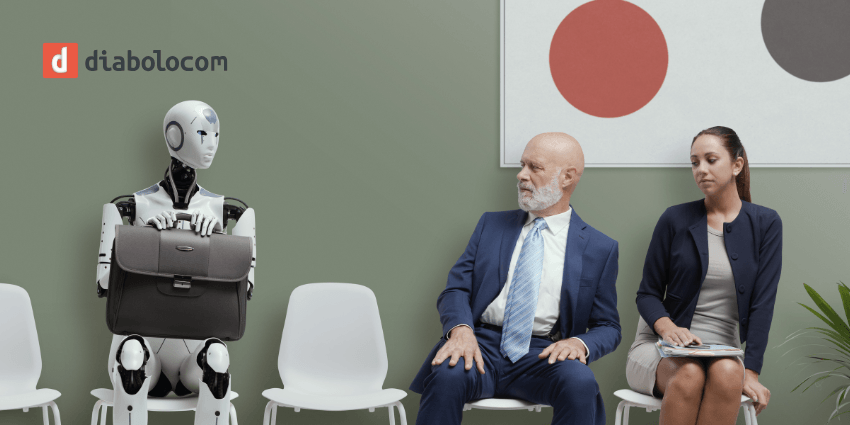
Whether it’s novels, music, or films, the story of futuristic tech taking over society and replacing humans is well established.
Given how embedded this trope is within pop culture across the globe, there’s no real surprise that the recent rise of AI has been met by many with fear and concern.
Indeed, even within the CX world, discussions about AI inevitably circle back to this same fear: ‘Will it take my job?’
Of course, with the rapid rise of AI and the complexity of contact center environments, it’s not always easy to cut through the noise and clearly understand what AI can, and can’t, realistically do.
For James Scott, Senior Solutions Engineer at Diabolocom, the ‘replacement’ framing overlooks the reality of how AI is built and deployed.
“Every AI model that you’ve ever worked with would not be useful and would not be applicable without the humans that were involved in training and designing it,” he says.
In short: the data, the behavioral guardrails, the required context; none of it exists without people.
Because of that, Scott does not believe CX will ever operate under fully autonomous systems.
“I don’t believe you’ll ever have a fully self-governable AI. And I don’t even think you would want that because you don’t want AI making the decisions on how AI behaves.”
CX outcomes still fall on human shoulders. If an interaction goes wrong, regulators and customers look to the organization and its people, not its models.
“You can’t hold an AI legally accountable for anything because it’s not a human,” Scott says. “The buck should always stop with the human in the loop.”
That idea is at the center of a sustainable AI strategy – one where humans and AI reinforce one another rather than compete for control.
AI-Empowered Agents: The Foundation of Sustainable CX
When it comes to AI in the contact center, many of you will be familiar with the phrase ‘human in the loop’.
In practical terms, it involves a human expert or experts who review responses, guide improvements, and monitor whether AI is meeting its intended purpose.
Rather than making educated assumptions and/or drawing theoretical conclusions, the ‘human in the loop’ strategy ensures that insights are gathered from supervisors and agents who observe how the technology behaves in real conversations and where interpretation gaps appear.
While Scott understands the origins of the ‘human in the loop’ concept, he believes that the phrase is no longer fit for purpose.
Instead, he argues that companies should view it more as a mutually beneficial relationship, where AI can empower the best agents and vice versa.
“The success of the AI is dependent on how well it’s implemented,” Scott says.
“The model can be good, the model can be bad… but it is only through humans identifying what it does well and what it doesn’t do well that the model is going to reach its maximum potential.”
This is where a particular group of employees becomes essential: the “glue employees” who hold operations together.
The Rise of Glue Employees
Glue employees may not have a formal AI title, but they understand processes, context, and team dynamics better than anyone. They connect departments, flag issues early, and steady the operation during change.
According to Scott, they also share another trait:
“Glue employees tend to be very informed and measured about what AI can and can’t do,” he says.
These are the people who take time to understand how AI actually works: how a scoring model evaluates sentiment, what transcript signals it reads, and where it might misinterpret nuance.
He emphasizes that organizations must move beyond generic descriptions, such as “ChatGPT for contact center.”
Instead, leaders should explain the mechanics: “This model is going to parse a transcript. It’s going to look at the words, and it’s going to look at the waveforms… and determine sentiment, answer a question, or evaluate criteria.”
Once employees understand how a model behaves, they also learn “where you might notice that the model is not doing what it needs to do.”