Organizations are centralizing data from across customer-facing functions, like service, sales, and marketing.
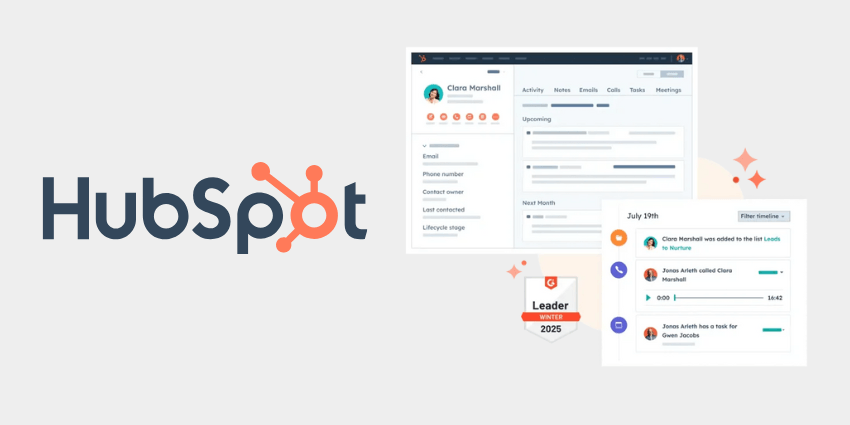
HubSpot Smart CRM provides the ecosystem to do this, aligning and integrating the vendor's six CRM apps or "Engagement Hubs".
Those hubs span marketing, sales, service, content, operations, and commerce, each storing valuable customer journey data.
In bringing them together, HubSpot converges departmental data and helps develop a single pane of glass customer view.
With cross-hub AI-powered features (now enhanced by HubSpot Breeze) and integrations with more than 1,500 third-party apps, Smart CRM is central to HubSpot's go-forward strategy.
What Is HubSpot Smart CRM?
HubSpot Smart CRM is a platform that unifies customer data, teams, and apps within a single ecosystem.
By connecting HubSpot's individual hubs, Smart CRM ensures there are no gaps between customer-facing teams or complex configuration requirements.
Instead, the vendor aims to offer every business a straightforward, intuitive platform to enhance every aspect of the customer journey.
Yet, not only that, Smart CRM converges data between CX teams, enabling a "single source of truth". As such, teams share the same up-to-date information, ensuring seamless collaboration.
Plus, these teams get access to end-to-end solutions for developing and automating more cross-departmental workflows.
In 2024, HubSpot released its Breeze suite to enable such automation, which is fully integrated into its Smart CRM. Breeze comprises a copilot, AI intelligence solution, and preconfigured agents.
Alongside this, HubSpot's Founder and CTO Dharmesh Shah is developing an agentic AI platform (Agent.AI) that - ultimately - he hopes the CRM stalwart will pull into its portfolio.
Already, this has over 500,000 users and may eventually help Smart CRM customers extract more value from their customer experience ecosystem.
HubSpot Smart CRM: The 6 Engagement Hubs
HubSpot Smart CRM encapsulates the vendor's six Engagement Hubs, all of which align with the same integrated database and AI tools.
Here’s some quick-fire insight into what each hub has to offer.
Marketing Hub
HubSpot first came to market to deliver "inbound marketing" software designed to streamline campaign management, amplify lead generation, and boost customer engagement.
Yet, since its early days, the CRM app has advanced significantly, with everything from Ads software for PPC campaigns to bulders for free online forms, landing pages, and newsletters.
Other key features include:
- Blogging software with integrations for website builders
- A dedicated IP address and email campaign tools
- Lead capture software and forms
- Ad management for platforms like Google Ads
- Marketing automation and campaign management
- List segmentation and lead tracking
- SMS marketing software
- Social media management tools
Additionally, marketing teams can identify and score leads, create hyper-personalized omnichannel campaigns, and access specialized SEO software.
Then, with HubSpot Breeze, marketers gain access to AI features for generating campaign strategies, monitoring results, and creating captions, emails, and content in seconds.
There’s even a pre-built Breeze Social agent, which leverages AI to manage entire social media campaigns on behalf of teams.
Sales Hub
The Sales Hub within the HubSpot Smart CRM is an all-in-one solution for managing sales processes, spotlighting critical insights, and leveraging automation.
Indeed, teams get various tools for managing tasks, payments, and customer profiles, alongside sending emails and outreach to prospects. Other features include:
- Communication tools, such as VoIP software, email, and live chat
- Prospecting and lead management software
- Free meeting scheduling tools
- CPQ software and payment management
- Sales reports and performance management tools
- Sales automation sequences
- Sales and deal pipeline management
Like all of the other engagement hubs in HubSpot’s CRM suite, the Sales Hub has plenty of AI-powered features.
Companies can use AI for forecasting and lead qualification or to create content for personalized outreach messages.
Finally, there's an AI-prospecting agent available through Breeze, which helps teams focus their outreach efforts on decision-makers and high-quality leads with in-depth insights.
Service Hub
When HubSpot introduced its Service Hub, it claimed to "reinvent" the traditional CRM app, unifying customer support and success strategies in a single environment.
While others have since followed suit, the solution's launch underlined its vision for a unified CRM environment. Ultimately, that led to the Smart CRM concept.
Service Hub includes the core tools teams need from a modern CRM, including a robust ticketing system, customer portal for self-service, knowledgebase software, analytical tools, and issue-tracking capabilities.
Additional features include:
- Omnichannel customer service
- Customer feedback software
- Customer success management tools
- SLA management solutions
- Service and support analytics
Again, AI plays a significant role within Service Hub, with HubSpot allowing customers to infuse pre-built AI agents with proprietary data, so they can autonomously handle every stage of specific ticket resolution processes.
These agents can also handle multi-stage queries around the clock, update CRM profiles, and more.
Plus, human agents can access tools like Breeze Copilot for instant suggestions and support during conversations with customers, helping them increase satisfaction and reduce churn.
Content Hub
Content Hub is the latest addition to Smart CRM, providing a centralized platform for content creation teams.
The CRM app builds on the core features of the Marketing Hub with unique tools for developing a brand voice and building online assets, like websites.