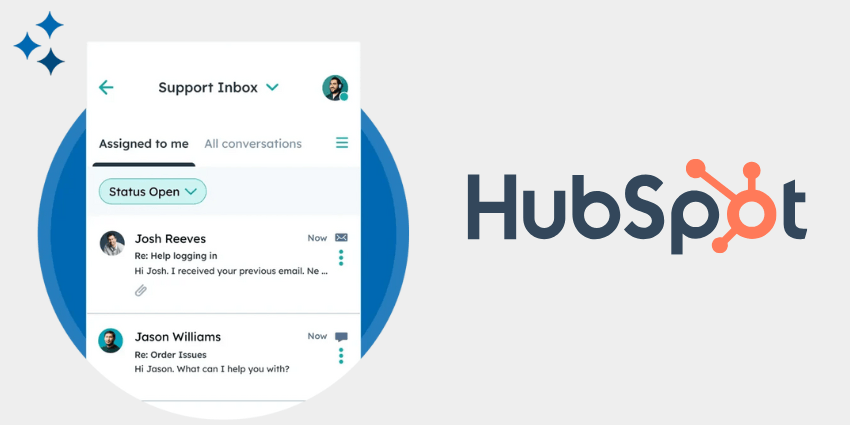
For decades, companies took a disjointed approach to managing customer experiences, with customer-facing teams functioning in silos.
HubSpot, one of the world’s leading CRM providers, decided to change that with the release of Service Hub.
Introduced in 2018, Service Hub aligns closely with Sales Hub to help unify the work of two critical CX functions: customer service and sales.
Since then, Hubspot has released its "Smart CRM" platform to unify service and sales with marketing, operations, content, and commerce teams.
Indeed, the AI-powered platform centralizes customer data and AI to help teams align CX teams and - ultimately - improve customer experience.
Service Hub proved a first step in this crucial mission. Yet, as an individual solution, it offers many noteworthy capabilities.
Salesforce Service Hub: The Key Features
HubSpot Service Hub is a CRM solution that serves customer service teams.
As noted above, it's one of six "hubs" within HubSpot’s Smart CRM, which offers an all-encompassing ecosystem for customer experience teams.
The Smart CRM expands its capabilities, so it can offer a more comprehensive customer view and connect cross-function workflows.
However, many businesses leverage Service Hub in isolation. As they do so, they may access the following key features.
A Unified, AI-Powered Help Desk
The centralized "Help Desk" workspace in HubSpot Service Hub gives teams a single pane of glass environment to triage and resolve tickets, track data, and collaborate with teams.
Additionally, it features a full ticketing system, which uses AI to automate ticket prioritization, task assignment, and issue resolution. There’s also native issue-tracking software.
From the Help Desk, teams can also use solutions like Breeze Copilot to identify troubleshooting strategies more quickly and create self-help content to share with customers.
Finally, an SLA Management tool helps staff prioritize requests based on importance.
Customer Success Features
HubSpot sets itself apart from other CRM providers by unifying customer support and customer success.
The Customer Success workspace helps team members monitor and manage customer relationships more effectively, with insights into customer health scores, task tracking, and sentiment.
These tools help customer success managers proactively engage with customers, address issues before they escalate, and enhance customer loyalty with unique onboarding experiences.
Teams can also access feedback management tools for tracking critical CX metrics - like the net promoter score (NPS), customer satisfaction (CSAT), and customer effort score (CES) - alongside creating custom surveys.
Lastly, there’s a customer portal for self-help tasks, and conversation intelligence tools, too.
Omnichannel Support
Service Hub doesn’t just help companies manage customer relationships, it also gives teams the tools they need to engage with leads and prospects.
Companies can manage customer interactions across voice and various digital channels. Meanwhile, users can leverage interactive call routing capabilities and design articles with AI for self-service.
Regarding self-service, HubSpot also recently introduced the Breeze Customer Agent, a preconfigured agentic AI solution designed to provide customers with fast solutions 24/7.
These AI agents can handle multi-stage tasks, update CRM records, assign tickets to staff members, and more.
A Knowledge Base
Within the HubSpot Service Hub, the knowledge base allows companies to create customizable support resources for both team members and customers.