

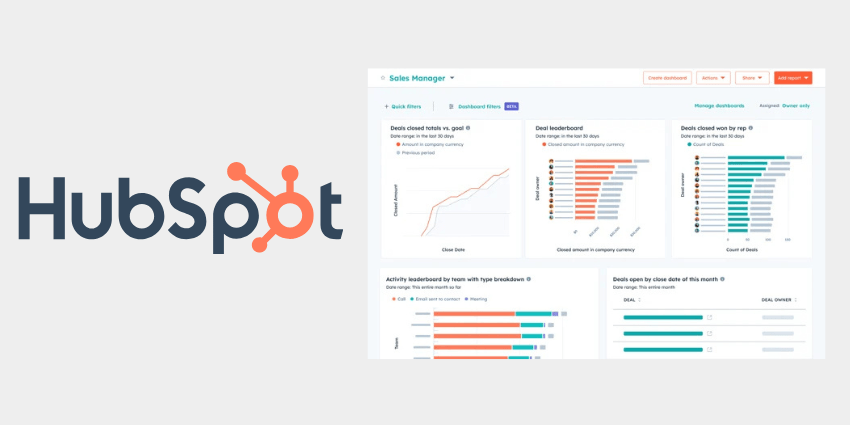
HubSpot started life as a software company delivering inbound marketing solutions. Now, it’s one of the biggest CRM platform providers in the world.
Competing with the likes of Salesforce and Microsoft, HubSpot offers a range of dedicated CRM "Hubs" for various customer-facing teams, including customer service, commerce, and - of course - sales.
The Sales Hub is HubSpot’s all-in-one solution for transforming sales processes, combining pipeline management software with conversational intelligence, task management apps, and much more.
Additionally, users can tap into the power of AI with embedded HubSpot Breeze AI.
That's the short story. Read on for the longer version, unpacking: what exactly does Salesforce Sales Hub have to offer? What are the core features and benefits, and how much does it cost?
HubSpot Sales Hub: The Key Features
Like all of HubSpot’s "Hubs", the Sales Hub is a constantly evolving ecosystem of tools.
In the last year, for instance, HubSpot has added preconfigured AI agents, via Breeze. That includes an agent that automatically sends proactive outreach to prospects.
Breeze also offers users an upgraded copilot and data intelligence tools.
Moreover, it's critical to note that all of HubSpot’s Hubs integrate seamlessly. That helps connect the CRM ecosystem, enabling improved data sharing and cross-application innovation.
Indeed, that's the first of the heavy-hitting features to look out for.
The Unified Smart CRM
All the Hubs centralize customer data within the HubSpot Smart CRM, providing sales teams with an up-to-date, unified view of each customer.
Users may also align data with other CRM systems (for instance, HubSpot integrates with Salesforce).
Streamlined Prospecting and Lead Management
Sales Hub aims to combine everything sales teams need to manage prospects and leads into one space.
Users can manage calls, emails, tasks, and LinkedIn connections, in a single dashboard.
Additionally, they can scan business cards, track when customers open leads, and organize leads into stages (such as new or qualified). Plus, there are tools for scheduling meetings with leads, too.
HubSpot even offers access to forecasting tools for sales teams and free scheduling software to help keep deals moving smoothly.
AI-Powered Assistance
HubSpot’s CRM solutions feature various embedded AI features, with more since the company introduced Breeze.
The Sales Hub offers AI tools for automatically generating emails specific to certain sales scenarios, like follow-ups and introductions. There are even Gmail and Outlook integrations, so users can compose messages with AI in their inbox.
Moreover, there are AI tools for validating leads, identifying the best times to call or contact leads, and determining which “decision-makers” salespeople should target.
Workflow Automation
There are a bunch of automation capabilities built into the HubSpot Sales Hub for things like following up with leads, scheduling emails, or creating reports.
Perhaps the most impactful automation tool is the sales automation "Sequences" solution. It allows users to create personalized sales cadences, with a series of calls, emails, and LinkedIn interactions scheduled over time.
The system can even trigger specific follow-up actions, like creating tasks for other team members or scheduling appointments.
Deal Management & Customizable Pipelines
The Deal Boards in HubSpot Sales Hub are a user-friendly option for deal management, with a drag-and-drop interface teams can use to monitor deals across stages.
Teams can customize pipelines by adjusting stages to align with their processes and even use AI to score the likelihood of a deal closing.
HubSpot’s AI assistant, Breeze Copilot, also assists reps by answering queries related to deals, contacts, and companies, drawing from CRM data to provide contextual insights.
AI-Assisted Sales Coaching & Analytics
For companies that need help reskilling their teams, Sales Hub has several handy features.