AI, you’ve probably heard of it, right? The generative variety, in particular, has been one of the biggest technological talking points of modern times.
While these illusive zeitgeist-avoiders do exist – ironically, as evidenced in a recent viral clip where Hollywood star Cillian Murphy enquired, with absolute sincerity, “What’s a meme?” – it would be almost impossible for anyone within the customer service and experience sector to be unaware of GenAI.
This is particularly true when it comes to the contact center. The phrase ‘game-changer’ is undoubtedly so overused that it flirts with becoming a platitude, but it does seem perfectly apt for describing generative AI’s impact on chatbots.
The revolutionary tech is transforming clunky, frustrating customer-scarer-offers into assistants capable of understanding complex queries and communicating in a more natural, conversational tone.
Whether it’s a techno dystopia like Bladerunner or an anti-industrialization classic novel by Thomas Hardy, technological advances have always been met with societal unease and the fear of robots replacing humans – and GenAI is no different.
While its naysayers fear that chatbot advancements will eventually make human agents obsolete, its champions argue that handling mundane, straightforward queries will reduce agents’ workloads and lead to a better overall employee experience.
Interestingly, despite much of the GenAI discourse revolving around contact centers, those at the actual coal face feel somewhat disconnected from many of these prophecies and announcements.
In an attempt to understand how AI advancements are impacting contact centers in real terms, Cirrus surveyed over 300 professionals for its latest report: AI in the Contact Centre: Exploring Leadership’s Perceptions of AI Suitability and Adoption.
The findings revealed the following five key trends away from the headlines and live from the contact center floor.
1. Contact Centers Show Cautious Optimism in Sentiment Analysis
Cautious optimism isn’t exactly a ringing endorsement, but it still highlights an acceptance of AI’s ability to accurately detect and identify emotional tone in customer interactions, and use that information to gain insights into their opinions about services, products, or brands.
In breaking down the figures, the survey revealed that 74 percent of respondents had slight to moderate confidence in sentiment analysis, with the highest levels of confidence being found in Inbound Customer Service, where 48 percent of respondents feel moderately to extremely confident in the technology’s potential.
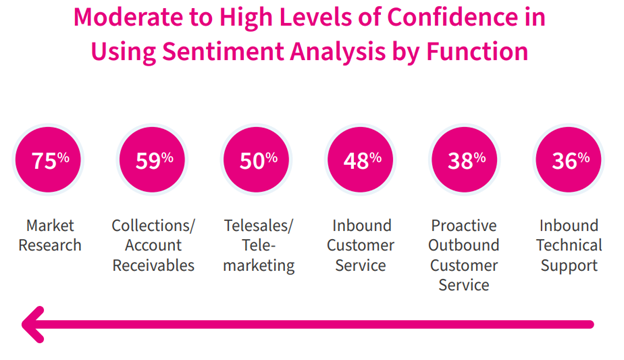
However, the caution seems well-placed, as in spite of the technology being well-received in some sectors, 13 percent of participants expressed no confidence, reflecting a noticeable degree of skepticism.
2. Conversational AI Apprehension Shows No Signs of Abiding
It isn’t just sentiment analysis that received a mixed reception from respondents; there was an air of apprehension throughout the report, particularly surrounding conversational AI.
Perhaps this is unsurprising, given GenAI is still in its infancy and many companies are experiencing teething problems – most notably DPD, who recently hit the news for all the wrong reasons when one of their chatbots was provoked into swearing and writing a disparaging poem about the company.
While this story was met with amusement, it does highlight the issues that accompany chatbot advancements and increased autonomy of thought, and the need for businesses to take AI guardrails seriously.