

The COVID pandemic, a tricky Winter period, and new economic challenges are contributing to rising customer vulnerability challenges.
Yet, spotting and supporting vulnerable customers is not easy. After all, there are many vulnerabilities for contact centres to consider.
The Current State of Customer Vulnerability
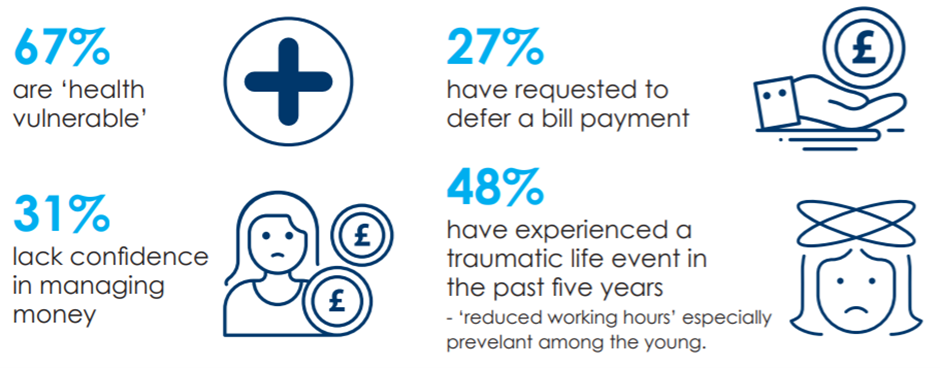
According to a 2021 CCMA report, two British adults out of three self-declare a vulnerability. Breaking this down, 49% of these adults declare that they are health-vulnerable – whether that is mental or physical.
Prominent examples include recurring vision problems, hearing issues, depression, fatigue, and difficulty understanding bills or letters.
Yet, there are other types of vulnerabilities. Consider financial vulnerability, which proves particularly troublesome given the current energy price crisis. Such susceptibility is higher with younger customers, according to the aforementioned report.
Interestingly, it highlights a significant difference in the response versus age demographic throughout. Self-declared vulnerabilities are much higher within the 18–34-year-old category than some of the older parts of the population.
Anxiety and confidence issues around financial transactions and handling money were prevalent, a vulnerability impacting 31% of this age group. While this is perhaps a poor indictment of the schooling system, it could influence the level of care companies deliver to younger customers.
David Noone, Innovation Evangelist at Odigo, believes that these statistics are critical considerations for companies that strive to be customer-centric. He says:
“A vulnerable customer plan is an extension of understanding customers, knowing the people that the business is engaging with. That comes down to accessing cross-departmental customer data that is typically kept in siloed systems and bringing it together to get a clear view of the customer”
Such an approach enables contact centre agents to think about the context of the customer. Instead of breaking people down into demographics to fit treatment strategies, think about the end person and their specific needs.
Identifying and Supporting Vulnerable Customers
According to the CCMA research, 69% of British consumers are willing to be included within a national register identifying vulnerable people. Such a database allows contact centres to route vulnerable customers to specialist agents for enhanced service experiences.
Training these “specialists” to handle contacts from all vulnerable customers is another critical consideration. Coaching models, such as CARE, play their part to help recognise the needs of vulnerable customers.
- Comprehend – Can the customer understand the information they are receiving?
- Assess - Do the customer’s questions and points make sense?
- Retain – Is the customer retaining the information or are you repeating yourself?
- Evaluate – Do the customer’s questions and points make sense?
Yet, companies that approach vulnerable customers most successfully often consider distinctive groups of vulnerabilities and coach agents accordingly.
Consider communication with a deaf customer as an example. Should the contact centre make their engagement chat dependent, and how could the contact centre shift the channel to best facilitate callers’ needs? An omnichannel solution is central to such a strategy, equipping agents with the right tools to switch channels and deal with vulnerable customers.
Another beneficial tool is speech analytics, which can pick out keywords to help identify vulnerable customers and pinpoint their specific susceptibility.