

“Quality assurance helps us ensure compliance.” Such is the view of many contact centre leaders. While this is true, it is only one benefit. Contact centres that champion QA can unlock several more golden customer, employee, and business benefits. Five excellent examples are:
- Motivating teams to improve performance and engaging agents with their work
- Changing agent behaviours to complement CX
- Pinpointing good performance for special recognition, alongside improvement opportunities
- Ensuring every agent, analyst, and leader understands what good service looks like
- Reporting quality as a mission-critical CX KPI
However, achieving these top-notch outcomes requires much more than a stale QA scorecard and spontaneous skills dips. Indeed, these practices are antiquated. Legend has it that cavemen established them while gathered around a campfire eating roast mammoth.
Okay, this is a slight exaggeration. However, in these times when many contact centres can do much more to elevate service through QA, thanks to incredible advancements in technology, some operations seem to have little desire to up their game. So, what is holding them back?
What Is Stifling Quality Assurance?
Firefighting is a constant reality for contact centre managers in recent times of upheaval, staffing shortages, and employee well-being troubles. As a result, the subject of rethinking QA has fallen down the pecking order of immediate priorities.
However, the ironic twist in the tale is that a more robust QA approach will help contact centres overcome these issues much more comprehensively than sticky-tape, short-term solutions.
Of course, an endless routine of firefighting is an easy trap to fall into. Still, with just a little breathing space, contact centres can achieve some unprecedented enhancements to service experiences.
Unfortunately, there is also an additional challenge of overcoming negative QA perceptions. As James Marscheider, CCO at EvaluAgent, says:
“There is a challenge around the reputation and validity of Quality Scores as they are a subjective measure of success which - as previous studies have suggested - are misaligned to the expectations of customers or don’t prioritise what is important correctly.”
Indeed, without validating the QA scorecard, it is tricky to understand whether good quality scores correlate with customer satisfaction and first contact resolution.
Fortunately, there are a whole host of simple solutions.
Changing Views of Quality Assurance
Regression analysis is the ultimate technique to validate a quality scorecard and showcase the value of QA. It simply involves looking for correlation between customer satisfaction and quality scores. In doing so, teams can connect the external view of performance with their internal outlook.
Over time, quality analysts will start to understand which agent behaviours drive customer satisfaction, adapting the QA framework to make sure they are listening for the right things.
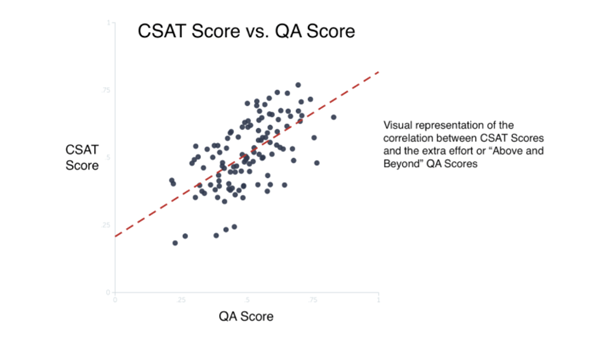
Naturally, elements of the scorecard will track critical business outcomes too. Nevertheless, correlation should exist, and by taking this approach, team leaders can ensure agent one-to-ones focus on both business expectations and customer feedback.
Also, enriching these one-to-ones with data from well-tested scorecards powers improved coaching, as analysts share advice that drives more positive customer conversations. As a result, agents alter their behaviours and enjoy an enhanced experience.
Such an approach will also bolster agent perspectives of QA over time. Building on this point, Marscheider highlights the value of a QA tool, stating: