

A net promoter score (NPS) predicts customer loyalty, gauging the willingness of customers to recommend the brand to a friend or family member.
The metric came to the fore after the release of a 2003 Harvard Business Review article by Fred Reichheld, a partner at Bain & Company. Its objective was to create a quick pulse check of consumer pleasure and loyalty.
Reichheld referred to NPS as “the one number you need to grow,” as it breaks down a customer base into three segments: promoters, detractors, and neutral/passives.
If a company has more promoters than detractors, it is likely to grow. Therefore, NPS is a leading indicator, not a lagging one, measuring future possibilities instead of past performance.
Measuring the Net Promoter Score
To calculate NPS, companies must ask customers: “On a scale of zero to ten, with zero being extremely unlikely and ten being extremely likely, how likely are you to recommend our business to a friend or colleague?”
Depending on the customer’s response, they filter into one of three groups. Those responding with a:
- 0 to 6 are detractors
- 7 or 8 are passives or neutral
- 9 or 10 are promoters.
Each of these three segments encapsulates a specific type of customer behavior:
- Promoters are enthusiastic about the company. Typically, they are repeat customers and zealous advocates who enthusiastically recommend the company to other prospective customers.
- Detractors are dissatisfied with their experience. They are unlikely to buy from the firm again and may spread unfavorable word of mouth that harms future business.
- Neutrals/Passives are somewhat happy but may easily switch to a competitor if given the chance. They are unlikely to spread poor word-of-mouth about the company but lack the passion to promote them.
Once these groups are in place, businesses may calculate NPS by using the following formula:
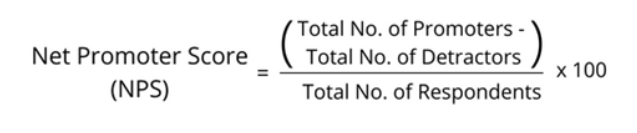
As an example of how this NPS formula works, consider a scenario where 1000 customers answer the NPS question as follows:
- 250 customers score between one and six
- 250 customers score a seven or eight
- 500 customers score a nine or ten
The final net promoter score is:
[(500 - 250) / 1000] x 100 = 25
The final NPS is an absolute numerical value, not a percentage. Also, an NPS is sometimes a negative when a business has more detractors than promoters.