
The travel industry was hit hard and fast by the Covid-19 pandemic. In those first few frantic months, travel bans were announced daily, and holidays cancelled en masse. At the same time, thousands of staff were being furloughed or let go, and many companies were operating remotely for the first time. All of this resulted in some pretty chaotic customer service, which saw trust in the sector plummet to record lows.
However, with restrictions now easing and life returning to normal, it seems the travel industry has an incredible opportunity at hand. As Jonathan Allan, Chief Marketing Officer at Puzzel, declares: “They can be the businesses that bring joy back to peoples’ lives.”
Indeed, a 2021 McKinsey & Company study found travelling is one of the top activities people want to get back to now the pandemic is petering out (beaten only by dining out). So if travel firms can act quickly, they can seize on this demand to rebuild customer relationships and restore trust in the sector.
What Steps are Travel Firms Taking to Win Back Trust?
Many travel companies are now proactively communicating with customers, accepting their customer service failures during the pandemic and promising to do better.
Here are two snippets of emails sent to British Airways (left) and Finnair (right) customers.
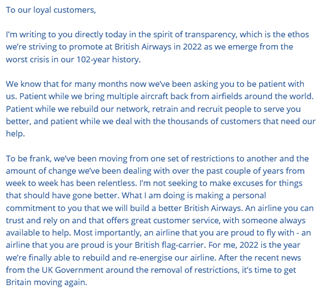

Specifically, British Airways notes that they will implement a new contact centre system and recruit more personnel to: “Ensure your calls are answered, social media messages are responded to and problems are solved in the moment, wherever possible.”
As such, it appears delivering true omnichannel service and improving response times is central to the industry’s strategy. But the execution isn’t quite there yet, as Allan states:
“I recently tried to contact a travel company, yet they refused to answer calls for amending bookings, didn’t offer chat, and insisted I email them. After taking seven days to respond, what I wanted was not available anymore. So, while this company is trying to digitise its service, in reality, it was less efficient, and my feelings towards that brand have certainly shifted.”
What this story underlines is a lack of understanding around customer needs. CX is not just about implementing the latest innovations. Instead, it is about designing customer journeys that best fit the task, offering a blend of digital, self-service, and human support.
Of course, that is much easier said than done, yet an excellent chance emerges for brands that get this right. For example, if British Airways makes good on the CX promises set out in its letter, it could be a huge differentiator from its budget competitors.
What More Can Travel Firms Do to Win Back Trust?
Alongside optimising their digital proposition and bolstering recruitment, travel companies can also win back trust by:
Subverting the Primary Focus of Leaders
Too often, the c-suite sets cost-related metrics as primary measures to assess the performance of customer service leaders. However, this strategy encourages department heads to consider the customer in the sense of “how can I serve you for less.” Such an approach is not conducive to achieving the ideal customer outcomes.
Consequently, many contact centres implement automation solutions that divert customers away from human support rather than automation that primarily aims to improve the customer experience and utilise agent know-how and empathy at the right moments.
The solution requires a change in c-suite thinking. A 2021 Harvard Business Review article highlights this as a necessity, arguing that digital and tech-savviness needs to reach the top tier of businesses.
As the article states: “Financial literacy is a baseline qualification for any top executive; we need to think about technological and digital literacy in the same way... These capabilities that used to be nice-to-haves are now must-haves: Companies can’t afford to have an executive who might confuse discussions about the cloud with small talk about the weather.”