

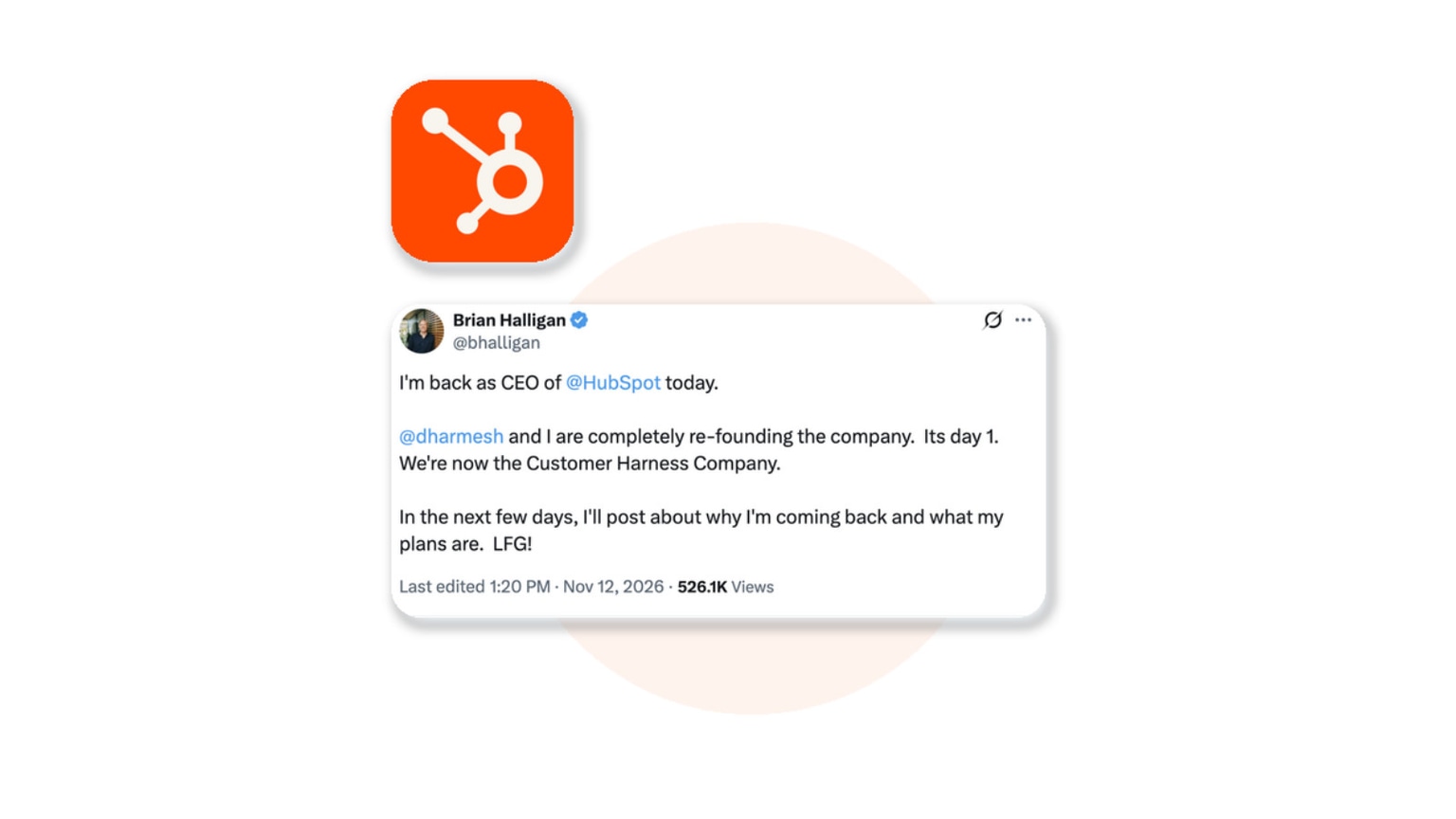
HubSpot has handed the company back to its co-founder.
Brian Halligan returned as chief executive on November 12, the same day Yamini Rangan stepped down as CEO and left the board. Rangan will stay through December 1 to help with the transition. Halligan co-founded the company in 2005 with chief technology officer Dharmesh Shah and ran it for 16 years.
On X, he wrote that he and Shah are "completely re-founding the company." It is "day 1," he said, and HubSpot is now "the Customer Harness Company." In the announcement:
"Chapter three is building the customer relationship harness that will enable millions to grow better. This is a refounding, and I can't wait to start!"
Brian Halligan, HubSpot announcement, November 12, 2026
That is a large claim for a company with more than 311,000 customers. The question is why the board moved now, and what it means if you already run customer work on HubSpot.
What Officially Changed
The board appointed Halligan president and CEO on November 12. The Form 8-K describes Rangan's departure as a termination by the company without cause. She will receive $1,336,712.33 over 12 months, plus health coverage and accelerated equity vesting. Halligan's new pay has not been finalized.
CFO Kate Bueker will retire on February 11, 2027, in a move HubSpot called long planned. Karen Burgess, CFO of Adobe's Creativity & Productivity unit, joins November 30 as executive vice president of finance and becomes CFO on February 11, 2027.
HubSpot reaffirmed its November 4 guidance: fourth-quarter revenue of $945 million to $947 million, up 12 percent, and full-year revenue of $3.685 billion to $3.687 billion.
Shah said on X that Duncan Lennox is now president of product, and that HubSpot will create "the world's first Customer Relationship Harness" and accelerate "Headless HubSpot."
The Record, and the Pressure
This is not a company that stopped growing. Under Rangan, CEO since September 2021, HubSpot says customers went from 135,000 to more than 311,000, and revenue from $1.3 billion in 2021 to an expected $3.7 billion in 2026. Third-quarter revenue was $947.6 million, up 17 percent, with 311,704 customers.
The market was not buying the next chapter. Quartz said the stock was down 50 percent this year through Wednesday. The Boston Globe reported shares rose 6 percent Thursday to almost $216, after a peak above $800 early in 2025.
On November 4, the 12 percent fourth-quarter outlook landed below expectations, after a third-quarter beat. Five weeks earlier, HubSpot cut about 660 jobs, roughly 7 percent of its workforce, and began organizing product teams around customer outcomes instead of Hubs. Rangan said the company was shifting from "building software that helps customers grow to delivering outcomes for them with AI," and that the cuts were "not driven by AI-related efficiencies."