

As someone who's spoken with countless CX leaders over the years, I keep hearing the same frustration: "Our AI was supposed to make things better, but customers are more annoyed than ever." If you're nodding along, you're not alone in wrestling with what the industry has come to call the "generic automation" problem.
Generic automation—those rigid, scripted chatbots and voice systems that follow predetermined paths regardless of customer context—has become the bane of modern customer experience. These systems force customers into narrow interaction channels, fail to understand nuance or emotion, and often escalate simple issues into complex problems. The result? Longer resolution times, frustrated customers, and CX teams spending more time fixing automated mistakes than they did handling the original inquiries.
The Hidden Costs of One-Size-Fits-All AI
The challenges run deeper than customer satisfaction scores. Generic automation creates operational inefficiencies that ripple throughout organizations. When AI systems can't adapt to different customer types, product lines, or business contexts, they require extensive manual overrides and constant human intervention. CX teams find themselves managing technology instead of focusing on strategy and relationship building.
Moreover, these systems often operate in silos. A customer might receive one type of automated response through the contact center, a completely different experience via the company website, and yet another through sales channels. This fragmented approach undermines the cohesive experience that modern customers expect across all touchpoints.
Enter GRAIA: A Different Approach to AI-Driven CX
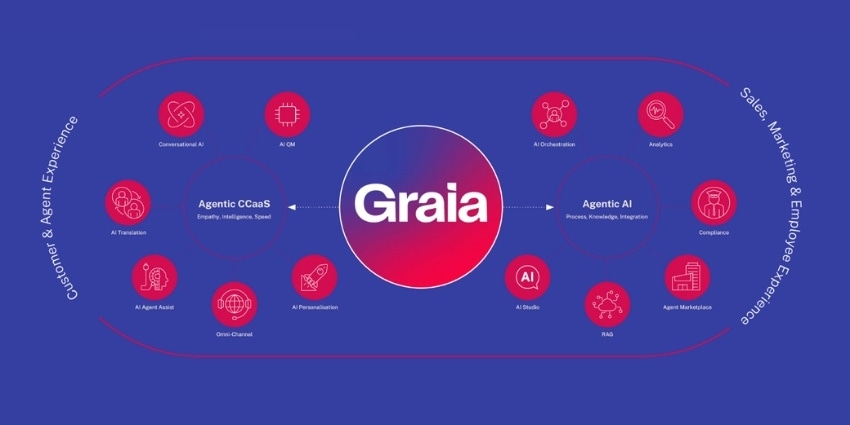
Three technology companies—Bulb Technologies, Geomant, and Buzzeasy—believe they've found a solution to this widespread challenge. Operating under the BOSQAR INVEST umbrella, they've launched GRAIA, an Agentic Contact Center as a Service (CCaaS) platform designed to address the limitations of generic automation.
Unlike traditional AI systems that follow predetermined scripts, GRAIA's approach centers on Agentic AI—intelligent agents that can learn, adapt, and evolve based on individual customer interactions. The platform claims to deploy these agents across sales, service, and operational touchpoints, creating a more unified customer experience.
"We aren't just joining the AI category, we are redefining it,"
said Marko Martinovic, CEO of the GRAIA initiative. "GRAIA is not another AI product, it is a reinvention of how customer experiences are delivered. We are moving beyond simple automation."
What Sets This Platform Apart
GRAIA's key differentiator lies in its proprietary intellectual property. Rather than licensing third-party AI components, the platform uses technology developed in-house across the three founding companies. This approach gives GRAIA control over customization and adaptation—two areas where generic automation typically falls short.