In May 2018, new data protection laws will come into force across Europe. This blog looks specifically at how this new legislation will affect you, if you record your telephone calls.
The EU- wide General Data Protection Regulations (GDPR) will come into force in May 2018, replacing all national data protection laws in the member states. This will affect any business or entity who holds or processes the personal data of EU citizens.
As the Brexit process will not have been completed by this date and for UK businesses to continue to conduct business with Europe, it would be good practice to ensure that your processes and procedures comply with this new legislation.
The purpose of these changes is to ensure that organisations collect, record and use personal data in a compliant and diligent way that protects the rights of individuals, as they conduct their business operations.
What Changes will occur under the GDPR?
The main principles behind the GDPR are similar to those already in place within UK legislation, for instance, the expectation to protect privacy, notification and consent and the requirements to adequately protect stored data from misuse, however the main difference with the GDPR will be that it gives individuals, or data subjects, increased ownership and control over their personal data assets and to encounter a more simplified level of accessibility for the acquisition, use and storage of their personal data.
- All data formats will be regulated by the GDPR - audio, video, photographs, IP addresses, device IDs and cookies, are all covered by the regulation
- From a Business or Entity’s perspective, there will now be a requirement to appoint a Data Protection Officer (DPO)*
- There will be a need to conduct routine Privacy Impact Assessments (PIAs) to regularly monitor exposure to risk **
- Privacy must be built-in to data processing and handling procedures.
- There will now be the need to provide increased transparency through the mandatory reporting of security and confidentiality breaches to regulators and those affected within specified timeframes
- The GDPR gives regulators the right to impose substantial fines for non-compliance – up to 4% of global turnover
Key Points to consider
There are now enhanced rights for individuals:
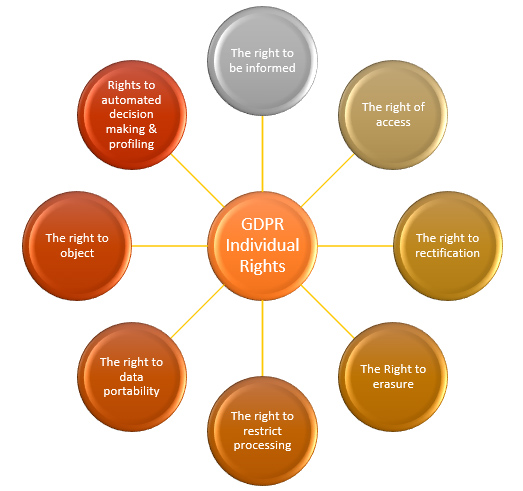
GDPR - an individual's rights
- The right to be informed – the right to provide fair processing information, focusing on the need for transparency over how you use personal data
- The right of access – the right to obtain confirmation that their data is processed, access to their personal data and other supplementary information
- The right to rectification – the right to have personal data rectified if it is inaccurate or incomplete
- The right to erasure – the right to have personal data erased and to prevent processing in specific circumstances
- The right to restrict processing – the right to suppress processing of personal data
- The right to data portability – the right to obtain and reuse their personal data for their own purposes across different services
- The right to object – the right to object to processing based on legitimate interests or the performance of a task in the public interest/exercise of official authority, direct marketing, and processing for purposes of scientific/historical research and statistics
- Rights in relation to automated decision making and profiling – safeguards individuals against the risk that a potentially damaging decision is taken without human intervention
There is now an increased importance in obtaining consent to hold and process data and this consent may be withdrawn by the data subject at any time. There will also be a “Principle of Accountability” that will place the onus on the Business or Entity to demonstrate compliance formally, which will force data protection elements to be more process driven and strategically applied throughout all aspects of the Organisation, in the form of policies and procedures.
Businesses wishing to record data, including telephone calls, will be required to actively justify legality, by demonstrating the purpose fulfils any of six conditions:
- The people involved in the call have given consent to be recorded
- Recording a call is necessary for the fulfilment of a contract
- Recording is necessary for fulfilling a legal requirement
- The call recording is necessary to protect the interests of one or more participants
- The call recording is in the public interest or necessary for the exercise of official authority
- Recording is in the legitimate interests of the entity or Business, unless those interests are overridden by the interests of the participant in the call
Some of these conditions will apply specifically to certain uses of call recording solutions in certain sectors, which could dovetail within their own specific compliance related and legislative requirements and industries.
- Numbers 3, 4 and 5 would be relevant for the majority of organisations and entities, including FCA regulated entities, Police investigations, Fire, Police and Emergency Services and Security Sectors
- Number 2 may be relevant for outsourced Contact Centres and Customer Service Centres
- For organisations that utilise call recording for quality and best practice purposes, No. 1 and No. 6 are relevant
The Legitimate interests of a Business to evaluate customer service levels are not likely to outweigh the interests of personal privacy under the new regulations, so realistically that only leaves gaining consent.
Under GDPR, assumed consent will not be satisfactory, explicit consent to record calls will be required.
Another point to consider is that if your organisation universally records all calls and employees are authorised to use the telephone for personal use, any private calls on these lines is in breach of DPA rules and will also breach the GDPR, so ensure that a non-recorded line is available, or ensure that all private calls are made on their own Mobile phones.
Accountability Principle of GDPR
The new accountability principle stipulates that a Business or Entity has a responsibility to demonstrate that they comply with the principle by: