

CRM platforms are swallowing up the customer service stack.
Now, they include more customer engagement channels, automate more service workflows, and leverage more advanced AI.
Such AI includes conversational intelligence tools, filling up the platform with new insights – including customer sentiment, intent, and even automated call notes.
All these trends – and several others - have gained traction since Gartner’s previous Magic Quadrant for CRM Customer Engagement Center, published in 2021.
Yet, despite all this disruption, the same CRM providers crop up in the analyst’s latest market evaluation, which pinpoints four leaders.
→ THE 2024 Edition: Check out CX Today’s coverage of the latest Magic Quadrant for CRM Customer Engagement Center.
The Definition of CRM Customer Engagement Center
According to Gartner, a CRM customer engagement center is a “cohesive” software suite that revolves around case management.
Indeed, the suite orchestrates, data, systems, workflows, and various other resources to support businesses in delivering their desired service experience across cases.
That service experience enriches customer engagements via personalization, knowledge management, and – oftentimes – self-service capabilities.
Yet, there are many more features within a CRM Customer Engagement Center, as evident in Gartner’s list of functional requirements and design considerations:
- Scalable cloud-based systems
- Digital engagement channels
- Unification of digital and voice touchpoints
- Use of contextual knowledge management
- Automation of engagements
- Proactive messaging to customers
- Workforce engagement management (WEM) components
- An ecosystem for functional enrichment
- Low-code development
Yet, other features extend the core CRM Customer Engagement Center offering. These include VoC tools, IoT and RPA connections, and customer success functionality – amongst several others.
Each highlights how the CRM is now much more than a system of record for customer conversations and how much Gartner had to consider in its market investigation.
Nevertheless, the analyst managed to stay on top of all this, splitting 12 prominent providers into four groups: Leaders, Challengers, Visionaries, and Niche Players.
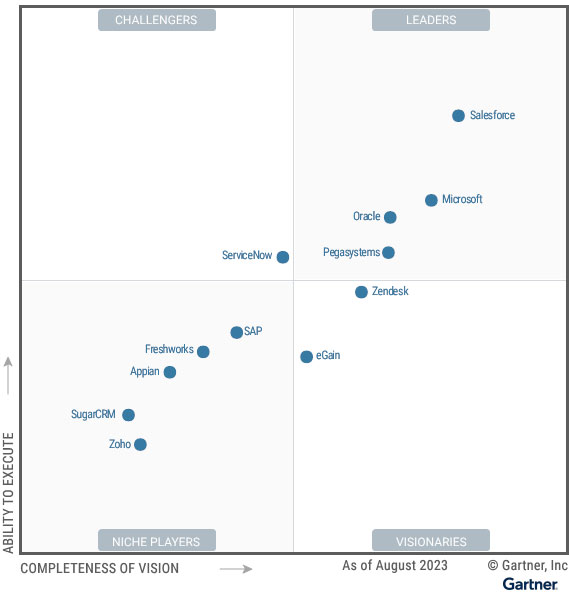
Gartner Magic Quadrant Leaders
Leaders in the Gartner Magic Quadrant help to define the market’s direction through products, services, and customer experience. They also offer a comprehensive platform that flexes to meet requirements across geographies and sectors. Finally, they pair their solution and innovation leadership with a clear vision of capitalizing on emerging technologies. This year’s leaders are:
- Salesforce
- Microsoft
- Oracle
- Pegasystems
Salesforce
Gartner commends Salesforce Service Cloud for its “overall viability and innovation”, which appeals to diverse sectors and market segments. In doing so, the analyst notes that the CRM is now Salesforce’s largest revenue-generating product – providing a sense of the solution’s long-term viability. Moreover, Gartner praises the vendor’s product strategy, which utilizes customer feedback to closely consider how organizations can more easily understand and leverage new features.
Microsoft
Microsoft is innovating at a rate of knots, rapidly releasing new agent productivity, collaboration, and GenAI features across the platform. The vendor has also substantially enhanced the messaging and voice services within Microsoft Dynamics 365 Customer Service. Gartner notes this fast innovation as a significant strength, alongside Microsoft’s mounting market presence and expanding platform. The addition of Nuance, the conversational AI and healthcare tech provider, exemplifies the latter.
Oracle
A core strength of Oracle’s Fusion Service offering is its unified agent workspace. Gartner recognizes this, lauding the streamlined agent UI, its activity stream panels, and other nifty features. “Smart text hashtags” – which help to automate customer responses via knowledge from a prewritten library - is an excellent example. In addition, the analyst notes Oracle’s collaboration capabilities and unified enterprise platform – which includes ERP, SCM, and HCM solutions - as prominent plus points.
Pegasystems
Pega Customer Service has an automation core, which enables AI-powered decisioning, automatic cross-workflow referencing, and AI-driven end-to-end customer service workflows. As such, it’s no surprise that Garter highlights Pegasystems’ process automation and augmentation as a critical strength, alongside its extensive integration ecosystem and engagement channels. The latter includes “long-running” asynchronous messaging, digital- and dialed-voice, and third-party messaging apps.
Gartner Magic Quadrant Challengers
Challengers in the Gartner Magic Quadrant enjoy a significant market presence, benefiting from specific sector expertise and robust, expanding relationships with the wider install base. In forging these relationships, these vendors understand their client’s evolving needs, yet may not be best-positioned to make the most of broader, emerging market trends. This year’s sole challenger is: