Embedded revenue intelligence, collaboration solutions, and – of course – AI agents are just some of the trends sweeping the sales space.
As these trends explode, pinpointing technology providers that will lead sales and the broader CX function into the future is a crucial mission that many enterprises are embarking on.
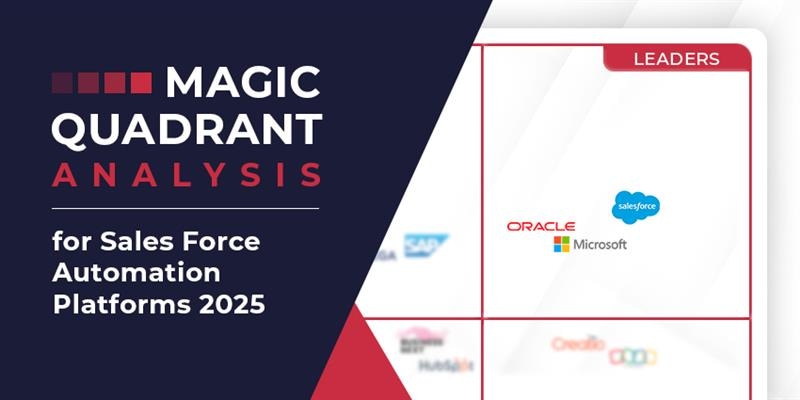
Analyst tools like the Gartner Magic Quadrant for Sales Force Automation Platforms aim to serve these enterprises, and the 2025 edition spotlighted three market Leaders.
As in 2024, the Leaders are: Salesforce, Microsoft, and Oracle.
Interestingly, the entire matrix looks similar to the previous year’s version, as the CRM space takes a collective breath and waits for the transformative impact of agentic AI.
That said, there is one mover this year, with SugarCRM falling from the Challenger group into the Niche Player quadrant.
Also, there’s one new entrant: Monday.com, which enters in the bottom-left square. Meanwhile, Freshworks has dropped from that square and off the matrix altogether.
ServiceNow is the most noticeable continued absentee, with its Sales and Order Management solution surprisingly missing the cut.
The Definition of a Sales Force Automation (SFA) Platform
A Sales Force Automation (SFA) platform typically sits within a CRM system that centralizes a sales team’s data - alongside data from other customer-facing functions - into a customer profile.
The SFA then takes that data and adds adjacent tooling to assist sales reps and automate several of their tasks.
As the years have rolled by, SFA solutions have swelled with new features. Yet, the fundamentals remain the same, with capabilities covering account, activity, contact, forecast, opportunity, and pipeline management.
Beyond that, there are tools for analytics, proposals and quotes, partner relationship management, and more that Gartner considers "mandatory" in its report.
Others becoming more common include: revenue intelligence and enablement solutions, digital sales rooms, and configure, price, quote (CPQ) applications.
After going through these capabilities and the many others, Gartner grouped 13 of the most prominent SFA providers into four camps: Leaders, Challengers, Visionaries, and Niche Players. Here’s how they performed.
Gartner Magic Quadrant Leaders
Leaders in the Magic Quadrant demonstrate a compelling vision for the SFA category’s future, a complete product, an above-average customer experience, and strong earnings. This year’s market Leaders are:
- Salesforce
- Microsoft
- Oracle
Salesforce
Salesforce Sales Cloud continues to lead the SFA space. Why? Per Gartner, its "strategic focus on agentic AI" is now a chief reason, with Agentforce for Sales now available to its SFA install base.
Notably, that includes a personalized Sales Coach that supports reps in advancing deals "effectively".
Yet, Gartner also cites Sales Cloud’s "robust customization and extensibility" as another core strength, alongside its "enhanced account and contact research" features.
Since Gartner conducted its research, Salesforce has made two big moves to bolster its SFA: embedding Slack channels and acquiring Bluebirds.
The former helps Salesforce step towards a more collaborative CRM ecosystem, while the latter empowers Salesforce with an AI agent that automates prospecting.
Microsoft
Microsoft Dynamics 365 Sales benefits significantly from its broad ecosystem, converging CRM solutions with ERP and broader enterprise technologies.
Yet, the Microsoft Teams chat panel now available within the SFA caught the eye of Gartner’s team, enabling employees across the enterprise to collaborate on customer cases.
The platform also benefits from integrated Microsoft Power BI technology, enabling deeper conversational intelligence capabilities than most competitive offerings.
Gartner picked up on this and noted the native Copilot as another strength, which allows users to build customized workflow automations, dashboards, and views.
However, it didn’t spotlight the AI agents Microsoft has added to the platform, which can perform tasks like customer outreach, surfacing at-risk deals, and more.
Oracle
Oracle may not market its SFA platform with the gusto of Salesforce or Microsoft, yet its offering has many advantages, especially for those already partnering with Big Red on ERP.
Gartner picks up on its "account and contact management capabilities", with unique tools for maintaining and enriching sales data.
The analyst also heaps praise on its "visualization and analytics" and "mobile" features, with the latter especially well-suited to sales teams that are constantly on the move.
The CX Awards 2025 judges recognized some of these features when giving Oracle the nod for "Best CRM Solution."
Additionally, they underscored how the tech giant is integrating AI into Oracle Sales and its other Fusion apps to deliver added value without raising costs. Instead, it just comes part and parcel.
Gartner Magic Quadrant Challengers
Challengers in the Magic Quadrant are typically larger than Niche Players, matching an impressive new flow of business with an excellent understanding of the current market. Yet, their longer-term vision may not resonate with top sales execs and IT leaders, with the latter coming increasingly to the fore in CX buying decisions. This year’s Challengers are:
- SAP
- Pegasystems
SAP
Like Oracle (and Zoho), SAP can enable advanced sales automations and data workflows by pulling CRM and ERP systems onto the same platform.
Surprisingly, Gartner doesn’t highlight this as a strength. However, it does commend SAP for establishing a workspace for admins to collaborate on cases, KPIs, and more.
Moreover, the analyst lauds SAP’s "guided selling" tools and "composable and microservice architecture". That composability is key, as when sales teams add niche tools to SAP Sales Cloud, businesses can establish a common data foundation.
As AI agents come into the fray, that data foundation may prove invaluable.
Nevertheless, SAP misses out on the Leader quadrant, with SAP citing its "reliance on add-ons and integrations" to deliver an enterprise-grade SFA platform.
Pegasystems
Pegasystems has long envisioned the “autonomous enterprise”, operating at the intersection of CRM, workflow automation, and low-code technologies.
As such, it appears well-positioned for the AI agent era, showing impressive thought-leadership when announcing an industry-first agent orchestrator in February 2024.
Gartner does not highlight this in its report. However, it does applaud Pega for its "opportunity-guided selling" and "partner relationship management" features.