Many believe that the companies that best understand their customers and act on that knowledge will win in the digital-first world.
Uninhibited by this belief, hyper-personalization has become much more than a buzz term for digital CX and marketing leaders – it is a critical differentiator.
Yet, there are many ways to personalize customer journeys, such as custom pricing, dynamic recommendations, prepopulating forms, and much more. Personalization engines help to bring many of these use cases to life.
Consequently, personalization engines have many facets. To come to terms with these, here is a closer look at how Gartner defines such solutions.
The Definition of Personalization Engines
According to Gartner, personalization engines allow CX teams to "identify, set up, conduct and measure" the ideal experiences for individual customers.
Such experiences hinge on customer intent, their journey context, and the information a company has stored about them.
Combining these nuggets of knowledge, companies can tailor content, offers, and interactions across many channels to optimize CX.
To facilitate such strategic individualization, Gartner notes each of the following as core capabilities of a personalization engine:
- Behavior tracking, data collection, and ingestion
- Interaction triggers based on a customer’s actions, context, and data
- Flexible user segmentation
- Numerous testing features
- Predictive analytics capabilities
- Personalization performance reporting
While these are the core capabilities, there are further differentiative features of personalization engines that come to light in the assessments of the 13 prominent providers below.
These assessments include some of the strengths and cautions of each vendor, as noted by Gartner, with the analyst separating them into four categories: Leaders, Challengers, Visionaries, and Niche Players.
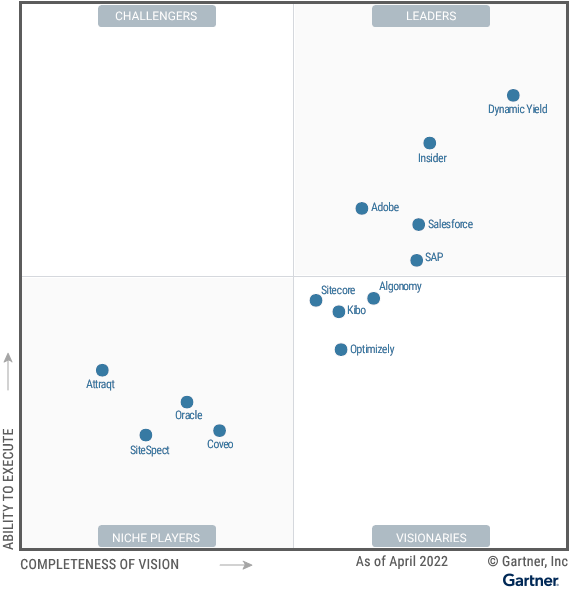
The 2022 Personalization Engine Magic Quadrant Leaders
Showcasing a clear-cut understanding of how to maximize the solution’s value and a commitment to driving customer outcomes, leaders in the magic quadrant couple a track record of delivering value with an innovative vision for the future. In addition, these vendors offer features that require little technical expertise, lowering the workload of IT teams. This year’s leaders are:
- Dynamic Yield
- Insider
- Salesforce
- Adobe
- SAP
Dynamic Yield
Dynamic Yield receives acclaim from Garter for its platform vision, innovation, and stand-alone email personalization. Yet, the analyst seemed particularly taken aback by AdaptML, its deep learning capability, which bolsters the vendor’s predictive analytics capacity. Not only does this enhance testing for personalization initiatives, but also automation, segmentation, and recommendations.
Insider
Insider offers a high-templated approach to personalization, aiming to simplify the deployment of personalization initiatives. Gartner lauds the diversity and configurability of these, while also pinpointing its broad set of reporting capabilities as another critical strength. All this, alongside comprehensive support services, helps Insider secure its place as a market leader.
Salesforce
Salesforce draws from its extensive portfolio to capture real-time customer data and supplement customer profiles. These capabilities supercharge many personalization uses cases, alongside cross-platform decisioning. However, Gartner identifies three further strengths as key differentiators: its robust bandit testing, B2B personalization support, and entry-level offering.
Adobe
Adobe, also a leader in digital experience platforms, powers many of its personalization used cases with its highly-regarded customer data platform. The compatibility of this solution with the Adobe Target personalization tool receives praise from Gartner, enabling sophisticated use cases and analytics. The analyst also highlights targeting and testing as additional strengths of the vendor.
SAP
Many companies worry that personalization sometimes crosses the "creepy line". SAP offers a differentiated approach to data privacy and deprecation that is central to its personalization approach. While the report does not delve much further, Gartner commends this approach while also lauding the "top-down triggering templates" and reporting features of SAP Emarsys.
The 2022 Personalization Engine Magic Quadrant Challengers
Likely to succeed in the personalization space, challengers in the magic quadrant demonstrate an ability to drive value through specific use cases. Unfortunately, the depth of these use cases lags behind industry leaders, while coordination between products in their portfolios is often lacking. Alternatively, they may trail in innovation, global presence, and sales. This year’s challengers are:
- There are no challengers in this year’s magic quadrant.
The 2022 Personalization Engine Magic Quadrant Visionaries
Putting forward a robust vision for the future of personalization, visionaries in the magic quadrant are thought leaders that offer depth within their solution suites. However, Gartner cautions that they sometimes have "gaps relating to broader functionality requirements" or frictions in client experiences, which cause them to fall behind industry leaders. This year’s visionaries are: