
Creating contextually relevant journeys is a critical consideration for modern marketing teams.
Unified customer profiles – topped up with predictive insights – are the cornerstone of such relevant customer journeys.
Indeed, they enable personalized engagements more likely to drive sales, retention, and several other business outcomes.
Multichannel Marketing Hubs help businesses to build these profiles and make more tactical customer engagements possible.
However, some do a better job than others to meet various business requirements.
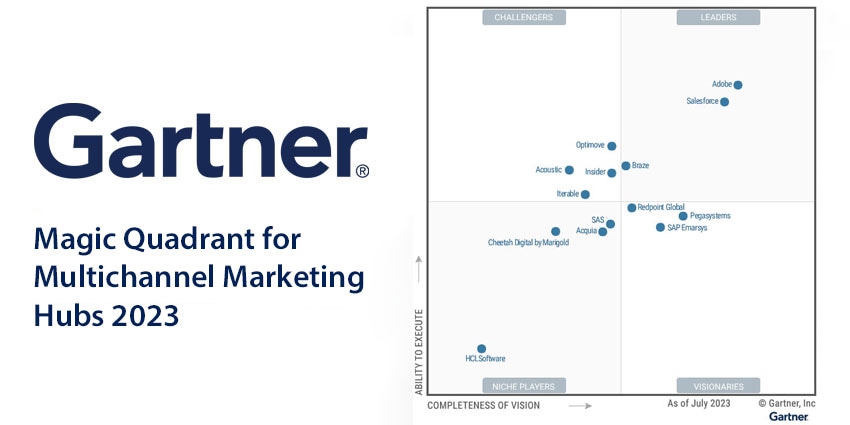
To help businesses see through the mist, Gartner has evaluated the offerings of 14 prominent providers, uncovering three market leaders.
The Definition of Multichannel Marketing Hubs
A multichannel marketing hub is a solution that allows businesses to compose multichannel communications to various customer segments.
Those may include special offers and discounts. As such, the solution will often integrate with sales tools to execute the strategy.
Yet, that is only one such feature. Others include: customer profile management, campaign wizards, and workflow creation tools.
Then, there are channel-specific capabilities like direct mail, video, and even IoT-fueled innovations that leverage smart connected devices.
Add to that native personalization, content management, and advanced analytics tools, and many advanced capabilities are now becoming the norm across the market.
Yet, some go further than others – as Gartner acknowledges by evaluating all these features, splitting 14 Multichannel Marketing Hub vendors into four quadrants: Leaders, Challengers, Visionaries, and Niche Players. Here’s how they performed.

Gartner Magic Quadrant Leaders
Leaders in this Gartner Magic Quadrant offer a robust set of capabilities across four use cases: campaign creation, orchestration, execution, and measurement. With this, they have established a significant market presence alongside a track record for successful worldwide implementations. Finally, they demonstrate a clear and long-term vision for growing further. This year’s leaders are:
- Adobe
- Salesforce
- Braze
Adobe
The Adobe Experience Platform is a quickly evolving product, with foundation versions of many of its solutions – i.e., its journey optimizer, journey optimizer, and data platforms – alongside fully-fledged alternatives. As such, it's easy to leverage the modern platform and scale up. Gartner notes this as a significant strength, alongside its first-party profile hub and healthcare support. In this vertical, Adobe even offers a Healthcare Shield solution for specialized data governance.
Salesforce
Salesforce does an excellent job of centralizing data across its clouds, which helps to fill up Marketing Cloud with more first-party data. That helps to further personalization efforts, orchestrate experiences, and analytics. Gartner recognizes this as a core strength, alongside the vendor's partnerships and expansions. Finally, the analyst lauds Salesforce's GenAI reach and use cases for marketers – including the capability to auto-generate campaigns to review, edit, and send.
Braze
Braze is one of the fastest growing providers in the multichannel marketing hub market – as per Gartner - managing to appeal to "organizations of all sizes". Alongside this, the analyst praises Braze's messaging innovation and modern platform architecture. That architecture services both traditional campaigns and orchestrated journeys. Meanwhile, the report notes users don't require a customer data platform (CDP) to fully benefit from the solution. Although, it does integrate with several.